


The European Commission has begun canvassing the region’s semiconductor industry for its views on China’s expanded production of older-generation computer chips, two sources familiar with the matter said.
The commission, the EU executive, has sought feedback ahead of two voluntary surveys for the chip industry and major chip-using industrial firms that are due in September.
It is unclear what action would result from the study but tensions between Brussels and Beijing are already rising as the EU seeks to protect its industries from Chinese competition.
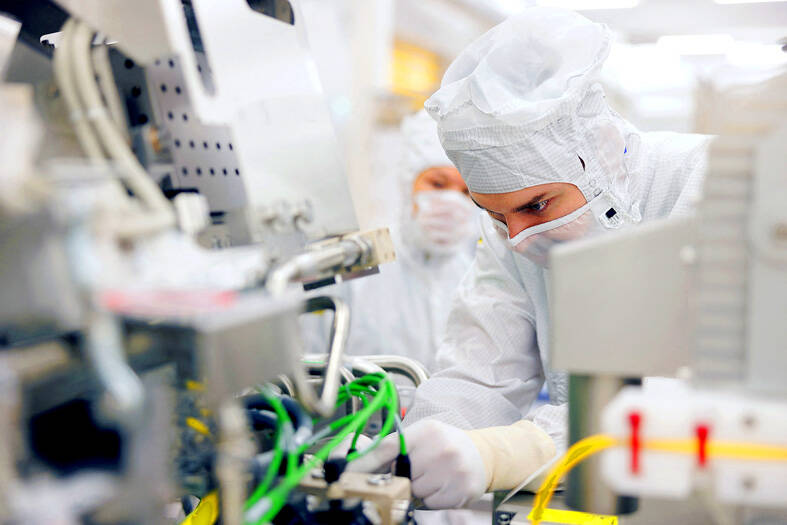
Photo: Reuters
The commission yesterday began imposing provisional tariffs of up to 37.6 percent on Chinese electric vehicles.
Trade analysts say the tariffs could be just the start of a toughened EU stance toward Beijing.
Chinese industry is investing heavily in expanding production of older chips, known as legacy chips, with help from state subsidies. That is in part because US-led restrictions limit its access to buying or making more advanced computer chips.
In the short run, China’s investment would lessen its dependence on foreign chips, but Western governments are worried about the long-term implications, including potential oversupply of the chips needed for countless appliances and cars.
The commission’s antitrust chief Margrethe Vestager in April indicated that the executive might investigate legacy chips after a meeting in Belgium with US officials, including US Secretary of Commerce Gina Raimundo.
Also in April, the commission released a 712-page report on the many layers of support it said the Chinese government provides to domestic firms.
The report included research into a wider range of industries including semiconductors, telecom equipment and renewable energy. Trade analysts interpreted it as a signal Brussels would be prepared to open more cases.
The new chip-focused surveys are a fact-finding mission, broader in scope than a security-focused survey sent by the US Department of Commerce to US firms, said the two sources who declined to be identified due to the sensitivity of the matter.
The commission has sought feedback on draft questions including where industrial firms source their chips. It is seeking information on chip firms’ products and pricing, as well as their estimates of the same information from their competitors, including their Chinese competitors.
For equipment suppliers such as Europe’s biggest tech firm, ASML Holding NV, China’s expansion of legacy chip production is an important source of revenue that mitigates US-led export restrictions on more advanced technology.
For chipmakers such as Infineon Technologies AG of Germany, STMicroelectronics NV of France and NXP of the Netherlands, the picture is mixed: All are important makers of chips for cars and for electrical infrastructure. They face increasing Chinese competition, but also do business in China.
Europe’s industrial, aerospace, automotive, health-tech and energy firms might be reluctant to disclose their use of Chinese legacy chips. They might also be uncertain where the chipsets they use are made, given the cross-border, multi-step nature of chipmaking and packaging.
German vehicle manufacturers are opposed to tariffs on Chinese electric vehicles, given their significant sales in China.
They have sought to diversify their chip suppliers to include production inside and outside China and Taiwan after costly shortages during the COVID-19 pandemic.


Taiwan’s foreign exchange reserves fell below the US$600 billion mark at the end of last month, with the central bank reporting a total of US$596.89 billion — a decline of US$8.6 billion from February — ending a three-month streak of increases. The central bank attributed the drop to a combination of factors such as outflows by foreign institutional investors, currency fluctuations and its own market interventions. “The large-scale outflows disrupted the balance of supply and demand in the foreign exchange market, prompting the central bank to intervene repeatedly by selling US dollars to stabilize the local currency,” Department of Foreign

Intel Corp is joining Elon Musk’s long-shot effort to develop semiconductors for Tesla Inc, Space Exploration Technologies Corp and xAI, marking a surprising twist in the chipmaker’s comeback bid. Intel would help the Terafab project “refactor” the technology in a chip factory, the company said on Tuesday in a post on X, Musk’s social media platform. That is a stage in the development process that typically helps make chips more powerful or reliable. The chipmaker’s shares jumped 4.2 percent to US$52.91 in New York trading on Tuesday. The Terafab project is a grand plan by Musk to eventually manufacture his own chips for
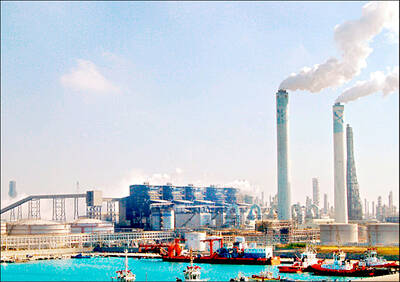
Taiwan Power Co (Taipower, 台電) yesterday said it plans to resume operations at two coal-fired power generators for three months to boost security of electricity supply as liquefied natural gas (LNG) supply risks are running high due to the Middle East conflict. The two coal-fired power generators are at Mailiao Power Plant in Yunlin County’s Mailiao Township (麥寮). The plant, operated by Formosa Plastics Group (台塑集團), supplied electricity to Taipower’s power grid until the end of last year. Taipower’s decision came about one month after Minister of Economic Affairs Kung Ming-hsin (龔明鑫) on March 10 said that the nation had no imminent

Some robotaxi passengers were left stranded in the middle of fast-moving traffic in a major Chinese city after their driverless vehicles stopped running, according to police and media reports on Wednesday. A preliminary investigation indicates more than 100 robotaxis came to a halt because of a “system malfunction,” police in the city of Wuhan said in a statement, without elaborating. No injuries were reported. One passenger told Chinese media that their robotaxi stopped after turning a corner. An instruction on a screen read: “Driving system malfunction. Staff are expected to arrive in 5 minutes.” After no one showed up, the passenger pushed


 RSS
RSS