


Taiwan Semiconductor Manufacturing Co (TSMC, 台積電) founder Morris Chang (張忠謀) yesterday received an award from KT Li Foundation for the Development of Science and Technology for his contribution to the nation’s high-tech and economic development.
The foundation set up the award to commemorate late economics minister Li Kwoh-ting (李國鼎), who played a crucial role in establishing the Industrial Technology Research Institute (ITRI) and recruited several scientific and technological talent, including Chang, from abroad to nurture the nation’s technology industry during the 1970s to 1980s.
“Without Li, TSMC will not be possible,” Chang said after receiving the first KT Li award from former vice president Vincent Siew (蕭萬長), a representative of the award’s review committee.
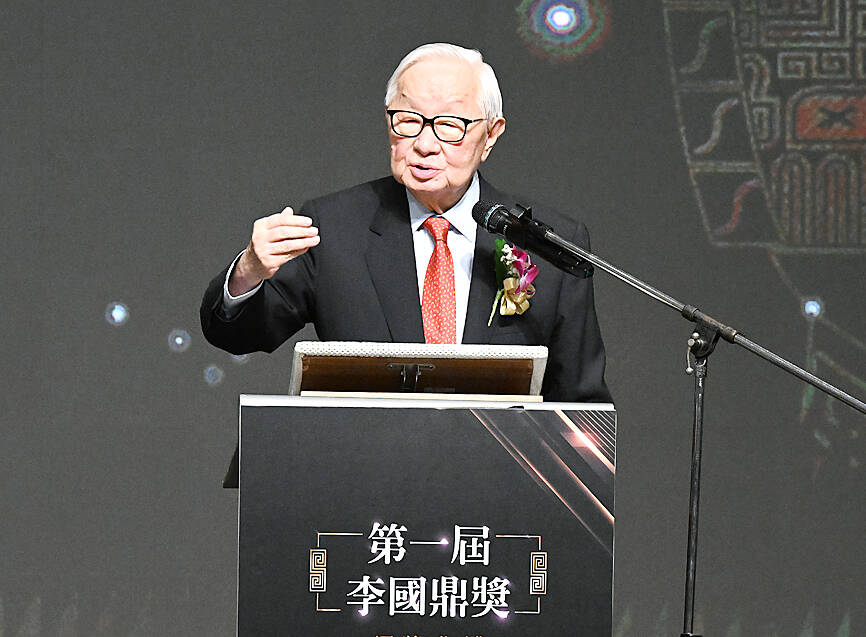
Photo: Liao Chen-hui, Taipei Times
Li invited Chang to work at ITRI, where Chang served as the institute’s president from 1985 to 1988 and its chairman from 1988 to 1994. Chang founded TSMC in 1987 in Hsinchu to focus on foundry business.
Nvidia Corp chief executive officer Jensen Huang (黃仁勳), who also attended the ceremony, praised Li as “the godfather of Taiwan’s technology industry” and Chang “the godfather of every industry.”
Huang said Chang has created a company that has had an unprecedented impact on the global technology industry.
He described TSMC as a masterpiece of Chang, like Beethoven’s Symphony No. 9 or Ode to Joy.
“Without TSMC, the entire world of technology industry today will not be possible,” Huang said. “Nvidia will not be possible without TSMC.”
Nvidia is one of the major customers of TSMC and one of the early adopters of the chipmaker’s most cutting-edge technologies. TSMC now makes Nvidia’s artificial intelligence (AI) chips.
Separately, TSMC yesterday reiterated that its most advanced 1.4-nanometer fab would be located in Taiwan after the chipmaker last month dropped a plan to build the fab in Taoyuan’s Longtan District (龍潭) due to local opposition.
“The company’s 1.4-nanometer technology will stay in Taiwan,” TSMC chairman Mark Liu (劉德音) said on the sidelines of the ceremony.
Speaking about TSMC’s capacity expansion in Japan, Liu said the chipmaker is on track to build a second fab in Kumamoto, while its first Japanese fab is set to begin production next year as scheduled.
Japan is set to allocate almost ¥2 trillion (US$13.3 billion) in an extra budget to boost its capacity to make and secure semiconductors at home, Bloomberg News reported on Wednesday, citing government officials familiar with the matter.
Of the total, about ¥760 billion would go into a fund to support the mass production of chips, money that could be used for supporting a second TSMC factory in Kumamoto, Bloomberg reported.
The Japanese government has pledged to provide a subsidy of ¥476 billion for TSMC’s first plant in Kumamoto.
Shares of contract chipmaker Taiwan Semiconductor Manufacturing Co (TSMC, 台積電) came under pressure yesterday after a report that Apple Inc is looking to shift some orders from the Taiwanese company to Intel Corp. TSMC shares fell NT$55, or 2.4 percent, to close at NT$2,235 on the local main board, Taiwan Stock Exchange data showed. Despite the losses, TSMC is expected to continue to benefit from sound fundamentals, as it maintains a lead over its peers in high-end process development, analysts said. “The selling was a knee-jerk reaction to an Intel-Apple report over the weekend,” Mega International Investment Services Corp (兆豐國際投顧) analyst Alex Huang
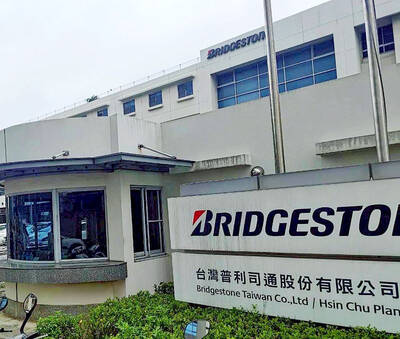
TRANSITION: With the closure, the company would reorganize its Taiwanese unit to a sales and service-focused model, Bridgestone said Bridgestone Corp yesterday announced it would cease manufacturing operations at its tire plant in Hsinchu County’s Hukou Township (湖口), affecting more than 500 workers. Bridgestone Taiwan Co (台灣普利司通) said in a statement that the decision was based on the Tokyo-based tire maker’s adjustments to its global operational strategy and long-term market development considerations. The Taiwanese unit would be reorganized as part of the closure, effective yesterday, and all related production activities would be concluded, the statement said. Under the plan, Bridgestone would continue to deepen its presence in the Taiwanese market, while transitioning to a sales and service-focused business model, it added. The Hsinchu
Taiwan Semiconductor Manufacturing Co (TSMC, 台積電) has approved a capital budget of US$31.28 billion for production expansion to meet long-term development needs during the artificial intelligence (AI) boom. The company’s board meeting yesterday approved the capital appropriation plan for purposes such as the installation of advanced technology capacity and fab construction, the world’s largest contract chipmaker said in a statement. At an earnings conference last month, TSMC forecast that its capital expenditure for this year would be at the higher end of the US$52 billion to US$56 billion range it forecast in January in response to robust demand for 5G, AI and
Taiwan Semiconductor Manufacturing Co’s (TSMC, 台積電) investment project in Arizona has progressed better than expected, but it still faces challenges such as water and labor shortages, National Development Council (NDC) Minister Yeh Chun-hsien (葉俊顯) said yesterday. Speaking with reporters after visiting TSMC’s Arizona hub and attending the SelectUSA Investment Summit in Maryland last week, Yeh said TSMC’s Arizona site turned a profit of NT$16.14 billion (US$514 million) last year in its first full year of mass production. “TSMC told me it was surprised by the smooth trial run of the first fab, which has left the company optimistic about the project’s outlook,”


 RSS
RSS