


It looks like any other scrappy Tel Aviv tech start-up, with staff in hip clothing huddled around laptops and downing espressos, but they are the volunteers in a “war room” assembled to help Israel bring home the hostages.
Militants from Hamas seized more than 220 people — including Israelis, foreigners and dual-nationals — when they stormed across Gaza’s border with Israel on Oct. 7 and, according to Israeli officials, killed more than 1,400 people.
Within days, as Israel launched reprisal strikes that the health ministry in the Hamas-run Gaza Strip says have killed more than 6,500 people, volunteers from Israel’s thriving tech sector teamed up to lend a hand in the hostage crisis.
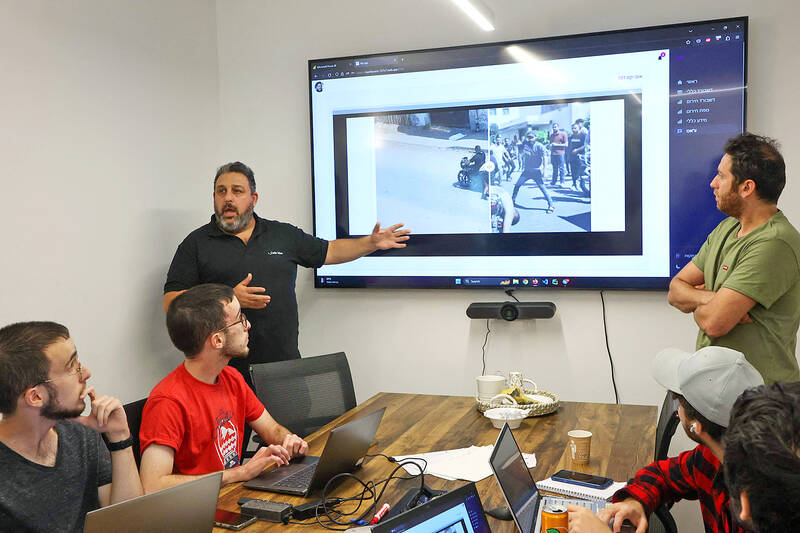
Photo: AFP
“We are a civilian war room. Our main purpose is to save lives,” said Refael Franco, 48, the chief executive of Code Blue Ltd — a cyber crisis management firm leading the effort at Gitam BBDO communications group in Tel Aviv.
“We collect. We compare. We deliver,” Franco said with a brand-ready slogan, as he pored over detailed, digital maps of Gaza dotted with color-coded markers linked to specific information about the captives.
For years, Israel’s tech sector has emerged as a formative pillar underpinning the country’s economy, with cybersecurity firms in particular serving as a powerful driver of growth and innovation.

Photo: AFP
Seemingly overnight, volunteers from the sector began meeting at the Gitam group’s offices where they pooled their expertise with artificial intelligence and innovative platforms to assist in identifying the missing in the aftermath of the Hamas attacks.
In this makeshift response center, volunteers have spent days combing through the deluge of social media posts across myriad platforms to gather information about the captives.
After amassing a database of images from social media in tandem with photos provided by families of the missing and kidnapped, the team then feeds the evidence into artificial intelligence software specializing in facial recognition.
With assistance from experts in geolocating, programmers and Arabic speakers, the team has rapidly pieced together an emerging picture of who was abducted, when they were last seen and where.
The information is then shared with the Israeli military’s special unit overseeing the hostage crisis, with about 60 captives successfully identified by the team to date.
The tech community’s reaction to the hostage crisis represents just a microcosm of the sweeping mobilization happening across Israel, with the young and old volunteering en masse to support affected families, soldiers and a range of other response efforts after the Oct. 7 attacks.
The hostage crisis has been particularly haunting.
Amid the trauma unleashed by the Hamas massacre, the hostage crisis remains an open wound, fueling anxiety and uncertainty during what Israeli leaders say will be a long war with the militant group.
“People here left their jobs. There are CEOs and CTOs [chief technology officers] and founders of companies that put everything aside and just came here ... to help,” said Ido Brosh, a 24-year-old volunteer programmer at Gitam BBDO with expertise in military intelligence. “It’s horrible that this event made us so unified, but that’s also the beauty of this country. In times of crisis, we come together.”
Even as the tech community pools its resources to help with the hostage response, the agony for the families of those held captive remains excruciating.
For 82-year-old Holocaust survivor Tsili Wenkert, the abduction of her grandson, Omer Weknert, from a music festival in southern Israel near the border with Gaza has brought an unending torrent of pain.
“What I’ve been through in the past is small. I’m now living through a nightmare,” she said. “It’s very hard for a grandmother at my age to know her grandson is a captive.”
The 22-year-old was last seen in footage posted on a Hamas-linked Telegram channel, showing him stripped to his underwear and bound in the back of a truck filled with armed militants, celebrating as they returned to Gaza.
Just four hostages have been released to date, thanks in part to backchannel negotiations involving Egypt and Qatar.
Yocheved Lifshitz, 85, was among those freed.
Following her release this week, she told reporters from a wheelchair that she was led through a “spiderweb” of tunnels under Gaza, where she was held with other captives.
The presence of the hostages would likely complicate the widely anticipated ground offensive by Israeli army following weeks of airstrikes across the besieged Gaza Strip.
Even amid the exhaustion and trauma triggered by the Oct. 7 attacks, the ongoing hostage crisis has stirred resolve in many.
For Omri Marcus, a creative director working on a campaign to battle misinformation at Gitam BBDO, the project is personal.
Marcus pointed to the wallpaper image on his laptop — a picture of his best friend’s cousin who is among the kidnapped.
The photograph serves as a constant reminder of the mission at hand, he said.
“She’s now ... in Gaza,” he said. “And we need to bring her back.”


The domestic unit of the Chinese-owned, Dutch-headquartered chipmaker Nexperia BV will soon be able to produce semiconductors locally within China, according to two company sources. Nexperia is at the center of a global tug-of-war over critical semiconductor technology, with a Dutch court in February ordering a probe into alleged mismanagement at the company. The geopolitical tussle has disrupted supply chains, with some carmakers reportedly forced to cut production due to chip shortages. Local production would allow Nexperia’s domestic arm, Nexperia Semiconductors (China) Ltd (安世半導體中國), to bypass restrictions in place since October on the supply of silicon wafers — etched with tiny components to

Taiwan’s foreign exchange reserves fell below the US$600 billion mark at the end of last month, with the central bank reporting a total of US$596.89 billion — a decline of US$8.6 billion from February — ending a three-month streak of increases. The central bank attributed the drop to a combination of factors such as outflows by foreign institutional investors, currency fluctuations and its own market interventions. “The large-scale outflows disrupted the balance of supply and demand in the foreign exchange market, prompting the central bank to intervene repeatedly by selling US dollars to stabilize the local currency,” Department of Foreign
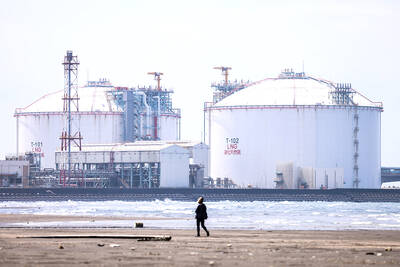
Taiwan is open to joining a global liquefied natural gas (LNG) program if one is created, but on the condition that countries provide delivery even in a scenario where there is a conflict with China, an energy department official said yesterday. While Taiwan’s priority is to have enough LNG at home, the nation is open to exploring potential strategic reserves in other countries such as Japan or South Korea, Energy Administration Deputy Director-General Chen Chung-hsien (陳崇憲) said. While the LNG market does not have a global reserve for emergencies like that of oil, the concept has been raised a few times —
AI-FUELED DEMAND: The company has been benefiting from the skyrocketing prices for DRAM chips amid the AI frenzy, especially its core product — DDR4 DRAM chips DRAM chipmaker Nanya Technology Corp (南亞科技) yesterday reported that its revenue for the first quarter surged 582.91 percent to NT$49.09 billion (US$1.54 billion) from NT$7.19 billion a year earlier, as the supply crunch caused chip price spikes. Last quarter’s figure is the highest on record. On a quarterly basis, revenue jumped 63.14 percent from NT$30.09 billion, the company said. In January, Nanya Technology expected global DRAM supply scarcity to continue through the first half of 2028, thanks to strong demand for artificial intelligence (AI) applications. Market researcher TrendForce Corp (集邦科技) forecast prices of standard DRAM chips would rise between 58 percent and 63


 RSS
RSS