


PricewaterhouseCoopers (PwC) Australia is putting nine senior partners on leave and appointing independent directors to its board as the embattled firm seeks to claw back confidence in the wake of a tax scandal.
The company plans to ring-fence business conducted with Australia’s government to minimize conflicts of interest and boost governance, it said in a statement yesterday.
The chairs of its governance board and its designated risk committee also stepped down from their respective roles.

Photo: AP
“We are announcing these actions today, despite the fact that our investigation continues, because we recognize that our stakeholders want more transparency in order to restore confidence in our firm,” PwC Australia acting CEO Kristin Stubbins said.
PwC has been under fire following revelations that one of its former tax chiefs obtained secret information during his time working as an adviser to the government, and then leaked it to his colleagues who used it to shop tax-planning advice to global customers.
“We recognize that enhanced governance, structures and controls are necessary, and the decision to ring-fence our Federal government business is a critical next step,” Stubbins said.
Earlier this month, Ziggy Switkowski, a former telecommunications executive, was appointed to lead an independent review into the firm’s governance and culture.
Stubbins said the full report and its recommendations would be published when the review concludes in September.
PwC did not name the partners being put on leave.
Then-PwC Australia CEO Tom Seymour and two other executives stepped down earlier this year after e-mails dating from 2014 to 2017 were made public following demands from the Australian parliament, albeit with names redacted.
The nation’s police force last week opened an investigation into the matter.
Australian Prime Minister Anthony Albanese was yesterday asked whether the names of all PwC partners who had access to confidential tax information should be publicly released.
“All of this should become public at the appropriate time. Of course, there are investigations under way and I don’t want to say anything to interfere with those processes, but quite clearly what went on there is completely unacceptable,” Albanese said on 2SM radio.
In a separate letter, Stubbins yesterday apologized on behalf of her firm for “betraying the trust placed in us.”
“I have worked at PwC for my whole career, and this has been personally and professionally devastating for me and my colleagues at PwC,” she said.

CHIP RACE: Three years of overbroad export controls drove foreign competitors to pursue their own AI chips, and ‘cost US taxpayers billions of dollars,’ Nvidia said China has figured out the US strategy for allowing it to buy Nvidia Corp’s H200s and is rejecting the artificial intelligence (AI) chip in favor of domestically developed semiconductors, White House AI adviser David Sacks said, citing news reports. US President Donald Trump on Monday said that he would allow shipments of Nvidia’s H200 chips to China, part of an administration effort backed by Sacks to challenge Chinese tech champions such as Huawei Technologies Co (華為) by bringing US competition to their home market. On Friday, Sacks signaled that he was uncertain about whether that approach would work. “They’re rejecting our chips,” Sacks

It is challenging to build infrastructure in much of Europe. Constrained budgets and polarized politics tend to undermine long-term projects, forcing officials to react to emergencies rather than plan for the future. Not in Austria. Today, the country is to officially open its Koralmbahn tunnel, the 5.9 billion euro (US$6.9 billion) centerpiece of a groundbreaking new railway that will eventually run from Poland’s Baltic coast to the Adriatic Sea, transforming travel within Austria and positioning the Alpine nation at the forefront of logistics in Europe. “It is Austria’s biggest socio-economic experiment in over a century,” said Eric Kirschner, an economist at Graz-based Joanneum

BUBBLE? Only a handful of companies are seeing rapid revenue growth and higher valuations, and it is not enough to call the AI trend a transformation, an analyst said Artificial intelligence (AI) is entering a more challenging phase next year as companies move beyond experimentation and begin demanding clear financial returns from a technology that has delivered big gains to only a small group of early adopters, PricewaterhouseCoopers (PwC) Taiwan said yesterday. Most organizations have been able to justify AI investments through cost recovery or modest efficiency gains, but few have achieved meaningful revenue growth or long-term competitive advantage, the consultancy said in its 2026 AI Business Predictions report. This growing performance gap is forcing executives to reconsider how AI is deployed across their organizations, it said. “Many companies
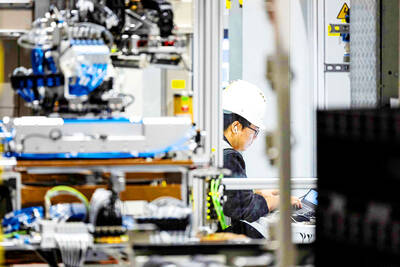
France is developing domestic production of electric vehicle (EV) batteries with an eye on industrial independence, but Asian experts are proving key in launching operations. In the Verkor factory outside the northern city of Dunkirk, which was inaugurated on Thursday, foreign specialists, notably from South Korea and Malaysia, are training the local staff. Verkor is the third battery gigafactory to open in northern France in a region that has become known as “Battery Valley.” At the Automotive Energy Supply Corp (AESC) factory near the city of Douai, where production has been under way for several months, Chinese engineers and technicians supervise French recruits. “They


 RSS
RSS