


Airbus SE is to double production capacity in China of its top-selling jet in a bold bet on future demand in one of the world’s biggest aviation markets.
The European planemaker is to add a second final assembly line for A320 narrow-bodies at its factory in Tianjin, under a deal signed by CEO Guillaume Faury in Beijing on Thursday. The move is a boost for Chinese manufacturing as other firms like Apple Inc rethink production in the nation amid rising tensions with the US.
The expansion of the Tianjin facility would be an “important part” of Airbus’ plan to produce as many as 75 A320neo family jets a month by 2026, Faury said on a call with reporters from Beijing.
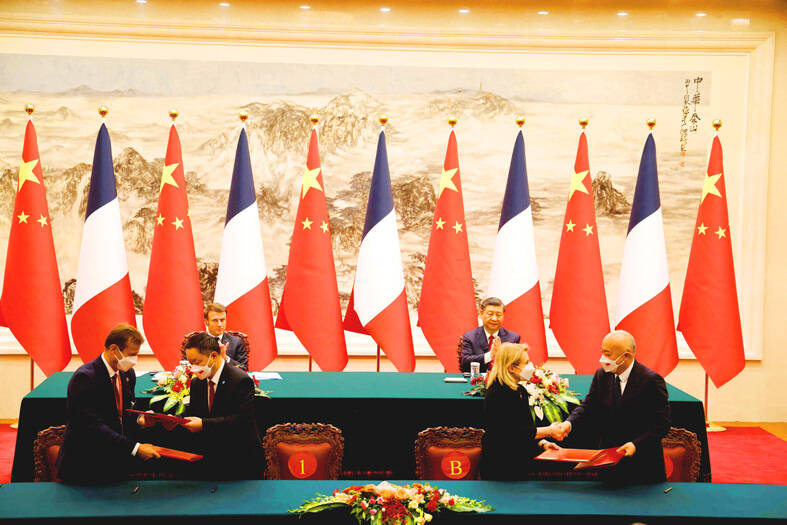
Photo: AFP
At the plant, which opened in 2008, workers stitch together major sections, such as wings and fuselage assemblies, giving the aircraft its final shape.
Airbus and chief rival Boeing Co have struggled to raise output amid supply-chain constraints, as demand for passenger planes has surged coming out of the COVID-19 pandemic.
“We’re paving the way for the growth of the market here in China,” Faury said.
Faury was part of a delegation of dozens of French business executives traveling with French President Emmanuel Macron, many of whom were returning to China for the first time since the pandemic.
However, Airbus looked set to leave China without a new plane order during Macron’s three-day state visit, despite intensive talks over the past weekend with Chinese customers.
Bloomberg reported this week that the company was targeting a follow-on order that would include A350 and possibly A330neo wide-body aircraft.
Faury said Airbus remained optimistic about winning more business in China, where it holds a sizable advantage over Boeing Co.
“We are all discussing with our customers and looking at the future,” Faury said. “Orders, if any — and there will be some I’m sure — will come at a later stage.”
The extra line in Tianjin would bring Chinese production capacity into proportion with its share of global demand, Faury said.
It is to come into service in the second half of 2025, he said.
Airbus now builds four A320s a month in Tianjin, and Faury said it plans to raise monthly output to six later this year, restoring a pre-COVID-19 goal.
The new investment would eventually bring capacity to 12 a month, with the possibility of going higher, Faury said.
While Tianjin now serves only Chinese customers, planes assembled there could potentially be delivered elsewhere, but these would be case-by-case decisions, he added.
In Beijing, Faury also signed a so-called general terms agreement, formalizing previously announced orders covering 160 aircraft, including 150 A320 family jets and 10 A350 wide-bodies, statements from Airbus and Macron’s office said.
Chinese carriers ordered more than 300 narrow-body aircraft from Airbus last year, valued at more than US$40 billion before customary discounts. Airlines in China make up about one-fifth of Airbus deliveries.
China, with its massive global tourism potential, is only just starting to emerge from a three-year freeze on international travel because of its COVID-19 border shutdowns.
Tensions between Washington and Beijing have also been on the rise, providing Toulouse, France-based Airbus with an opening in an important market while Boeing has been effectively locked out, with no major deals signed in China since 2017.

DAMAGE REPORT: Global central banks are assessing war-driven inflation risks as the law of unintended consequences careens around the world, spiking oil prices Central banks from Washington to London and from Jakarta to Taipei are about to make their first assessments of economic damage after more than two weeks of conflict between the US and Iran. Decisions this week encompassing every member of the G7 and eight of the world’s 10 most-traded currency jurisdictions are likely to confirm to investors that the specter of a new inflation shock is already worrying enough to prompt heightened caution. The US Federal Reserve is widely expected to do exactly what everyone anticipated weeks ahead of its March 17-18 policy gathering: hold rates steady. The narrative surrounding that
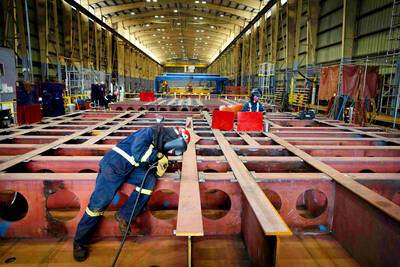
At a massive shipyard in North Vancouver, Canadian workers grind metal beams for a powerful new icebreaker crucial to cementing the country’s presence in the increasingly contested arctic. Icebreakers are specialized, expensive vessels able to navigate in the frozen far north. And “this is the crown jewel,” said Eddie Schehr, vice president of production at the Seaspan shipyard. For Canadian Prime Minister Mark Carney, who heads to Norway next Friday to observe arctic defense drills involving troops from 14 NATO states, Canada’s extreme north has emerged as a strategic priority. “Canada is and forever will be an Arctic nation,” he said ahead of

Chinese entrepreneur Frank Gao used to spend long hours running his social media accounts but now outsources the chore to artificial intelligence (AI) agent tool OpenClaw, which is taking China by storm despite official warnings over cybersecurity. OpenClaw, created in November by an Austrian coder, differs from bots such as ChatGPT because it can execute real-life tasks such as sending e-mails, organizing files or even booking flight tickets. “Since January, I’ve spent hours on the lobster every day,” Gao said in an interview, referring to OpenClaw’s red crustacean mascot. “We’re family.” After downloading OpenClaw, users connect it to artificial intelligence models of their
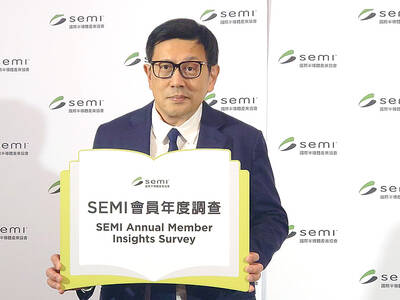
PRICE HIKES: The war in the Middle East would not significantly disrupt supply in the short term, but semiconductor companies are facing price surges for materials Taiwan’s semiconductor companies are not facing imminent supply disruptions of essential chemicals or raw materials due to the war in the Middle East, but surges in material costs loom large, industry association SEMI Taiwan said yesterday. The association’s comments came amid growing concerns that supplies of helium and other key raw materials used in semiconductor production could become a choke point after Qatar shut down its liquefied natural gas (LNG) production and helium output earlier this month due to the conflict. Qatar is the second-largest LNG supplier in the world and accounts for about 33 percent of global helium output. Helium is


 RSS
RSS