


At a massive shipyard in North Vancouver, Canadian workers grind metal beams for a powerful new icebreaker crucial to cementing the country’s presence in the increasingly contested arctic.
Icebreakers are specialized, expensive vessels able to navigate in the frozen far north.
And “this is the crown jewel,” said Eddie Schehr, vice president of production at the Seaspan shipyard.
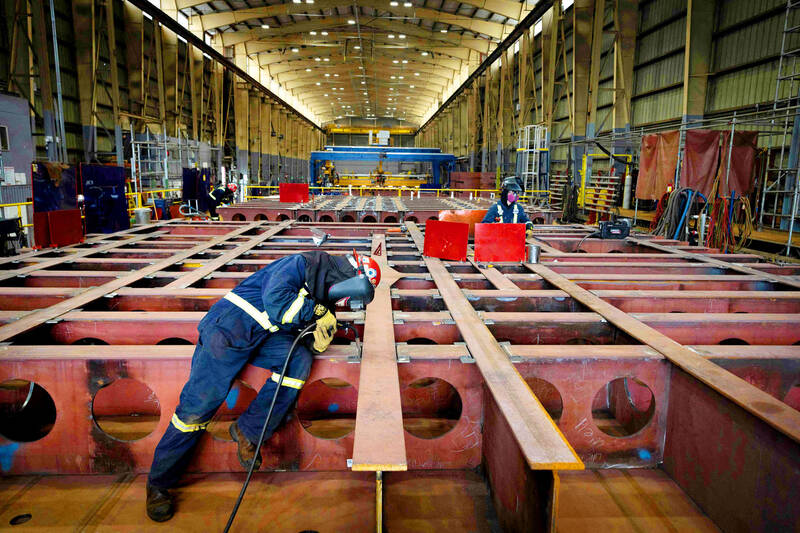
Photo: AFP
For Canadian Prime Minister Mark Carney, who heads to Norway next Friday to observe arctic defense drills involving troops from 14 NATO states, Canada’s extreme north has emerged as a strategic priority.
“Canada is and forever will be an Arctic nation,” he said ahead of the trip. During a stop in Canada’s Northwest Territories before flying to Norway, Carney announced nearly C$35 billion (US$25.3 billion) in arctic funding, with most of the funds dedicated to upgrading military infrastructure. “We cannot rely on other nations for our security,” he said. “We are securing every corner of this terrain.”
Concerns about Russian aggression, especially after the invasion of Ukraine, have focused attention on the arctic, where territorial sovereignty is disputed in several areas.
Climate change is intensifying competition, with previously inaccessible minerals increasingly available for exploitation as the ice thaws and new shipping routes open.
For Wesley Wark, a national security expert at the Center for International Governance Innovation, icebreaker fleets are a key part of the defense innovation required to safeguard Canada’s position.
“We’re in the business of trying to reassert ourselves as an icebreaking superpower,” Wark said.
Two new ships are under construction, each costing more than C$3 billion. One is being partly built in Finland, due for delivery in 2030. The other ship, set to be ready in 2032, is being built at the Seaspan shipyards in North Vancouver.
Senior vice president Dave Hargreaves said Canada’s icebreaking fleet is “getting old.”
And this ship, he said, “gives Canada the ability to have a strong presence in the Arctic, which is where you start.”
Canada’s decision to upgrade its icebreaker fleet preceded US President Donald Trump’s return to office.
Carney has delivered stark warnings about new risks from the US since entering Canadian politics last year, including a claim from last year’s federal election campaign that Trump wanted to “break us so America can own us.”
Wark said that Canada’s challenge in the Arctic has two main planks. First, Carney’s government wants “to show that it’s a strong NATO partner and to take part in NATO collective
security,” he said, adding that NATO is “deeply concerned about Russian activities in the Arctic.” Russia has the world’s largest icebreaker fleet by far — Canada is a distant second — and Wark said Carney wants to signal to a domestic audience and allies that Canada can defend NATO’s “Arctic flank.”
HARD POWER CAPACITY
Canada must consider that “the US itself potentially represents a danger to Canadian security,” Wark said. Trump has discussed annexing Canada at various points in his second term. He again mocked Carney as the “governor” of a US state this week, renewing a taunt he first levelled at former prime minister Justin Trudeau. Wark maintains the chance of direct military confrontation with the US is low.
The more immediate risk is that Washington might conclude Canada is incapable of defending the Arctic, compelling the US military to take charge, he said.
“I think Canadian officials have come to understand that the US administration, Trump, people around Trump in positions of power and influence, do not hold Canada in high regard as a country... essentially arguing Canada has no military,” he said.
For Canada, “the incentive to increase its hard power capacity is partly driven by those US concerns,” Wark said, while stressing that, “whatever the Trump administration might say, Canada is not a military freeloader.”
Unlike Russia, Canada has no intention of arming its icebreakers.
The ships are designed to operate in the harshest Arctic conditions, equipped for intelligence gathering, search-and-rescue as well as scientific exploration.
The Seaspan ship “can go anywhere in the Canadian Arctic any time of the year, which is a very difficult requirement to meet,” Hargreaves said.

Cairo’s new monorail slices across the city skyline, running above the familiar chaos of blaring horns and aging buses’ exhaust fumes that mark rush hour below. The US$4.5 billion monorail, opened this month, is among Egypt’s most prominent new transport projects, part of a debt-funded infrastructure drive criticized for sapping state finances while bringing limited benefits to most of the country’s 109 million people. “It feels like you’re in a different country,” said Ramy Sayed, a restaurant manager, aboard a driverless Innovia 300 train. “No noise, no traffic, we’re not used to this.” The eastern line runs 56km from the bustling middle-class
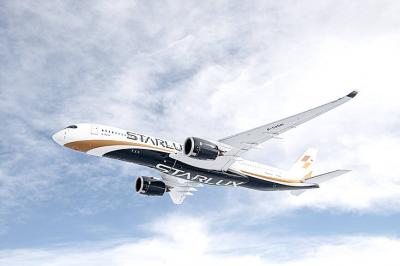
Starlux Airlines Co (星宇航空) today unveiled a long-haul network expansion plan at a shareholders’ meeting in Taipei, including direct flights to Barcelona, Spain, and Zurich, Switzerland, as well as a service connecting Taipei, Sydney and New Zealand. Starlux is to become the first Taiwanese carrier to offer non-stop services to the two European cities, while the inaugural oceanic route is expected to expand transit opportunities within the Australia-New Zealand market, Starlux said. Flight services to Chicago, Dallas, Washington and New York are under evaluation, the airline added. Prior to the shareholders’ meeting, the airline earlier this year announced that it would be

Taiwanese prosecutors suspect that three people successfully smuggled at least one shipment of Nvidia Corp artificial intelligence (AI) chips to China after first exporting them to Japan, people familiar with the matter said. The trio was detained last week by the Keelung District Prosecutors’ Office for allegedly falsifying documents related to exports of Super Micro Computer Inc servers containing advanced Nvidia chips, which the US has barred from sale to China without a license from Washington. The move marked Taiwan’s first public crackdown on AI chip diversion after years of pressure from the US to take a more active role in curtailing

Taiwan Semiconductor Manufacturing Co (TSMC, 台積電) employee bonuses are likely to grow more than 30 percent this year, in line with the past few years as the company’s profits continue to set new records, an anonymous source cited TSMC chairman C.C. Wei (魏哲家) as saying yesterday. TSMC, the world’s largest contract chipmaker, is committed to taking care of its workers, the source said, citing Wei’s meeting with employees yesterday morning. Wei also expressed gratitude to employees for their contribution to the company’s improving bottom line, the source added. Since 2023, TSMC’s employee bonuses have grown at an annual rate of


 RSS
RSS