


EU member states and lawmakers yesterday announced an agreement for a major reform to the bloc’s carbon market, the central facet of its ambition to reduce emissions and invest in climate-friendly technologies.
The deal aims to accelerate emissions cuts, phase out free allowances to industries, and target fuel emissions from construction and transportation sectors, a European Parliament statement said.
The EU Emissions Trading System allows electricity producers and industries with high energy demands such as steel and cement to purchase “free allowances” to cover their carbon emissions under a “polluter pays” principle.

Photo: Reuters
The quotas are designed to decrease over time to encourage them to emit less and invest in greener technologies as part of the EU’s goal of carbon neutrality.
Negotiators representing member states and the parliament had spent more than 24 hours in intense talks before reaching an agreement on Saturday night that would widen the scope of the EU carbon market.
The deal means that sectors under the trading system must cut their emissions by 62 percent by 2030 based on 2005 levels, up from a previous goal of 43 percent.
The agreement also seeks to accelerate the timetable for phasing out the free allowances, with 48.5 percent phased out by 2030 and a complete removal by 2034, a schedule that caused fierce debates between lawmakers and member states.
The carbon market is to be progressively extended to the maritime sector, intra-European flights and waste incineration sites, depending on a favorable report by the commission, it said.
A “carbon border tax,” which imposes environmental standards on imports into the bloc based on the carbon emissions linked to their production, would offset the reduction of free allowances and allow industries to compete with more polluting non-EU rivals.
The agreement also aims to make households pay for emissions linked to fuel and gas heating from 2027, but the price would be capped until 2030.
The commission had proposed a second carbon market targeting building heating and road fuels, but the plan raised concerns as European households grapple with soaring energy prices exacerbated by Russia’s invasion of Ukraine.
If energy prices continue to spiral, the application of this part of the agreement would be delayed by a year, the statement said.
Proceeds from this second market would go to a “social climate fund,” which would support vulnerable households and businesses weather the energy price crisis.


Taiwan’s foreign exchange reserves fell below the US$600 billion mark at the end of last month, with the central bank reporting a total of US$596.89 billion — a decline of US$8.6 billion from February — ending a three-month streak of increases. The central bank attributed the drop to a combination of factors such as outflows by foreign institutional investors, currency fluctuations and its own market interventions. “The large-scale outflows disrupted the balance of supply and demand in the foreign exchange market, prompting the central bank to intervene repeatedly by selling US dollars to stabilize the local currency,” Department of Foreign

Intel Corp is joining Elon Musk’s long-shot effort to develop semiconductors for Tesla Inc, Space Exploration Technologies Corp and xAI, marking a surprising twist in the chipmaker’s comeback bid. Intel would help the Terafab project “refactor” the technology in a chip factory, the company said on Tuesday in a post on X, Musk’s social media platform. That is a stage in the development process that typically helps make chips more powerful or reliable. The chipmaker’s shares jumped 4.2 percent to US$52.91 in New York trading on Tuesday. The Terafab project is a grand plan by Musk to eventually manufacture his own chips for

Some robotaxi passengers were left stranded in the middle of fast-moving traffic in a major Chinese city after their driverless vehicles stopped running, according to police and media reports on Wednesday. A preliminary investigation indicates more than 100 robotaxis came to a halt because of a “system malfunction,” police in the city of Wuhan said in a statement, without elaborating. No injuries were reported. One passenger told Chinese media that their robotaxi stopped after turning a corner. An instruction on a screen read: “Driving system malfunction. Staff are expected to arrive in 5 minutes.” After no one showed up, the passenger pushed
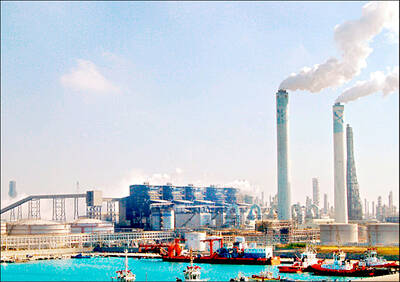
Taiwan Power Co (Taipower, 台電) yesterday said it plans to resume operations at two coal-fired power generators for three months to boost security of electricity supply as liquefied natural gas (LNG) supply risks are running high due to the Middle East conflict. The two coal-fired power generators are at Mailiao Power Plant in Yunlin County’s Mailiao Township (麥寮). The plant, operated by Formosa Plastics Group (台塑集團), supplied electricity to Taipower’s power grid until the end of last year. Taipower’s decision came about one month after Minister of Economic Affairs Kung Ming-hsin (龔明鑫) on March 10 said that the nation had no imminent


 RSS
RSS