


Yuen Foong Yu Consumer Products Co (永豐餘消費品實業) has pledged to invest NT$1.9 billion (US$60.96 million) in Taiwan to expand its capacity to manufacture toilet paper, inner layers for masks and cleaning products, the Ministry of Economic Affairs said on Friday.
The company has gained approval from the InvesTaiwan Service Center to participate in a government incentive program as it is planning to build a new factory in Taichung’s Cingshui District (清水) and install smart production lines at its plant in Taoyuan’s Yangmei District (楊梅), the ministry said.
Yuen Foong Yu, a unit of YFY Inc (永豐餘控股), sells its products in Taiwan and China. The company is the largest household paper maker in Taiwan, owning the brands Mayflower, Delight and Tender. It also sells kitchen paper towels and interfold tissue under a Mayflower sub-brand in China.
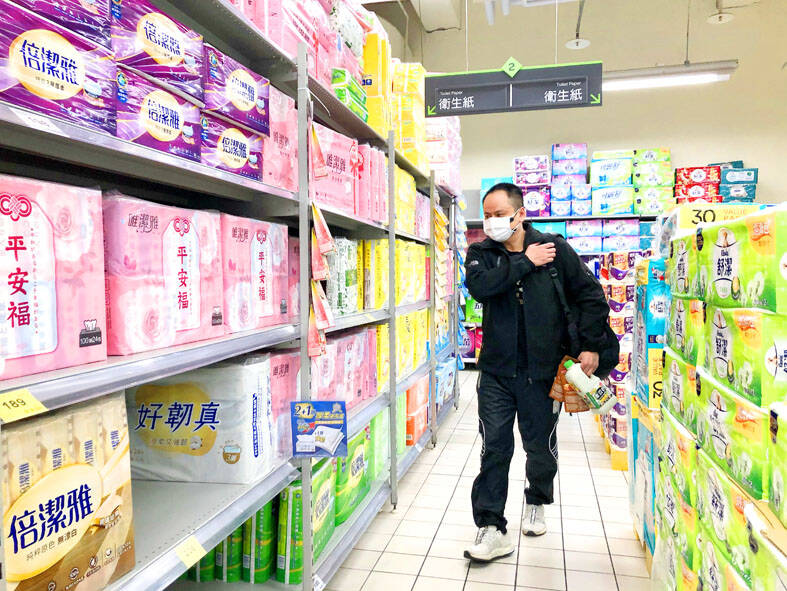
Photo: Peter Lo, Taipei Times
The firm has in the past few years also made inroads into the high gross margin cleaning product segment through its natural cleaning product brands Fresh Sense and Orange House in the two countries.
Apart from meeting growing consumer demand through the construction of new manufacturing facilities, the company also aims to be more environmentally friendly, the ministry said, adding that the new Cingshui plant would have solar power generation systems installed on its roof.
The company is committed to better waste management at its plants to address sustainable production, and plans to convert recycled materials and surplus materials into alternative fuels for boilers to ensure that resources are reused effectively, the ministry said.
The company also proposed increasing the reuse rate of recycled water and build paper recycling systems at its plants, it added.
Yuen Foong Yu posted revenue of NT$7.39 billion in the first three quarters of this year, up from NT$7.25 billion a year earlier, while net profit fell to NT$552.48 million, from NT$832.04 million. Earnings per share were NT$2.07 in the first three quarters, down from NT$3.39 a year earlier, company data showed.
Proposed investments by sheet metal producer Yeong Jye Co (永傑空調機械) and Primo Biotechnology Co (普瑞默生物科技) were also approved by the InvesTaiwan Service Center, as the two firms are planning to construct new manufacturing facilities, the ministry said.
The Invest in Taiwan initiative has to date attracted 1,279 companies to invest more than NT$1.82 trillion and create 140,758 local jobs, the ministry added.

Taiwanese firms have increased investment in the Philippines in recent years as Manila’s ties with Washington deepen and global supply chains continue to shift away from China, an expert at the Chung-Hua Institution for Economic Research (CIER, 中華經濟研究院) said yesterday. The Philippines had not been among Taiwanese investors’ top choices in Southeast Asia, CIER Taiwan ASEAN Studies Center director Kristy Hsu (徐遵慈) said at a seminar in Taipei. However, Taiwan’s investment in the country has grown significantly since the COVID-19 pandemic, reaching US $257 million last year, a high in recent years, she said. Although Taiwan’s total investment in the Philippines still lags

Intel Corp regards Taiwan Semiconductor Manufacturing Co (TSMC, 台積電) as a longstanding partner, as the US chipmaker would continue outsourcing production of advanced chips to TSMC, Intel chief executive officer Lip-Bu Tan (陳立武) said yesterday. “I don’t look at people as competitors. I look at the collaboration... Nvidia is also, you know, a good friend,” Tan told a news conference following his keynote speech at the Computex trade show in Taipei. “It’s a very trusted partnership for us... We are a big, top customer for them, and we’re going to continue doing that,” he said, referring to TSMC, the world’s largest foundry

Artificial intelligence (AI) agents would supplant smartphones as the center of people’s digital lives, fundamentally reshaping personal devices and driving a major computing upgrade cycle, Qualcomm Inc CEO Cristiano Amon said yesterday. In his keynote speech for this year’s Computex trade show in Taipei, Amon said that the rise of "agentic AI" — AI systems capable of reasoning, planning and carrying out tasks autonomously — would transform how people interact with technology across phones, PCs, vehicles and wearable devices. Describing the technology as the next major evolution in computing, Amon said that "2026 is the year of agents.” For decades, smartphones have sat

Hon Hai Precision Industry Co (鴻海精密) yesterday said it would work with US chipmaker Intel Corp to jointly develop and deploy next-generation artificial intelligence (AI) infrastructure and intelligent computing platforms in a move to capture booming demand for AI computing systems. Hon Hai, also known as Foxconn Technology Group (富士康), said in a statement that the partnership would combine its global manufacturing scale, system integration expertise and AI data center deployment capabilities with Intel’s strengths in processor architecture, silicon technologies and software ecosystem. The companies said they plan to work on equipment used in AI data centers, including server racks powered by


 RSS
RSS