


Taiwan Semiconductor Manufacturing Co’s (TSMC, 台積電) share of the global foundry market rose to almost 70 percent last year amid booming demand for artificial intelligence (AI), market information advisory firm TrendForce Corp (集邦科技) said on Thursday.
The contract chipmaker posted US$122.54 billion in revenue, up 36.1 percent from a year earlier, accounting for 69.9 percent of the global market, TrendForce said.
Its share was up from 64.4 percent in 2024, it said.
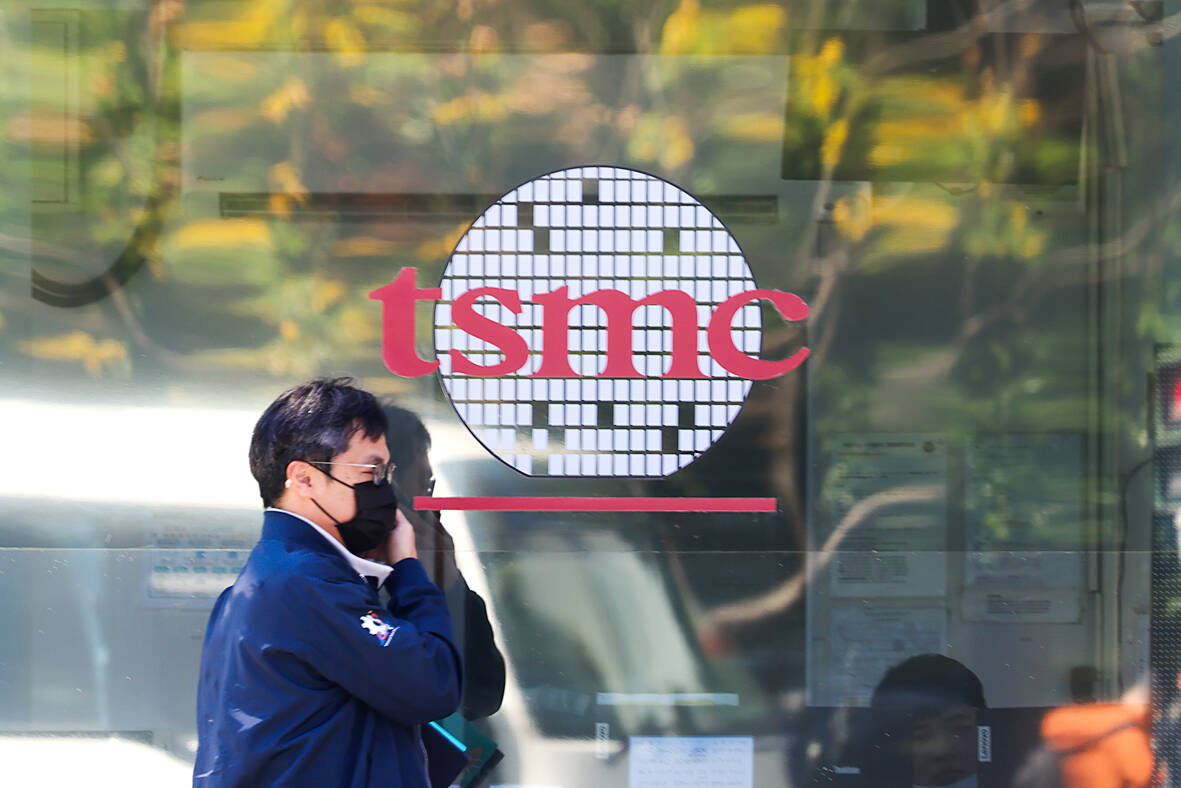
Photo: Ritchie B. Tongo, EPA
TSMC’s closest rival, Samsung Electronics, was a distant second, posting US$12.63 billion in sales, down 3.9 percent from a year earlier, for a 7.2 percent share of the global market.
In the fourth quarter of last year alone, TSMC’s share of the global foundry market was 70.4 percent, down from 71.0 percent in the third quarter, although its sales rose 2 percent from a quarter earlier to US$33.72 billion.
Although TSMC’s shipments in the October-to-December period fell slightly from a quarter earlier, strong demand for its 3-nanometer process pushed average selling prices higher, boosting revenue, TrendForce said.
The global foundry market’s 10 largest firms generated US$169.47 billion in combined sales last year, up 26.3 percent from a year earlier.
China’s Semiconductor Manufacturing International Corp (SMIC, 中芯) ranked third with US$9.33 billion in sales, or a 5.32 percent market share, ahead of Taiwan’s United Microelectronics Corp (聯電) with US$7.63 billion, or 4.35 percent, and US-based GlobalFoundries with US$6.79 billion, or 3.87 percent.
Huahong Group (華虹) of China was sixth with US$4.50 billion (2.6 percent).
Rounding out the top 10 were: Israel’s Tower Semiconductor Ltd (US$1.57 billion, 0.89 percent), Taiwan’s Vanguard International Semiconductor Corp (世界先進, US$1.56 billion, 0.89 percent), China’s NexChip Co (合晶集成, US$1.51 billion, 0.86 percent), and Taiwan’s Powerchip Semiconductor Manufacturing Corp (力積電, US$1.40 billion, 0.80 percent).
Taiwan Semiconductor Manufacturing Co (TSMC, 台積電) is now ranked ninth among the world’s 100 most valuable companies after its market capitalization more than doubled over the past year, PricewaterhouseCoopers (PwC) Taiwan said in a report last month. TSMC’s market capitalization surged 101 percent year-on-year to US$1.427 trillion as of March 31, the accounting and consulting firm’s 2026 Global Top 100 Companies by Market Capitalization report said. The gain catapulted the world’s largest contract chipmaker from 12th place to ninth in the rankings, and it was the fastest-growing among the global top 10, it said. TSMC was the only Taiwanese company among the top
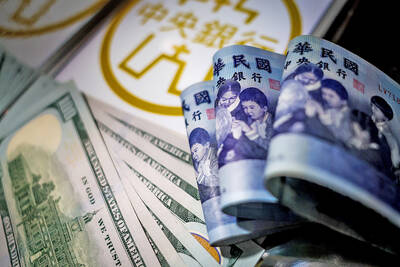
The New Taiwan dollar yesterday fell sharply against the US dollar to close at its lowest level since May 22 amid a massive outflow of funds from the country because of investors panicking over global equity markets. The NT dollar ended at NT$31.580 against the US dollar, slightly lower than its close of NT$31.568 on May 22, after moving between NT$31.5 and NT$31.648 on combined turnover of US$3.062 billion on the Taipei Foreign Exchange and the Cosmos Foreign Exchange. The NT dollar received a significant hit in the morning session, slumping as much as NT$0.173 at a time when other Asian currencies
Taiwan Semiconductor Manufacturing Co (TSMC, 台積電) yesterday reported record revenue of NT$416.975 billion (US$13.17 billion) for last month, putting the world’s largest contract chipmaker on track to set a record for quarterly revenue. Last month’s figure surpassed March’s record NT$415.19 billion and represented increases of 1.5 percent from April and 30.1 percent from a year earlier. For the first five months of the year, TSMC generated NT$1.96 trillion in revenue, up 30 percent year-on-year, it said in a statement. TSMC has forecast second-quarter revenue of between US$39 billion and US$40.2 billion, representing sequential growth of about 10 percent and year-on-year growth of about
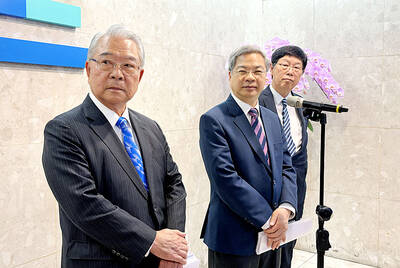
PATENT PROBE: US lawmakers called for a ban on imports of chips made by TSMC if they are found to infringe on US patents, with a preliminary ruling expected soon Minister of Economic Affairs Kung Ming-hsin (龔明鑫) yesterday expressed confidence in Taiwan Semiconductor Manufacturing Co’s (TSMC, 台積電) compliance with patent regulations after reports linked the company to a patent infringement lawsuit in the US. US Representative Ryan Zinke, and US senators Tim Sheehy, Roger Marshall and Bernie Moreno urged the US International Trade Commission in a May 22 letter to ban imports of chips made by TSMC if they are found to infringe on US patents, Axios reported on Wednesday. An administrative law judge is expected to issue a preliminary ruling this month, with the commission potentially making a final decision in


 RSS
RSS