


The technology industry is facing a fundamental overhaul with rising geopolitical tensions and dwindling investor appetite for money-losing start-ups, a panel of leading venture capital partners said.
“The reset has arrived,” GGV Capital managing partner Jenny Lee (李宏瑋) said.
The venture capitalist said that money is harder to come by for start-ups and valuations have dropped 30 percent to 50 percent in some cases.

Photo: Bloomberg
She said that the “wake-up” has already hit many smaller start-ups, although larger private companies might be able to wait out the painful market turn.
The sentiment was echoed by other investors on the panel at the Bloomberg New Economy Forum. In the past few years, start-up valuations surged to record highs, but many companies have struggled to maintain those levels.
“Valuation became disconnected from fundamentals,” General Atlantic chairman and CEO Bill Ford said. “Capital felt free.”
The mentality of founders used to be “use as much capital as you need to drive top line growth,” but now “there’s a new world,” Ford said
China has been particularly hard hit, especially as Chinese President Xi Jinping’s (習近平) administration cracked down on the private sector.
The value of venture capital deals in the country tumbled 44 percent to US$62.1 billion through last month, compared with the same period last year, research firm Preqin said.
For example, General Atlantic invested in ByteDance Ltd (字節跳動), the parent company of video sensation TikTok.
Ford said that the company now needs to deal with political scrutiny from the Chinese government and from the US authorities.
“I think what that’s meant for all of us is that the level of risk is higher,” he said, adding that investors still have to be in the China market as “it’s too big to ignore.”
Southeast Asia and India are now at the top of General Atlantic’s list of target markets, Ford said.
Lee said that GGV now looks at venture deals — globally, not just in China — through the lens of “policy-sensitive” deals and “policy-non-sensitive” deals.
Deep tech sectors such as semiconductors are very sensitive to political factors in governments around the world, so they require a different investment approach, she said.
ZhenFund founding partner Anna Fang (方愛之) said that deal activity is still strong in China, although the pace of investments has slowed.
Her firm has found that valuation boosts are harder to come by, she said.
Beijing has to be sensitive to the private sector and foster a vibrant ecosystem of start-ups, she said.
It is also important for venture firms and their limited partners to have patience during difficult times. The industry is full of people who sold out too quickly from Facebook and Google.
“Obviously we don’t want to sell ByteDance right?” she said.


The domestic unit of the Chinese-owned, Dutch-headquartered chipmaker Nexperia BV will soon be able to produce semiconductors locally within China, according to two company sources. Nexperia is at the center of a global tug-of-war over critical semiconductor technology, with a Dutch court in February ordering a probe into alleged mismanagement at the company. The geopolitical tussle has disrupted supply chains, with some carmakers reportedly forced to cut production due to chip shortages. Local production would allow Nexperia’s domestic arm, Nexperia Semiconductors (China) Ltd (安世半導體中國), to bypass restrictions in place since October on the supply of silicon wafers — etched with tiny components to
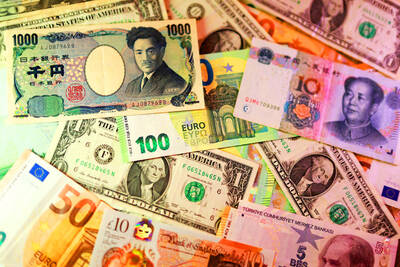
Taiwan’s foreign exchange reserves fell below the US$600 billion mark at the end of last month, with the central bank reporting a total of US$596.89 billion — a decline of US$8.6 billion from February — ending a three-month streak of increases. The central bank attributed the drop to a combination of factors such as outflows by foreign institutional investors, currency fluctuations and its own market interventions. “The large-scale outflows disrupted the balance of supply and demand in the foreign exchange market, prompting the central bank to intervene repeatedly by selling US dollars to stabilize the local currency,” Department of Foreign
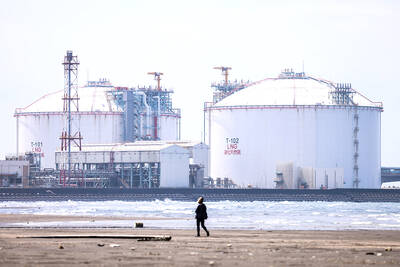
Taiwan is open to joining a global liquefied natural gas (LNG) program if one is created, but on the condition that countries provide delivery even in a scenario where there is a conflict with China, an energy department official said yesterday. While Taiwan’s priority is to have enough LNG at home, the nation is open to exploring potential strategic reserves in other countries such as Japan or South Korea, Energy Administration Deputy Director-General Chen Chung-hsien (陳崇憲) said. While the LNG market does not have a global reserve for emergencies like that of oil, the concept has been raised a few times —
AI-FUELED DEMAND: The company has been benefiting from the skyrocketing prices for DRAM chips amid the AI frenzy, especially its core product — DDR4 DRAM chips DRAM chipmaker Nanya Technology Corp (南亞科技) yesterday reported that its revenue for the first quarter surged 582.91 percent to NT$49.09 billion (US$1.54 billion) from NT$7.19 billion a year earlier, as the supply crunch caused chip price spikes. Last quarter’s figure is the highest on record. On a quarterly basis, revenue jumped 63.14 percent from NT$30.09 billion, the company said. In January, Nanya Technology expected global DRAM supply scarcity to continue through the first half of 2028, thanks to strong demand for artificial intelligence (AI) applications. Market researcher TrendForce Corp (集邦科技) forecast prices of standard DRAM chips would rise between 58 percent and 63


 RSS
RSS