


The global PC market saw its steepest decline on record as economic uncertainty and a glut of unsold inventory dented shipments for the fourth quarter in a row.
Worldwide shipments of desktop and laptop computers fell by 19.5 percent to 67.996 million units in the third quarter of the year compared with a year earlier, research firm Gartner Inc said on Monday.
It was the biggest drop Gartner has documented in more than two decades of tracking the market, echoing data compiled by Canalys Co, which on Monday said that total shipments of desktops and notebooks fell 17.7 percent to 69.42 million units last quarter.
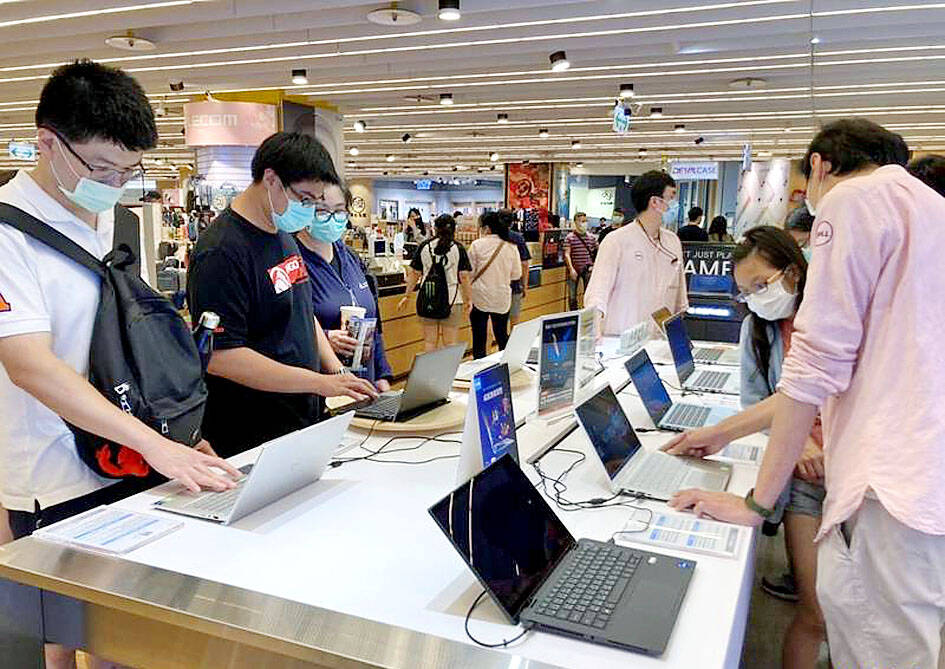
Photo: Taipei Times file photo
The dismal PC numbers coincide with a period of upheaval for the global tech industry, which is parsing a plethora of restrictions Washington imposed on chip and technology exports to China last week.
PC vendors and major suppliers such as Advanced Micro Devices Inc (AMD) had already warned of a market slowdown this year, emphasizing the need for new growth to replace demand from remote work and online learning as the COVID-19 pandemic eases.
Although shipping volume remains comparable to pre-pandemic levels and robust hiring numbers suggest positive commercial demand, it is likely that economic headwinds would affect information technology spending for business and personal use into next year, Canalys said.
“The rapid deterioration in demand across all segments is a worrying sign not only for vendors, but for stakeholders across the supply chain,” Canalys senior analyst Ishan Dutt said. “Intel and AMD are facing headwinds from weakness in their PC businesses, and smaller makers of components from ICs to memory are cutting production and lowering earnings forecasts.”
The market is likely to recover by the second half of next year, Dutt added.
Lenovo Group Ltd (聯想) remained the top global PC maker in the third quarter, although its shipments fell 15.3 percent year-on-year to 17.11 million units, Gartner said.
Among the top five vendors, ranking second place, HP Inc saw the largest decline in the third quarter with a 27.9 percent drop to 12.71 million units, Gartner added.
Apple Inc was the only exception among the top five vendors to post an annual increase in PC shipments last quarter, as it shipped more Mac computers to make up for lost orders stemming from COVID-19 lockdowns in China during the second quarter, the International Data Corp (IDC) said in its latest report on Sunday.
Apple’s shipments rose 40.2 percent to 10.06 million units in the third quarter, ranking the fourth largest after Dell Technologies Inc but ahead of Asustek Computer Inc (華碩).
Acer Inc (宏碁) dropped out of the top five PC vendors last quarter in the latest statistics tracked by Gartner, Canalys and IDC.
IDC — which categorizes PCs as desktops, notebooks and workstations — said global shipments totaled 74.25 million units last quarter, down 15 percent year-on-year due to cooling demand.
“Consumer demand has remained muted though promotional activity from the likes of Apple and other players has helped soften the fall and reduce channel inventory by a couple of weeks across the board,” IDC mobility and consumer device research manager Jitesh Ubrani said in a statement.
Additional reporting by staff writer


Taiwan’s foreign exchange reserves fell below the US$600 billion mark at the end of last month, with the central bank reporting a total of US$596.89 billion — a decline of US$8.6 billion from February — ending a three-month streak of increases. The central bank attributed the drop to a combination of factors such as outflows by foreign institutional investors, currency fluctuations and its own market interventions. “The large-scale outflows disrupted the balance of supply and demand in the foreign exchange market, prompting the central bank to intervene repeatedly by selling US dollars to stabilize the local currency,” Department of Foreign

Intel Corp is joining Elon Musk’s long-shot effort to develop semiconductors for Tesla Inc, Space Exploration Technologies Corp and xAI, marking a surprising twist in the chipmaker’s comeback bid. Intel would help the Terafab project “refactor” the technology in a chip factory, the company said on Tuesday in a post on X, Musk’s social media platform. That is a stage in the development process that typically helps make chips more powerful or reliable. The chipmaker’s shares jumped 4.2 percent to US$52.91 in New York trading on Tuesday. The Terafab project is a grand plan by Musk to eventually manufacture his own chips for

Taiwan Power Co (Taipower, 台電) yesterday said it plans to resume operations at two coal-fired power generators for three months to boost security of electricity supply as liquefied natural gas (LNG) supply risks are running high due to the Middle East conflict. The two coal-fired power generators are at Mailiao Power Plant in Yunlin County’s Mailiao Township (麥寮). The plant, operated by Formosa Plastics Group (台塑集團), supplied electricity to Taipower’s power grid until the end of last year. Taipower’s decision came about one month after Minister of Economic Affairs Kung Ming-hsin (龔明鑫) on March 10 said that the nation had no imminent

Some robotaxi passengers were left stranded in the middle of fast-moving traffic in a major Chinese city after their driverless vehicles stopped running, according to police and media reports on Wednesday. A preliminary investigation indicates more than 100 robotaxis came to a halt because of a “system malfunction,” police in the city of Wuhan said in a statement, without elaborating. No injuries were reported. One passenger told Chinese media that their robotaxi stopped after turning a corner. An instruction on a screen read: “Driving system malfunction. Staff are expected to arrive in 5 minutes.” After no one showed up, the passenger pushed


 RSS
RSS