


China Airlines Ltd’s (CAL, 中華航空) board of directors yesterday approved a plan to spend up to US$4.6 billion to purchase 16 Boeing Co 787-9 airplanes, with delivery scheduled to start in 2025.
The airline expects to receive all 16 new planes by the end of 2027, it said.
As the new planes arrive, the company would at the same time retire its older Airbus SE 330-300 aircraft for medium-haul services.
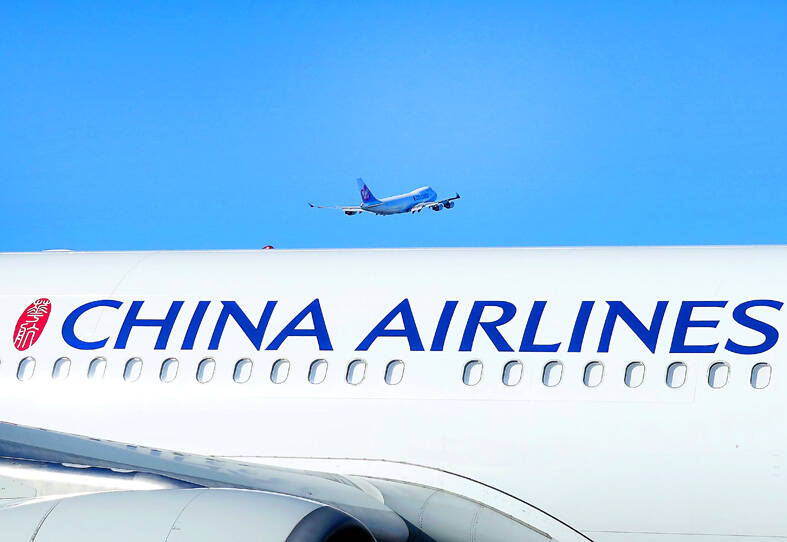
Photo: Chu Pei-hsiung, Taipei Times
The new wide-body Boeing aircraft equipped with General Electric Co’s next-generation engines would be used mainly for regional routes, such as flights between Taiwan and Australia, as well as New Zealand, CAL said.
Asked why it did not opt for a similar wide-body plane such as the Airbus 330neo, CAL said that its primary concerns were fuel efficiency, maintenance costs and cargo capacity, as well as jet design and market acceptance.
In particular, in light of the COVID-19 pandemic, CAL needs to make allowances for a new business model in which a passenger jet might also be utilized for air cargo business, it said, adding that the cabin of a 787-9 jet can accommodate 36 containers, much more than other wide-body aircraft.
The addition of the Boeing 787-9 planes would boost CAL’s cargo capacity, the airline said.
“Overall, our purchase task force gave Boeing 787-9 passenger jets the highest score among all wide-body aircraft, believing that the airplane would have the best utility,” the airline said.
CAL in September last year set up the task force responsible for determining the purchase of new aircraft and recently finalized its conclusion, the airline said.
The 787-9 aircraft’s fuel consumption and carbon emissions are 20 percent lower than that of older passenger jets, which would help the airline reach its goal of net zero carbon emissions by 2050, it said.
The deal includes eight options allowing CAL to buy the bigger 787-10 aircraft if necessary, it said.
CAL has 65 passenger jets and 21 cargo jets.
CAL would be the second Taiwanese airline to purchase Boeing’s 787-9 aircraft, after EVA Airways Corp (長榮航空) in 2018.
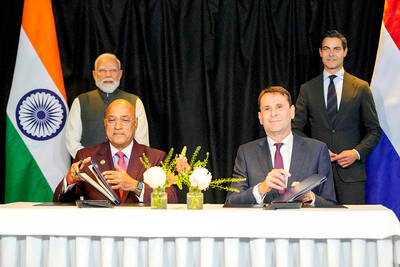
NEW MARKET: The partnership opens up India to the Dutch company, which already has a strong hold in the semiconductor market of South Korea, Taiwan and China ASML Holding NV entered into a partnership agreement with Tata Electronics Pvt Ltd aimed at ramping up India’s goal to develop domestic chip-manufacturing capabilities. The Dutch company’s technology would help power Tata Electronics’ planned 300 millimeter (mm) semiconductor foundry in Gujarat, according to a joint statement from the two companies on Saturday. The signing of a memorandum of understanding coincides with a visit by Indian Prime Minister Narendra Modi to the Netherlands, which is looking to deepen bilateral relations with New Delhi. ASML, whose top customers include Taiwan Semiconductor Manufacturing Co (台積電) and Samsung Electronics Co, makes lithography machines that can print

TECH RELIANCE: Growth is increasingly reflecting an unequal K-shaped distribution, where technology sectors outperform and other industries struggle, an expert said Standard Chartered Bank has significantly raised its forecast for Taiwan’s economic growth to 9.5 percent this year, up from 7.6 percent previously, citing surging artificial intelligence (AI) demand driving exports, semiconductor production and investment. The upgrade reflects a sustained AI supercycle that continues to fuel demand for advanced chips and technology infrastructure, which form the backbone of Taiwan’s exports, the bank said in a report this week. “We raise our 2026 growth forecast to reflect a much stronger-than-expected first-quarter GDP figure,” Standard Chartered senior economist for greater China and Asia Tommy Wu (胡東安) said in the report. Driven largely by a 35.3 percent
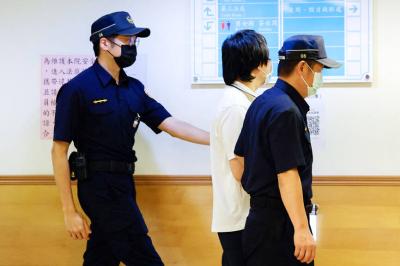
Tokyo Electron's Taiwan unit today said in a written response that it respects the judicial process, takes the court ruling seriously and would not appeal in the Taiwan Semiconductor Manufacturing Co (TSMC, 台積電) trade secrets case. Last month, a court fined the Taiwan unit of Japan's Tokyo Electron NT$150 million (US$4.74 million) in a case involving trade secrets related to TSMC's sensitive chip technology.
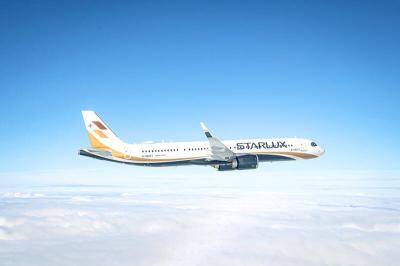
Two of Taiwan’s international carriers, Starlux Airlines Co (星宇航空) and EVA Airways Corp (長榮航空), have retained the five-star airline rating awarded by international airline review organization Skytrax. Starlux was awarded the distinction for a second consecutive year, while EVA Air received it for the 11th straight year, Skytrax said in statements released yesterday and on Thursday last week, respectively. The five-star rating is considered one of the airline industry's highest honors and is awarded following professional audits of airline product and frontline service standards, Skytrax said. The ratings are based on in-depth assessments using unified global quality standards rather than customer review scores


 RSS
RSS