


The nation’s foreign exchange reserves last month decreased US$3.71 billion to US$545.06 billion, the central bank said in a statement yesterday.
The latest data showed that foreign exchange reserves have been falling for two consecutive months, as the net outflow of foreign capital offset returns from the bank’s management of reserve assets.
Exchange rate shifts of other reserve currencies against the US dollar were the main factor behind the decrease in Taiwan’s foreign exchange reserves, the bank said.
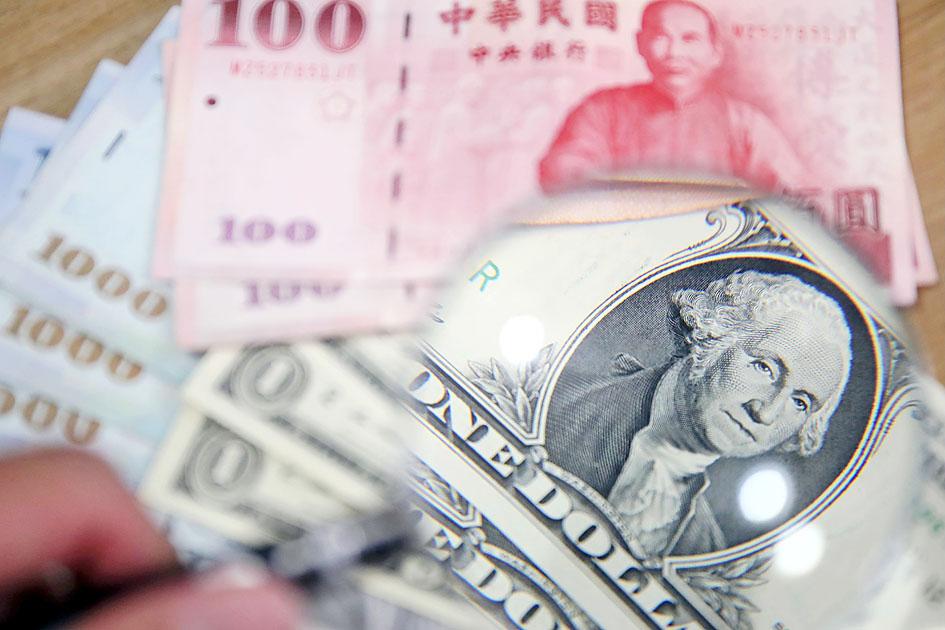
Photo: CNA
Based on the bank’s tallies, the euro fell 5.84 percent against the US dollar last month on a monthly basis, while the British pound declined 4.8 percent and the yen shed 6.36 percent.
The Australian dollar fell 4.77 percent, the Canadian dollar weakened 2.03 percent, the yuan retreated 4.76 percent and the Singaporean dollar dropped 2.27 percent against the greenback, the bank’s data showed.
The central bank said it slowed the effect of volatile capital flows on the local currency last month, as foreign outflows totaled US$12 billion, given changes in stock market investment forecasts and the economic outlook.
The New Taiwan dollar decreased 3 percent against the US dollar last month, data showed.
Due to geopolitical concerns, foreign investors in the past few months have reduced their holdings of risky assets, including Taiwanese equities, the bank said.
Foreign investors sold a net NT$263.9 billion (US$8.94 billion) of local shares in March and NT$259.5 billion last month, contributing to a decline in the nation’s foreign exchange reserves, it said.
Due to price corrections, the market value of securities investment and deposits held by foreign portfolio investors fell to a 17-month low of US$602.6 billion last month, equivalent to 111 percent of foreign exchange reserves, compared with 123 percent the previous month, the bank said
In a separate statement yesterday, the central bank said that it has instructed the Bank of Taiwan (臺灣銀行) to conduct an online auction of banknotes with special serial numbers in denominations of NT$100, NT$500 and NT$1,000.
A total of 4,592 banknotes are to be auctioned, which are to be divided into 122 sets for bidding, which opens on May 19 and ends on May 24, it said.


The domestic unit of the Chinese-owned, Dutch-headquartered chipmaker Nexperia BV will soon be able to produce semiconductors locally within China, according to two company sources. Nexperia is at the center of a global tug-of-war over critical semiconductor technology, with a Dutch court in February ordering a probe into alleged mismanagement at the company. The geopolitical tussle has disrupted supply chains, with some carmakers reportedly forced to cut production due to chip shortages. Local production would allow Nexperia’s domestic arm, Nexperia Semiconductors (China) Ltd (安世半導體中國), to bypass restrictions in place since October on the supply of silicon wafers — etched with tiny components to
Taiwan’s foreign exchange reserves fell below the US$600 billion mark at the end of last month, with the central bank reporting a total of US$596.89 billion — a decline of US$8.6 billion from February — ending a three-month streak of increases. The central bank attributed the drop to a combination of factors such as outflows by foreign institutional investors, currency fluctuations and its own market interventions. “The large-scale outflows disrupted the balance of supply and demand in the foreign exchange market, prompting the central bank to intervene repeatedly by selling US dollars to stabilize the local currency,” Department of Foreign
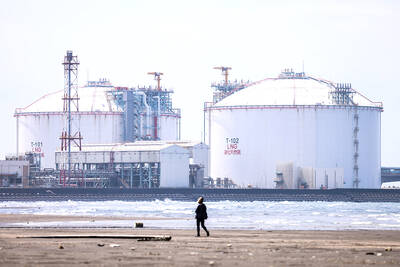
Taiwan is open to joining a global liquefied natural gas (LNG) program if one is created, but on the condition that countries provide delivery even in a scenario where there is a conflict with China, an energy department official said yesterday. While Taiwan’s priority is to have enough LNG at home, the nation is open to exploring potential strategic reserves in other countries such as Japan or South Korea, Energy Administration Deputy Director-General Chen Chung-hsien (陳崇憲) said. While the LNG market does not have a global reserve for emergencies like that of oil, the concept has been raised a few times —
AI-FUELED DEMAND: The company has been benefiting from the skyrocketing prices for DRAM chips amid the AI frenzy, especially its core product — DDR4 DRAM chips DRAM chipmaker Nanya Technology Corp (南亞科技) yesterday reported that its revenue for the first quarter surged 582.91 percent to NT$49.09 billion (US$1.54 billion) from NT$7.19 billion a year earlier, as the supply crunch caused chip price spikes. Last quarter’s figure is the highest on record. On a quarterly basis, revenue jumped 63.14 percent from NT$30.09 billion, the company said. In January, Nanya Technology expected global DRAM supply scarcity to continue through the first half of 2028, thanks to strong demand for artificial intelligence (AI) applications. Market researcher TrendForce Corp (集邦科技) forecast prices of standard DRAM chips would rise between 58 percent and 63


 RSS
RSS