


Revenue at the world’s top 10 IC designers soared 48 percent year-on-year to US$127.41 billion last year, with Taiwan’s Novatek Microelectronics Corp (聯詠科技) posting the fastest growth, TrendForce Corp (集邦科技) data showed.
The revenue growth was mainly driven by surging demand for electronics, which led to a global chip crunch and prompted chipmakers to increase prices, TrendForce said.
Four Taiwanese chip designers made the top 10 list for last year.
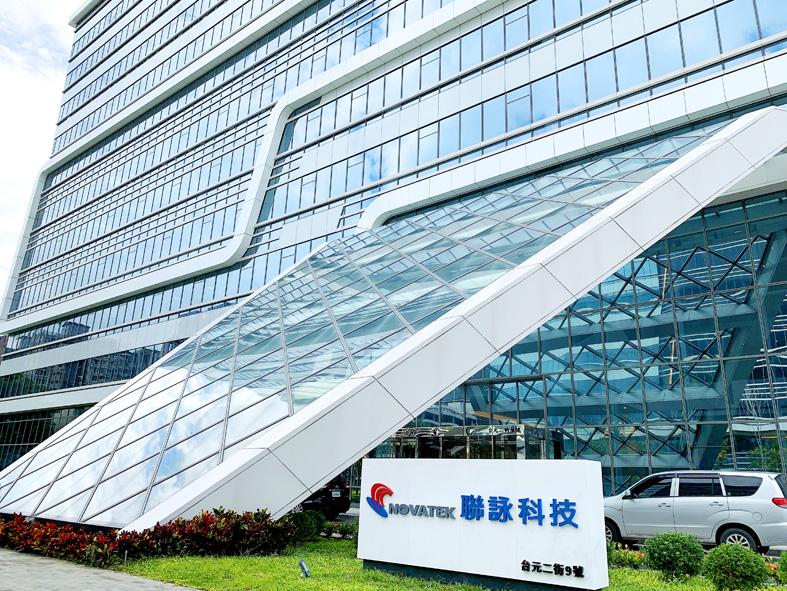
Photo: Grace Hung, Taipei Times
Hsinchu-based Novatek outperformed its global peers with revenue soaring 79 percent annually to US$4.84 billion last year, which helped raise the company’s ranking two notches to No. 6, data showed.
TrendForce attributed Novatek’s strong growth to higher demand and prices for Novatek’s system-on-a-chips (SoC) used in consumer electronics and display driver ICs.
Local networking IC designer Realtek Semiconductor Corp (瑞昱半導體) rose one spot to No. 8 on the list after growing its revenue 43 percent to US$3.77 billion, data showed.
Robust demand for Ethernet switches and Wi-Fi chips fueled Realtek’s revenue growth, TrendForce said.
MediaTek Inc (聯發科), which commands about a 40 percent share of the world’s 5G mobile phone chip market, safeguarded its No. 4 place, with revenue soaring 61 percent to US$17.62 billion.
TrendForce attributed MediaTek’s growth to its offerings of SoC for handsets and higher 5G handset penetration rate. Revenue from the cellphone chips skyrocketed 93 percent annually.
Display driver IC supplier Himax Technologies Inc (奇景光電) elbowed its way into the top 10 list for the first time, aided by strong revenue growth of 74 percent to US$1.55 billion after expanding its business to vehicle displays.
Qualcomm Inc retained its top position with revenue expanding 51 percent to US$29.33 billion, driven primarily by rising demand for mobile phone SoCs and chips used in Internet-of-Things devices, TrendForce said.
Higher demand for the US firm’s radio frequency chips and vehicle chips also helped, it added.
Nvidia Corp climbed one spot to No. 2, as revenue surged 61 percent to US$24.89 billion on demand for graphics processing units used in gaming PCs and data centers, while Broadcom Inc ranked third, as revenue rose 18 percent to US$21.03 billion.

GROWING OWINGS: While Luxembourg and China swapped the top three spots, the US continued to be the largest exposure for Taiwan for the 41st consecutive quarter The US remained the largest debtor nation to Taiwan’s banking sector for the 41st consecutive quarter at the end of September, after local banks’ exposure to the US market rose more than 2 percent from three months earlier, the central bank said. Exposure to the US increased to US$198.896 billion, up US$4.026 billion, or 2.07 percent, from US$194.87 billion in the previous quarter, data released by the central bank showed on Friday. Of the increase, about US$1.4 billion came from banks’ investments in securitized products and interbank loans in the US, while another US$2.6 billion stemmed from trust assets, including mutual funds,
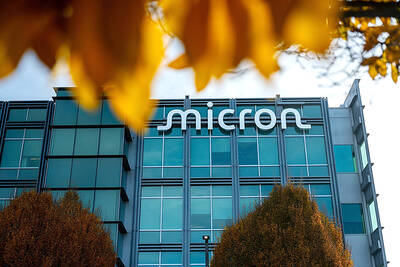
Micron Memory Taiwan Co (台灣美光), a subsidiary of US memorychip maker Micron Technology Inc, has been granted a NT$4.7 billion (US$149.5 million) subsidy under the Ministry of Economic Affairs A+ Corporate Innovation and R&D Enhancement program, the ministry said yesterday. The US memorychip maker’s program aims to back the development of high-performance and high-bandwidth memory chips with a total budget of NT$11.75 billion, the ministry said. Aside from the government funding, Micron is to inject the remaining investment of NT$7.06 billion as the company applied to participate the government’s Global Innovation Partnership Program to deepen technology cooperation, a ministry official told the
Taiwan Semiconductor Manufacturing Co (TSMC, 台積電), the world’s leading advanced chipmaker, officially began volume production of its 2-nanometer chips in the fourth quarter of this year, according to a recent update on the company’s Web site. The low-key announcement confirms that TSMC, the go-to chipmaker for artificial intelligence (AI) hardware providers Nvidia Corp and iPhone maker Apple Inc, met its original roadmap for the next-generation technology. Production is currently centered at Fab 22 in Kaohsiung, utilizing the company’s first-generation nanosheet transistor technology. The new architecture achieves “full-node strides in performance and power consumption,” TSMC said. The company described the 2nm process as

Even as the US is embarked on a bitter rivalry with China over the deployment of artificial intelligence (AI), Chinese technology is quietly making inroads into the US market. Despite considerable geopolitical tensions, Chinese open-source AI models are winning over a growing number of programmers and companies in the US. These are different from the closed generative AI models that have become household names — ChatGPT-maker OpenAI or Google’s Gemini — whose inner workings are fiercely protected. In contrast, “open” models offered by many Chinese rivals, from Alibaba (阿里巴巴) to DeepSeek (深度求索), allow programmers to customize parts of the software to suit their


 RSS
RSS