


The Taiwan Institute of Economic Research (TIER, 台灣經濟研究院) yesterday kept its forecast for Taiwan’s GDP growth this year unchanged at 4.1 percent, but trimmed values for key components due to surging cases worldwide of the Omicron variant of SARS-CoV-2 and escalating geopolitical tensions.
Private consumption would replace exports as the main growth driver, although the spread of COVID-19 has slowed this quarter, the institute said.
“The COVID-19 pandemic continues to pose the biggest downside risk, while inflation and geopolitical conflicts are adding to the uncertainty,” TIER president Chang Chien-yi (張建一) said, citing Russia’s military buildup at Ukraine’s borders.
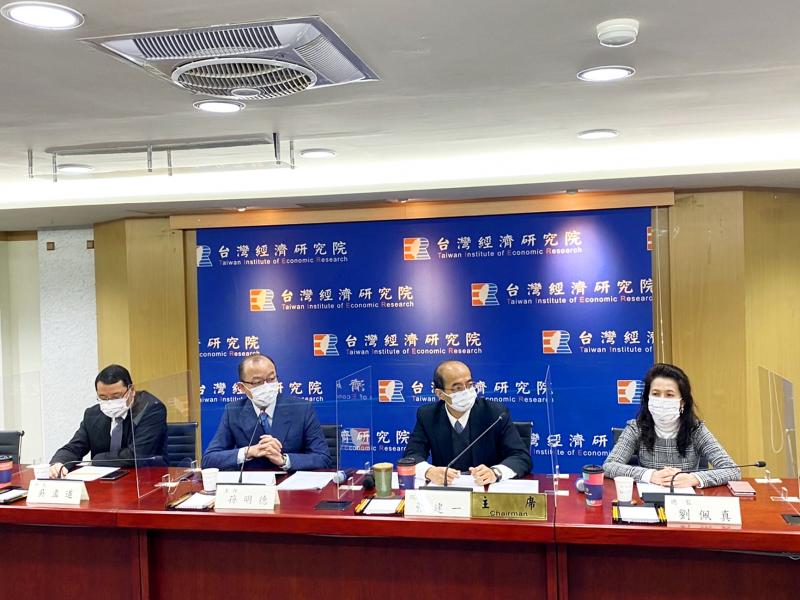
Photo: Allen Wu, Taipei Times
Tensions between Moscow and Kiev have rocked the international oil market, as major world powers warned Russia they would not tolerate an invasion of Ukraine.
Consumer prices climbed 7 percent in the US and 5 percent in the EU last month, but inflation is not expected to become a major threat in Taiwan, where authorities have policy tools to rein it in, Chang said.
The US Federal Reserve is expected make known its latest policy stance after its meeting this week, including the number of rate hikes it is planning this year, he said.
TIER expects consumer prices to rise a mild 1.65 percent this year, moderating from 2 percent growth last year.
Private consumption would expand 4.93 percent, down 0.1 percentage points from its projection in November, to reflect the Omicron headwinds, the institute said.
Tightened social distancing requirements might temporarily derail restaurants, hotels, retailers and recreational facilities from the course of recovery, it said.
Over time, the world — including Taiwan — might choose to coexist with COVID variants, as most Omicron patients appear to display mild or no symptoms, Chang said.
A general pay raise would step up private consumption, aided by a stable economy, he said.
Exports would remain strong, thanks to insatiable demand for new technology products and applications, but the trajectory would not look as steep as last year, he said, adding that major technology firms have offered positive guidance for their business.
Exports are expected to increase 3.75 percent, while imports are forecast to advance 3.42 percent, 0.66 and 0.82 percentage points weaker than previous projections respectively, TIER said.
Supply chain bottlenecks would remain a concern, but not a serious threat, it said, as countries around the world refrain from lockdowns to contain COVID-19 infections.
Private investment, another growth pillar last year, would expand 2.75 percent this year, as very few firms would aggressively increase capital spending year after year, it said.
The central bank is likely to follow the lead of a hawkish Fed by raising its key interest rates in June at the earliest, the institute said.
Wu Meng-tao (吳孟道), director of the institute’s sixth research division, said the time was right for the Fed to tighten monetary policy amid continued economic stability and with unemployment below 4 percent.
More importantly, the Fed would likely start a cycle of rate increases to rein in rising consumer prices, Wu said.
“The local central bank is likely to make its own move by hiking interest rates by 0.125 to 0.25 percentage points in June at the earliest,” he added.
The institute also released a survey which showed that business sentiment in the manufacturing and service sectors improved last month, and that companies across sectors were optimistic about business in the next six months.
The sentiment gauge for manufacturers last month picked up 1.55 points to 103.91, while the measure for service providers rose 0.38 points to 98.59, the survey showed.
The confidence level for property developers and brokers grew 1.88 points to 110.95, it showed, consistent with a market boom.
Additional reporting by CNA

GROWING OWINGS: While Luxembourg and China swapped the top three spots, the US continued to be the largest exposure for Taiwan for the 41st consecutive quarter The US remained the largest debtor nation to Taiwan’s banking sector for the 41st consecutive quarter at the end of September, after local banks’ exposure to the US market rose more than 2 percent from three months earlier, the central bank said. Exposure to the US increased to US$198.896 billion, up US$4.026 billion, or 2.07 percent, from US$194.87 billion in the previous quarter, data released by the central bank showed on Friday. Of the increase, about US$1.4 billion came from banks’ investments in securitized products and interbank loans in the US, while another US$2.6 billion stemmed from trust assets, including mutual funds,

AI TALENT: No financial details were released about the deal, in which top Groq executives, including its CEO, would join Nvidia to help advance the technology Nvidia Corp has agreed to a licensing deal with artificial intelligence (AI) start-up Groq, furthering its investments in companies connected to the AI boom and gaining the right to add a new type of technology to its products. The world’s largest publicly traded company has paid for the right to use Groq’s technology and is to integrate its chip design into future products. Some of the start-up’s executives are leaving to join Nvidia to help with that effort, the companies said. Groq would continue as an independent company with a new chief executive, it said on Wednesday in a post on its Web
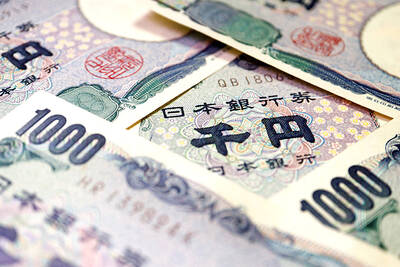
RESPONSE: The Japanese Ministry of Finance might have to intervene in the currency markets should the yen keep weakening toward the 160 level against the US dollar Japan’s chief currency official yesterday sent a warning on recent foreign exchange moves, after the yen weakened against the US dollar following Friday last week’s Bank of Japan (BOJ) decision. “We’re seeing one-directional, sudden moves especially after last week’s monetary policy meeting, so I’m deeply concerned,” Japanese Vice Finance Minister for International Affairs Atsushi Mimura told reporters. “We’d like to take appropriate responses against excessive moves.” The central bank on Friday raised its benchmark interest rate to the highest in 30 years, but Bank of Japan Governor Kazuo Ueda chose to keep his options open rather than bolster the yen,

Even as the US is embarked on a bitter rivalry with China over the deployment of artificial intelligence (AI), Chinese technology is quietly making inroads into the US market. Despite considerable geopolitical tensions, Chinese open-source AI models are winning over a growing number of programmers and companies in the US. These are different from the closed generative AI models that have become household names — ChatGPT-maker OpenAI or Google’s Gemini — whose inner workings are fiercely protected. In contrast, “open” models offered by many Chinese rivals, from Alibaba (阿里巴巴) to DeepSeek (深度求索), allow programmers to customize parts of the software to suit their


 RSS
RSS