


Intel Corp plans to spend US$20 billion on a chipmaking hub on the outskirts of Columbus, Ohio, which the company expects to grow to be the world’s largest manufacturing site for silicon chips, a person familiar with its plans said.
The chipmaker is to begin construction of two fabrication plants on a 405 hectare site in New Albany, which it expects to be operational by 2025, the person said, asking not to be identified before a planned public announcement.
Time magazine reported the plans earlier, citing an interview with Intel CEO Pat Gelsinger, who said that the company, based in Santa Clara, California, would use the location as a hub to research, develop and manufacture its most advanced chips, and would have the option to expand to 809 hectares and up to eight fabs.
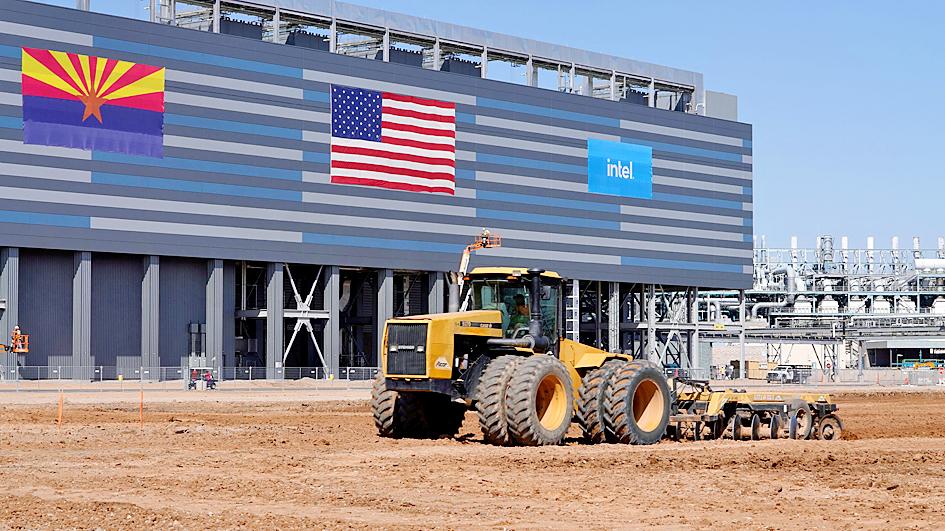
Photo: Reuters
“We helped to establish the Silicon Valley,” Gelsinger told Time. “Now we’re going to do the Silicon Heartland.”
Intel’s leader has been vocal about the need to build more chip factories in the US and Europe, areas where manufacturing of the vital electronic components has declined precipitously.
Gelsinger has argued that a rebalancing of production is needed to reverse its increasing concentration in East Asia. He has pointed to the COVID-19-pandemic-induced supply chain crunch and increasing geopolitical tension between China and the US as evidence that Western governments need to find cash to persuade chipmakers to relocate.
Adding Ohio to its list of locations, not traditionally an area associated with the technology industry, adds to the greater geographical diversity that Gelsinger has championed.
Intel is also looking at sites in Germany, Italy and France for new factories, test and assembly plants, and research and design centers, Bloomberg has reported.
Putting some of Intel’s billions of dollars in capital expenditure to work in a new location for the company — it has plants in Arizona, New Mexico and Oregon — might help bolster Gelsinger’s appeal for taxpayer money.
That in turn would help cushion some of the drag on profitability caused by the company’s ambitious plans to restore Intel’s manufacturing prowess, and muscle in on the business of outsourced chipmaking, an area dominated by Taiwan Semiconductor Manufacturing Co (TSMC, 台積電) and Samsung Electronics Co.
This year Intel’s CEO has budgeted a record amount of spending on new factories and equipment, but, highlighting the massive and growing cost of state-of-the-art chipmaking, TSMC and Samsung are planning to raise the stakes even higher.
TSMC has set aside more than US$40 billion for capital expenditures this year. That compares with Intel’s plan to spend up to US$28 billion.
South Korea’s Samsung would likely announce its plans on Thursday next week in its earnings release. Analysts, on average, predict a companywide budget of about US$36 billion.

SECOND-RATE: Models distilled from US products do not perform the same as the original and undo measures that ensure the systems are neutral, the US’ cable said The US Department of State has ordered a global push to bring attention to what it said are widespread efforts by Chinese companies, including artificial intelligence (AI) start-up DeepSeek (深度求索), to steal intellectual property from US AI labs, according to a diplomatic cable. The cable, dated Friday and sent to diplomatic and consular posts around the world, instructs diplomatic staff to speak to their foreign counterparts about “concerns over adversaries’ extraction and distillation of US AI models.” Distillation is the process of training smaller AI models using output from larger, more expensive ones to lower the costs of training a powerful new
Shares of Taiwan Semiconductor Manufacturing Co (TSMC, 台積電) have repeatedly hit new highs, but an equity analyst said the stock’s valuation remains within a reasonable range and any pullback would likely be technical. The contract chipmaker’s historical price-to-earnings (P/E) ratio has ranged between 20 and 30, Cathay Futures Consultant Co (國泰證期) analyst Tsai Ming-han (蔡明翰) told Central News Agency. With market consensus projecting that TSMC would post earnings per share of about NT$100 (US$3.17) this year, supported by strong global demand for artificial intelligence (AI) applications, and the stock currently trading at a P/E ratio of below 25, Tsai said the valuation
The artificial intelligence (AI) boom has triggered a seismic reshuffling of global equity markets, with Taiwan and South Korea muscling past European nations one by one. With its stock market now valued at nearly US$4.3 trillion, Taiwan surpassed the UK, Europe’s biggest market, earlier this month, data compiled by Bloomberg showed. South Korea is about US$140 billion away from doing the same. The tech-heavy Asian markets have shot past Germany and France in the past seven months. The shift is largely down to massive gains in shares of three companies that provide essential hardware for AI: Taiwan Semiconductor Manufacturing Co (TSMC, 台積電),

The US Department of Commerce last week ordered multiple chip equipment companies to halt shipments of certain tools to China’s second-largest chipmaker, Hua Hong Semiconductor Ltd (華虹半導體), its latest action to slow the country’s development of advanced chips, two people familiar with the matter said. The department sent letters to at least a handful of companies informing them of restrictions on tools and other materials destined for two Hua Hong facilities US officials believe make China’s most sophisticated chips, the people said. Top US chip equipment companies Lam Research Corp, Applied Materials Inc and KLA Corp, each of which has significant


 RSS
RSS