

CHINA
PBOC injects US$13.9bn
The People’s Bank of China (PBOC) yesterday injected short-term cash into the financial system in a sign the authorities are seeking to soothe market nerves frayed by concern over quarter-end funding needs and China Evergrande Group’s (恆大集團) debt crisis. The central bank added 90 billion yuan (US$13.9 billion) of funds on a net basis via seven-day and 14-day reverse repurchase agreements, the most since February. It was the first time this month the authorities added more than 10 billion yuan of short-term liquidity into the banking system in a single day. The funds come as the crisis facing Evergrande fuels concern over the health of the nation’s real-estate and credit markets. Adding to the stress is a seasonal spike in demand for cash as banks become less willing to lend toward quarter-end as they prepare for regulatory checks. Liquidity also tends to diminish at this time of year as the Mid-Autumn Festival approaches.
TECHNOLOGY
S4 Capital to buy Zemoga
Martin Sorrell’s S4 Capital has struck a deal to buy Zemoga, a technology services company that provides a new route for the rapidly growing digital advertising group to win work from multinational clients. Sorrell, the founder of WPP, has turned S4 into a US$6 billion company in the three years since its launch by acquiring businesses to combine data with digital content and serve the likes of Facebook, Google, Burberry and Netflix. The move into tech services is to enable it to better compete with companies like Accenture and Globant, which can sell digital advertising services and advice to clients. Zemoga provides product design, engineering and delivery services to clients such as Bridgestone, Sony, Roku and Morningstar.
SINGAPORE
Fund aims to boost market
Singapore is looking to set up a S$1.5 billion (US$1.1 billion) fund backed by state investment firm Temasek Holdings Pte to bolster its stock market, which has struggled with tepid listings and poor trading volumes. The fund is to invest in high-growth companies and initial public offerings. Separately, the investment arm of the Economic Development Board, a government agency promoting foreign investment, is to invest up to S$500 million into a fund aimed at companies looking to list in two to five years. The plan aims to increase Singapore’s attractiveness as a location for raising capital for local and regional companies, the government said.
STEEL
US Steel to build mini-mill
US Steel Corp is to spend about US$3 billion to build a new mill, the latest sign that steelmakers are growing more comfortable that higher prices will last. The so-called mini-mill is to combine two electric arc furnaces, which primarily use steel scrap and are far more energy-efficient than traditional integrated plants that are fed by coal. The company expects to begin construction in the first half of next year and start producing in 2024. US Steel’s announcement comes as domestic futures prices have more than tripled in the past year. While this has produced a windfall for domestic suppliers, it is driving up the cost of everything from automobiles to wind turbines to kitchen appliances as the world recovers from the COVID-19 pandemic. The company forecast that it would report record earnings for the third quarter on the back of the strong prices, which would allow it to reduce debt.


INFRINGEMENT: The investigation comes after a complaint from Vicor Corp, with the company seeking a limited exclusion order as well as cease-and-desist orders, the ITA said The US International Trade Commission (USITC) has launched a Section 337 investigation naming Taiwanese technology companies, including Hon Hai Precision Industry Co (鴻海), Delta Electronics Inc (台達電) and Quanta Computer Inc (廣達), as respondents. The Ministry of Economic Affairs (MOEA) pledged assistance if needed. The USITC said on Friday in a statement that it had voted to institute an investigation under Section 337 of the US Tariff Act of 1930 into certain vertical power delivery systems, related components and computing devices incorporating such systems. The investigation covers 20 companies from Taiwan, China, Germany and the US, the commission said, adding that it
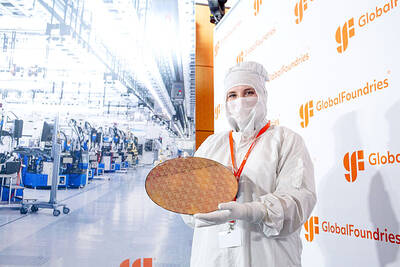
PACKAGING PUSH: The chipmaker said that it would begin ramping up silicon interposer production in New York in the first half of 2028 to support AI systems GlobalFoundries Inc shares gained as much as 7 percent after the chip manufacturer announced a five-year, US$2 billion deal to provide US production capacity to Taiwan Semiconductor Manufacturing Co (TSMC, 台積電). Under the agreement, announced on Thursday, GlobalFoundries is to help supply components known as silicon interposers. The US company is to rely on manufacturing at its facility in Malta, New York, and said it has the option to expand capacity “as customer demand grows.” An interposer is a small layer of silicon that sits between a chip and its packaging. It is home to the wires that carry electronic signals and
A man charged along with Super Micro Computer Inc co-founder Yih-Shyan “Wally” Liaw (廖益賢) of conspiring to send cutting-edge chips to China in violation of US export controls pleaded guilty, court documents said. Ting-Wei “Willy” Sun (孫廷瑋), a former outside contractor described by US authorities as a “fixer” who allegedly aided in the sales, pleaded guilty on Thursday at a hearing in federal court in New York as part of an agreement with prosecutors, court filings showed. Prosecutors claimed the men were part of a scheme to send Nvidia Corp-powered servers to an unnamed Southeast Asian company and then divert them to
SECOND-TOP MONTH: September revenue was 0.6 percent lower month-on-month, but despite the drop, it was the firm’s highest-ever sales report for the month Taiwan Semiconductor Manufacturing Co (TSMC, 台積電) yesterday reported record quarterly revenue for last quarter, after sales last month hit the second-highest monthly level in the company’s history. Revenue in the quarter ended last month was NT$1.49 trillion (US$46.75 billion), up 17 percent from NT$1.27 trillion in the second quarter and exceeding the combined prediction of 19 LSEG SmartEstimate analysts of NT$1.46 trillion. Last quarter’s figure — which was up 12 percent from the midpoint of last year — also surpassed the company’s July estimates of US$44.6 billion to US$45.8 billion amid surging demand for the ramp-up of its advanced 2-nanometer technology, artificial


 RSS
RSS