


Gudeng Precision Industrial Co (家登), which supplies wafer pods to the world’s major semiconductor firms, yesterday said it is in no rush to set up production in the US due to high costs.
The company supplies its customers through a warehouse in Arizona jointly operated by TSS Holdings Ltd (德鑫控股), a joint holding of Gudeng and 17 Taiwanese firms in the semiconductor supply chain, including specialty plastic compounds producer Nytex Composites Co (耐特) and automated material handling system supplier Symtek Automation Asia Co (迅得).
While the company has long been exploring the feasibility of setting up production in the US to address its major customer’s capacity expansion there, “it is premature to set up a factory there now because the production costs are too high,” Gudeng chairman Bill Chiu (邱銘乾) said on the sidelines of a National Innovation and Entrepreneurship Association of the Republic of China event in Taipei.

Photo: Lisa Wang, Taipei Times
“We are hoping for more incentives from customers or related parties” to absorb some of the cost burden, Chiu said.
Commenting on media reports about the US government’s plan to create a science park in Arizona, duplicating Taiwan’s semiconductor hub, Hsinchu Science Park (新竹科學園區), Chiu said the US is “unlikely” to replicate such a science park, as the its strict immigration policies hinder talent acquisition.
Creating such a park requires building a whole semiconductor supply ecosystem rather than merely attracting chipmakers to set up fabrication plants, Chiu said.
There is also a massive culture gap between American and Taiwanese engineers in the workplace, he added.
Gudeng is a key supplier of extreme ultraviolet pods to Taiwan Semiconductor Manufacturing Co (TSMC, 台積電), which it uses in the production of cutting-edge 2 and 3-nanometer chips. It also supplies advanced front-opening unified pods and wafer cassettes to TSMC and Intel Corp, as well as Chinese and South Korean chipmakers.
The company also supplies front-opening-shipping boxes used in the chip packaging process on advanced chip-on-wafer-on-substrate (CoWoS) technology. More than half of TSMC’s CoWoS capacity is utilized in the process of making artificial intelligence (AI) chips for Nvidia Corp.
Gudeng expects the CoWoS technology to be the new growth engine for Taiwanese semiconductor companies over the next five to 10 years, as scaling semiconductor technology faces physical barriers, Chiu said.
The company is also not concerned about an AI bubble bursting over the next three to five years, as long as consumers continue using AI models such as ChatGPT, he said.
Gudeng yesterday reported cumulative revenue of NT$6.47 billion (US$207.32 million) in the first 11 months of this year, up 8.57 percent year-on-year.
The company said its factories are running at full capactiy and it expects growth momentum to extend into next year.
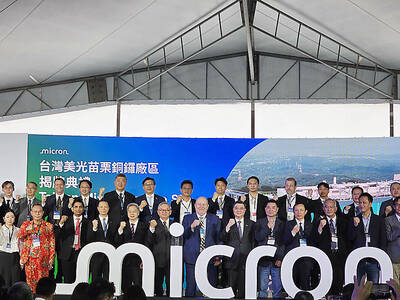
UNPRECEDENTED PACE: Micron Technology has announced plans to expand manufacturing capabilities with the acquisition of a new chip plant in Miaoli Micron Technology Inc unveiled a newly acquired chip plant in Miaoli County yesterday, as the company expands capacity to meet growing demand for advanced DRAM chips, including high-bandwidth memory chips amid the artificial intelligence boom. The plant in Miaoli County’s Tongluo Township (銅鑼), which Micron acquired from Powerchip Semiconductor Manufacturing Corp (力積電) for US$1.8 billion, is expected to make a sizeable capacity contribution to the company from fiscal 2028, the company said in a statement. It would be an extended production site of Micron’s large-scale manufacturing hub in Taichung, the company said. As the global semiconductor industry is racing to reach US$1 trillion

Singapore-based ride-hailing and delivery giant Grab Holdings Ltd has applied for regulatory approval to acquire the Taiwan operations of Germany-based Delivery Hero SE's Foodpanda in a deal valued at about US$600 million. Grab submitted the filing to the Fair Trade Commission on Friday last week, with the transaction subject to regulatory review and approval, the company said in a statement yesterday. Its independent governance structure would help foster a healthy and competitive market in Taiwan if the deal is approved, Grab said. Grab, which is listed on the NASDAQ, said in the filing that US-based Uber Technologies Inc holds about 13 percent of

Taiwan’s food delivery market could undergo a major shift if Singapore-based Grab Holdings Ltd completes its planned acquisition of Delivery Hero SE’s Foodpanda business in Taiwan, industry experts said. Grab on Monday last week announced it would acquire Foodpanda’s Taiwan operations for US$600 million. The deal is expected to be finalized in the second half of this year, with Grab aiming to complete user migration to its platform by the first half of next year. A duopoly between Uber Eats and Foodpanda dominates Taiwan’s delivery market, a structure that has remained intact since the Fair Trade Commission (FTC) blocked Uber Technologies Inc’s

Memory chip stocks extended their losses yesterday after Alphabet Inc’s Google publicized research that could allow more efficient use of the storage needed for artificial intelligence (AI) development. SK Hynix Inc and Samsung Electronics Co, South Korean leaders in the market, fell more than 6 percent and about 5 percent respectively in Seoul. In the US, Micron Technology Inc, Western Digital Corp and Sandisk Corp slid more than 2 percent in pre-market trading, after they all closed lower on Wednesday. Memory companies have been on a tear in recent months as the rapid development of AI infrastructure triggered a spike in chip


 RSS
RSS