


Wall Street rallied on Friday, pushing the S&P 500and the NASDAQ to record closing highs for the fourth time this week, as US Federal Reserve Chairman Jerome Powell’s remarks at the Jackson Hole Symposium calmed fears over a tapering timetable and sent investors into the weekend in a buying mood.
“I see two things happening,” said Mike Zigmont, head of research and trading at Harvest Volatility Management in New York. “I see a reflexive dip-buying validation and I see the market embracing a dovish Fed.”
Regarding the indices’ recent string of all-time highs, including the S&P 500’s 52nd record high close so far this year, Zigmont said: “The march north has been very consistent. The drawdowns are super shallow, and the recoveries are very fast.”
In his prepared remarks, Powell stopped short of providing a clearer picture regarding the timing of the central bank’s tapering of asset purchases or hiking interest rates, the key elements of its dovish monetary policy aimed at helping the US economy recover from the recession caused by the COVID-19 pandemic.
Indeed, Powell appeared to strike a more dovish tone than other US Federal Open Market Committee officials, including St Louis Fed President James Bullard and Cleveland Fed President Loretta Mester, who said earlier in the day that they expect the tapering process to begin soon and wind down next year.
“The market is very happy that the Fed is pumping more liquidity into the economy every month,” Zigmont said. “The Fed is enabling asset prices to climb, and the market is pleased with that.”
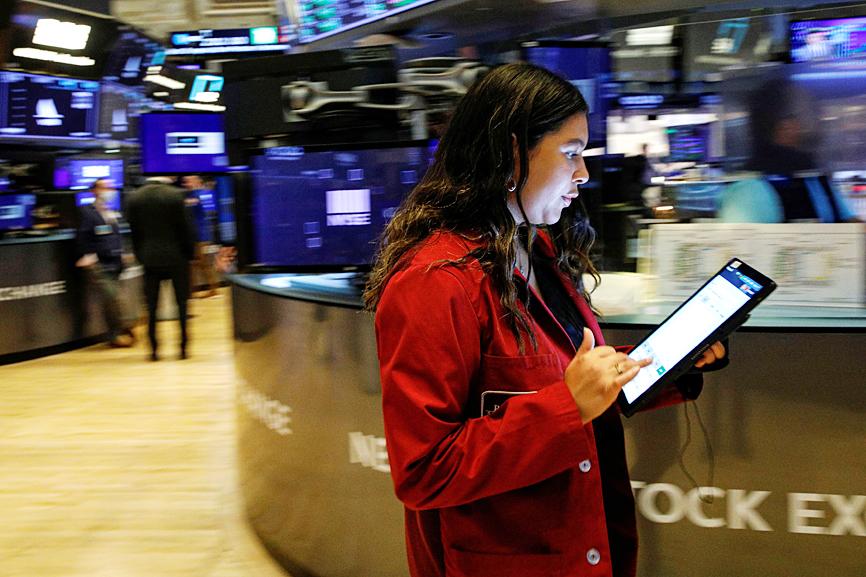
Photo: Reuters
Economic data released on Friday delivered, in large part, precisely what economists expected — a pullback in consumer spending and sentiment due to the Delta variant of SARS-CoV-2, and signs that the current wave of price spikes would not morph into long-term inflation, in line with Fed assurances.
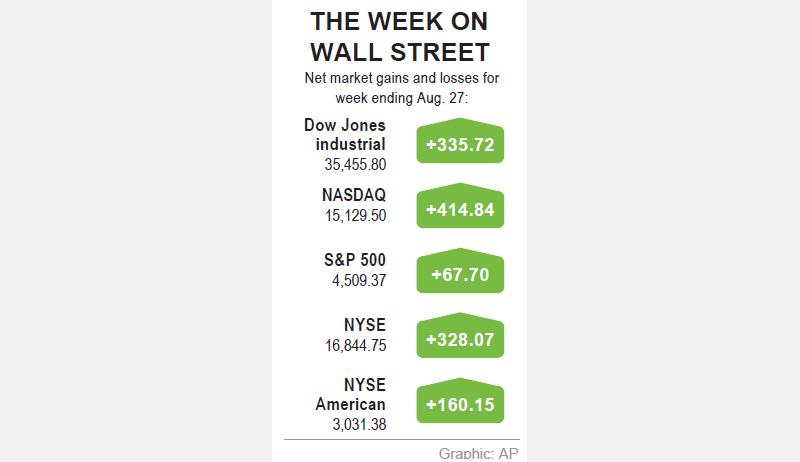
The Dow Jones Industrial Average rose 242.68 points, or 0.69 percent, to 35,455.8, the S&P 500 gained 39.37 points, or 0.88 percent, to 4,509.37 and the NASDAQ Composite added 183.69 points, or 1.23 percent, to 15,129.50.
For the week, the Dow grew 0.96 percent, the S&P 500 increased 1.52 percent and the NASDAQ rose 2.82 percent.
Ten of the 11 major sectors of the S&P 500 advanced, with energy shares enjoying the largest percentage gain.
Chipmaker Nvidia Corp’s shares rose 2.6 percent after sources said it would likely seek antitrust approval from the EU to take over British chip designer Arm Ltd.
Workday Inc jumped 9.1 percent as brokerages upped their price targets after the company beat second-quarter revenue estimates.
Stay-at-home darling Peloton Interactive Inc slid 8.5 percent following its profit warning and its announcement it was being probed by US regulators over an accident involving the safety of its treadmills.
Beijing continued its crackdown on its tech companies, threatening to curb their ability to list on US exchanges.
US-listed shares of Alibaba Group Holding Ltd (阿里巴巴) and Tencent Music Entertainment Group (騰訊音樂娛樂集團) fell 3.5 percent and 1.4 percent, respectively.
Advancing issues outnumbered declining ones on the NYSE by a 5.21-to-1 ratio; on the NASDAQ, a 3.40-to-1 ratio favored advancers.
The S&P 500 posted 60 new 52-week highs and one new low; the NASDAQ Composite recorded 132 new highs and 37 new lows.
Volume on US exchanges was 8.67 billion shares, compared with the 8.95 billion average over the past 20 trading days.

The Fair Trade Commission’s (FTC) ongoing review of Grab Holdings Ltd’s US$600 million acquisition of Foodpanda Taiwan’s operations, announced on March 23, has taken on fresh urgency as industry experts warn that the transaction could embed significant Chinese cybersecurity vulnerabilities into Taiwan’s digital infrastructure through Grab’s deep ties to autonomous-driving firm WeRide (文遠知行). Less than 16 months after the FTC blocked Uber Eats’ direct attempt to acquire Foodpanda Taiwan — citing potential combined market shares of 80 to 90 percent — the emergence of Grab as the buyer has prompted questions about whether the same competitive harm is simply being rerouted
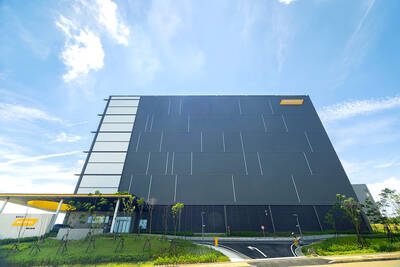
POWER BUILDUP: Powered by Nvidia’s B200 Blackwell chips, the data center would support MediaTek’s computing power demand and business growth, the company said Smartphone chip designer MediaTek Inc (聯發科) yesterday launched a new artificial intelligence (AI) data center with a maximum capacity of 45 megawatts to meet its rising demand for computing power required to develop new advanced chips for AI applications. The company has completed the first-phase computing power buildup at the data center in Miaoli County’s Tongluo Township (銅鑼), providing 15 megawatts of capacity to support its research and development (R&D) capabilities, despite an industrywide shortage of key components, MediaTek said. Supply constraints have plagued a wide range of key components, including memory chips, solid-state drives, power supply units and central
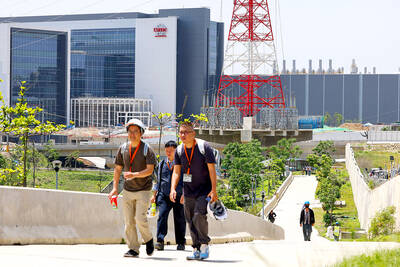
IMAGE SENSORS: The Japanese company would be the controlling shareholder of the venture, with development and production lines to be set up in Kumamoto Taiwan Semiconductor Manufacturing Co (TSMC, 台積電) yesterday said it has signed a non-binding memorandum of understanding (MOU) with Sony Semiconductor Solutions Corp to create a joint venture to develop and produce next-generation images sensors. The partnership seeks to explore and address emerging opportunities in physical artificial intelligence (AI) applications, such as automotive and robotics, paving the way for innovations and expanded technological advancements, TSMC said in a statement. Sony would be the majority and controlling shareholder of the joint venture, the statement said, adding that the company would set up development and production lines in its newly constructed fab in Kumamoto Prefecture’s
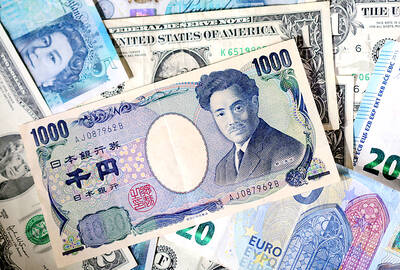
The nation’s foreign exchange reserves climbed back above US$600 billion at the end of last month, as investment gains, currency valuation effects and renewed foreign inflows offset volatility seen earlier in the month, the central bank said yesterday. Reserves stood at US$602.49 billion, up US$5.6 billion from the previous month, the central bank said. The rebound reflected returns on reserve assets, fluctuations in major currencies against the US dollar and the central bank’s market operations aimed at maintaining orderly trading conditions, Department of Foreign Exchange Director-General Eugene Tsai (蔡炯民) said. Financial markets were volatile early last month, with foreign investors recording net purchases


 RSS
RSS