


The legislature yesterday passed a supplementary budget bill to fund the purchase of separate packages of US military equipment, with the combined amount of spending capped at NT$780 billion (US$24.8 billion).
The Chinese Nationalist Party (KMT) and Taiwan People’s Party (TPP) used their legislative majority to pass the bill, which runs until 2033 and has two main funding provisions.
One was for NT$300 billion of arms sales already approved by the US for Taiwan on Dec. 17 last year, the other was for NT$480 billion for another arms package expected to be announced by Washington.
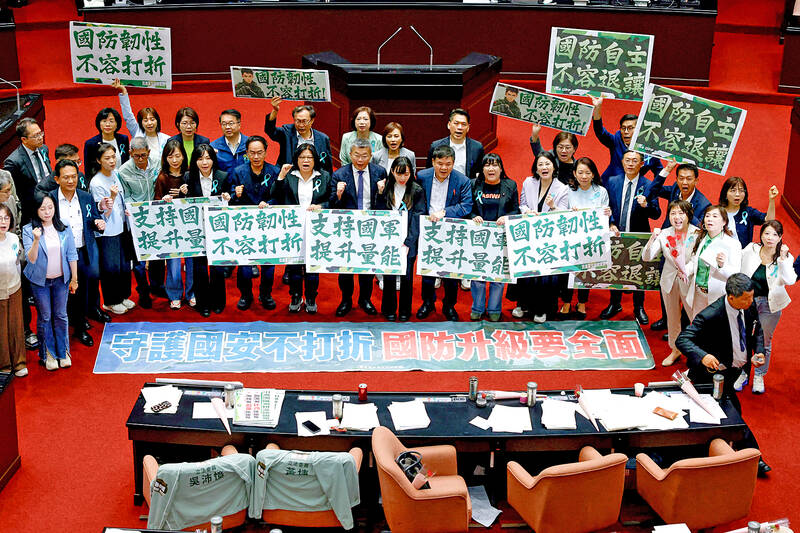
Photo: Ann Wang, Reuters
The bill, which fell short of the NT$1.25 trillion requested by the government, passed by a 59-0 margin with 48 abstentions in the 113-seat legislature.
Legislative approval for disbursing the funding for both provisions is contingent on a legislative review after Taiwan receives letters of offer and acceptance from the US for specific weapons systems.
Under the bill, the funding stipulated in both provisions would be allocated through annual drawdowns, with budgets and implementation schedules for each year being subject to the approval of the legislature.
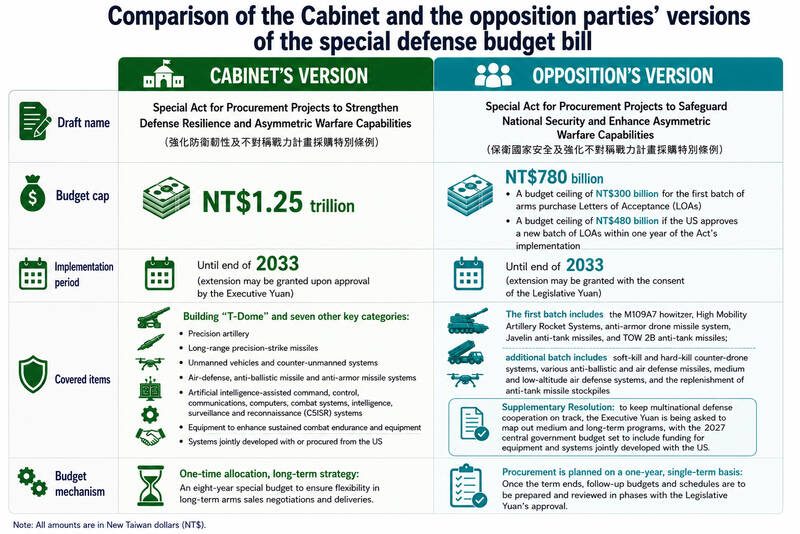
Sources: Executive Yuan and Legislative Yuan
The package of weapons already approved by the US includes High Mobility Artillery Rocket Systems, M109A7 self-propelled howitzers, TOW 2B missiles, Altius-700M and 600 drones, and Javelin anti-armor missiles.
The bill did not specify the items that Taiwan further anticipates acquiring from Washington, but it did delineate broad categories into which the weapons should fall.
They include “soft and hard-kill integrated counterdrone systems,” medium and low-altitude air defense systems, anti-ballistic and air defense missiles, and a replenishment program for wartime stockpiles of anti-armor missiles.
The Executive Yuan is required to report to the Legislative Yuan within a month of the law's passage on military spending over the past five years, detailing costs, effectiveness, deliveries, and how the purchases boost joint operations. Only with the legislature's approval can the budget move forward, and the first batch of special budget proposals must be submitted for review within two months.
KMT Chairwoman Cheng Li-wun (鄭麗文) told a post-vote news conference that the KMT-TPP alliance has protected the constitutional principles governing the legislature’s control over budgets.
She denied the characterization of the opposition’s act as capping arms procurement, saying that the provision “only preserved the legislature’s freedom of action to process US arms sales.”
TPP Chairman Huang Kuo-chang (黃國昌) said that his party firmly supports Taiwan’s self-defense, but has been on guard against government waste and corruption since reading about the US arms sale in the Wall Street Journal in December last year.
Both parties believe in protecting taxpayer money, and have reached a consensus through dialogue and discussion, he said.
KMT member Jaw Shaw-kong (趙少康), who was the party’s vice presidential nominee in 2024, on social media said that Cheng mobilized the party to push for more drastic cuts and repeatedly attacked Jaw by proxy, just for the outcome to be nearly identical to the NT$800 billion he proposed.
“If this is the outcome, what was all that for?” he asked.
The KMT’s strategy of reviewing each item of arms sales is almost calculated to fit the DPP narrative that the party and its allies are pro-China and anti-US, he said.
“How are you even going to compete in the county and city elections with this? Can you find a dumber political party than this in the world?” Jaw asked.
Democratic Progressive Party Legislator Chen Kuan-ting (陳冠廷) accused KMT leaders of “trying to disarm Taiwan” by excluding domestic procurement from the budget.
“If we restrict ourselves only to US arms purchases, then if one day Taiwan is encircled, Taiwan is blockaded, how are we going to maintain our supply of ammunition and how are we going to sustain our combat capacity?” Chen said.
Additional reporting by Lo Kuo-chia and AFP

A signaling system malfunction disrupted high-speed rail (HSR) services beginning at 8am today, with trains temporarily reduced to three northbound and three southbound trains per hour as authorities conduct inspections. The malfunction occurred on a section of track in Miaoli County during pre-operation checks early this morning, forcing northbound and southbound trains to use a single track, the HSR operator said. The regular schedule has been replaced with three hourly trains offering only nonreserved seating in each direction, stopping at every station, it said, adding that business class cars would still have reserved seating. Departures from terminal stations are scheduled at the top

Taiwan is still in the process of assessing the possibility of recruiting workers from Eswatini, the Ministry of Foreign Affairs said yesterday, adding that its goal is to help Eswatini upgrade its vocational training centers. If there are plans to recruit workers from Eswatini, safeguarding national security, protecting public health and ensuring the employment rights of Taiwanese would be prerequisites, Department of West Asian and African Affairs Director-General Yen Chia-liang (顏嘉良) told a news conference. Key considerations would also include filling labor shortages in specific industries, and fostering bilateral professional and technical exchanges, he said. Yen was asked about the progress of labor

VERBOSE VESSELS: A CGA cutter and a China Coast Guard exchanged verbal barbs for more than a day in Taiwanese-controlled waters before the Chinese vessel left The Taiwanese and Chinese coast guards had a standoff near the strategically located Pratas Islands (Dongsha Islands, 東沙群島) in the north of the South China Sea, the Coast Guard Administration (CGA) said yesterday. The two sides engaged in intense radio exchanges over sovereignty claims during the 33-hour standoff. China Coast Guard vessel 3501 eventually left the restricted waters, 26.6 nautical miles (49.2km) west of the Pratas Islands, at 5pm yesterday, the CGA said. Lying approximately between southern Taiwan and Hong Kong, the Taiwan-controlled Pratas are seen by some security experts as vulnerable to Chinese attack due to their distance — more than
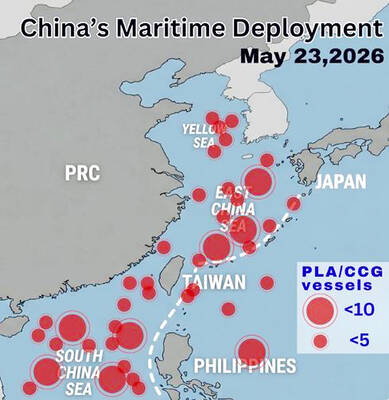
WARNING: China should stop engaging in actions that undermine regional peace and stability, as it would only build resentment among people across the Strait, the CGA said China has deployed more than 100 navy, coast guard and other vessels in waters from the Yellow Sea to the South China Sea and the western Pacific since US President Donald Trump and Chinese President Xi Jinping (習近平) met in Beijing, National Security Council Secretary-General Joseph Wu (吳釗燮) said yesterday. “In this part of the world, #China is the one & only PROBLEM wrecking the #StatusQuo & threatening regional peace & stability,” Wu wrote on X. In a separate post, he said Beijing was coercing Taiwan’s maritime domain, calling it illegal and provocative, after the Coast Guard Administration (CGA) expelled a


 RSS
RSS