


The Ministry of Transportation and Communications yesterday pledged to submit a report on ways to harden the communication security of railway systems after a university student hacked into Taiwan High Speed Rail Corp’s (THSRC) radio communications system and disrupted operations of four high-speed rail trains last month.
Investigation by the police and prosecutors found that the university student and radio enthusiast, surnamed Lin (林), first used a software-defined radio (SDR) filter to analyze THSRC signals, downloaded the data to a computer, cracked the parameters and then programmed the codes into his radio devices.
Lin then sent a general alarm signal to THSRC’s control center in Taoyuan from his residence in Taichung at 11:23pm on April 5, causing the center to alert four operating trains to temporarily halt services in accordance with procedure. Operations resumed at 11:43pm that evening.
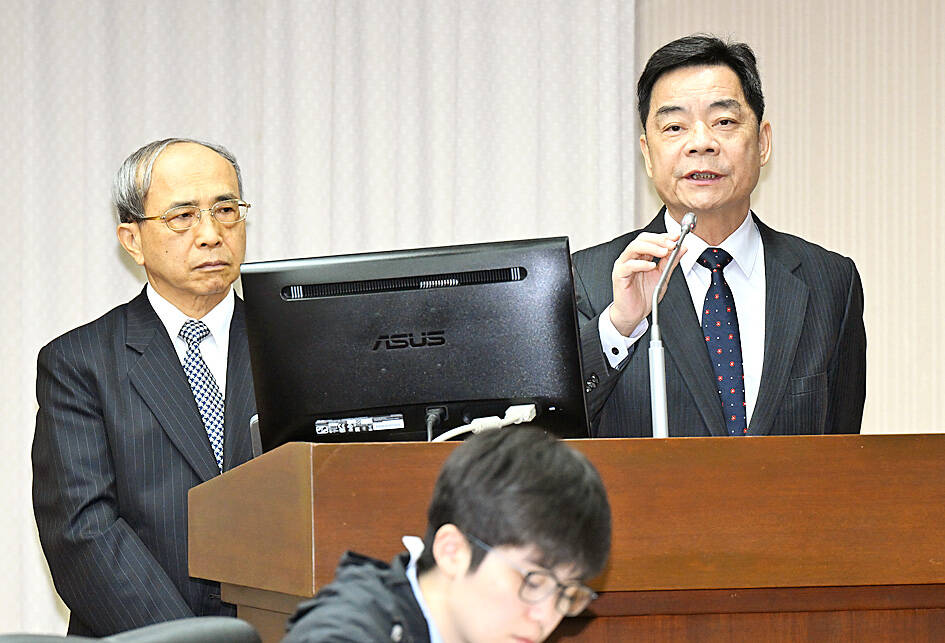
Photo: Liao Chen-huei, Taipei Times
The four trains were delayed for 48 minutes due to the incident, prompting the company to file a lawsuit against Lin on April 24.
Aside from an SDR filter, police seized 11 professional two-way radios from Lin’s residence. They found that he could access radio frequencies of the high-speed rail system, New Taipei City Fire Department and Taoyuan International Airport MRT Line.
Democratic Progressive Party Legislator Ho Shin-chun (何欣純) said in a meeting at the legislature’s Transportation Committee yesterday that Lin managed to gain access to THSRC’s radio communication by cracking seven layers of verification mechanisms and transmit a false alarm, causing four trains to temporarily halt.
“If a college student could hack into a system as sophisticated as that of the high-speed rail system, what would happen if the same thing happened with the Taiwan Railway Corp’s system?” Ho asked.
She asked whether the ministry conducted a comprehensive safety review of railway systems following the incident, including reviewing replacement cycles and maintenance procedures of radios used for railway operations and whether they regularly updated security protocols against unauthorized access.
She asked if the Taiwan Transportation Safety Board was notified about the incident.
The board said it was not notified.
Deputy Minister of Transportation and Communications Wu Sheng-yuan (伍勝園) said the Railway Bureau confirmed it received the report on the night of April 5 and that notifications to the board are subject to specific criteria before being made.
The ministry would later discuss with the board whether these types of incidents should be included in the mandatory reporting scope, he added.
Wu said that THSRC and Taiwan Railway Corp have begun reviewing the security of the radio communication system, while the Railway Bureau would instruct metro operators to conduct the same task.
He added that a report would be submitted following a one-month review of the case.

FUKUOKA SITUATION: Japanese media reported that the pathogen is expected to be identified by the summer, while the CDC downplayed the idea that it was hMPV A “mysterious cold-like illness” reported in Japan’s Fukuoka Prefecture does not seem to be a new disease, but Japanese authorities have been asked about the situation, the Centers for Disease Control (CDC) said yesterday. The Fukuoka Prefectural Medical Association on Wednesday told a news conference that a “mystery cold” that has become a hot topic on social media is “highly likely to be caused by some kind of viral infection,” Japan’s KBC News reported. “Many people are experiencing symptoms starting with a sore throat, followed by a runny nose, phlegm and a severe cough,” KBC News reported, citing association officials. Health authorities are

Nvidia Corp CEO Jensen Huang (黃仁勳) arrived in Taiwan yesterday ahead of upcoming AI and technology events, saying he plans to meet with clients and Taiwan Semiconductor Manufacturing Co Chairman C.C. Wei (魏哲家) during his visit. After landing at Taipei Songshan Airport, Huang posed for photos with fans and handed out Yakult drinks to reporters and supporters waiting at the scene, saying he has “a lot to do” during the trip. Asked about reports that Nvidia’s planned headquarters site in Taipei’s Beitou Shilin Technology Park could break ground on May 27, Huang said that if the company holds an event, he would

Carrefour Taiwan is to begin using a new name from the start of July, but it cannot divulge the name until then, the chairman of the supermarket chain's parent company said today. President Chain Store Co chairman Lo Chih-hsien (羅智先) was asked by reporters after a shareholders' meeting to confirm whether the company has settled on a new name for the supermarket brand. In March, the government-registered name of two Carrefour Taiwan branches was quietly changed to "Le Chia Kang" (樂家康) in Chinese, raising speculation that has been selected as the name. Lo said that because of local regulations and contractual obligations, the

The Philippines would likely be involved in any conflict over Taiwan due to its proximity to the democracy claimed by China, President Ferdinand Marcos Jr said, reiterating a stance that risks angering Beijing. “In the Philippines, we do not have a choice because Taiwan is so close to the Philippines and we have almost 200,000 Filipino nationals living and working in Taiwan,” Marcos said in an interview with Japanese media in Manila on Monday. The Philippine leader’s comments come ahead of a state visit to Japan next week, where he is to meet with Japanese Prime Minister Sanae Takaichi to discuss security


 RSS
RSS