


Imagine being able to control a robotic arm from a distance, using only your mind. Now imagine being able to feel when its fingers grasp an object, as though it were your own hand.
US researchers on Thursday published a study in the journal Science about the world’s first brain-computer interface that allowed a volunteer with paralysis from the chest down to accomplish the feat.
The team say their work demonstrates that adding a sense of touch drastically improves the functionality of prosthetics for quadriplegics, as opposed to having them rely on visual cues alone.
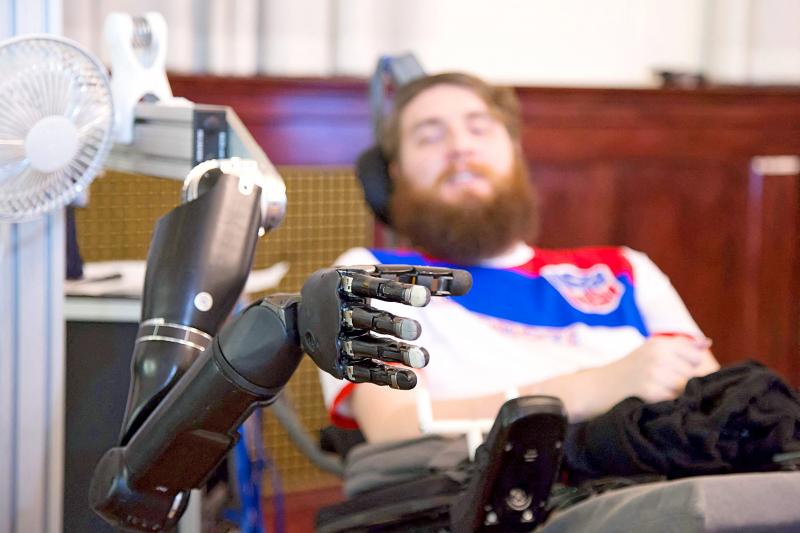
Photo: AFP / UPMC / Pitt Health Sciences / Handout
“I am the first human in the world to have implants in the sensory cortex that they can use to stimulate my brain directly, and then I feel as if a sensation is coming from my actual hand,” 34-year-old Nathan Copeland said.
In 2004, Copeland was in a car accident that left him with a serious spinal cord injury and without the use of his hands or his legs.
He volunteered to participate in scientific research, and six years ago underwent a major operation to have tiny electrodes implanted into his brain.
Two sets of 88 electrodes the width of a strand of hair are arranged into “arrays” that resemble tiny hairbrushes and penetrate deep into the brain’s motor cortex, which directs movement.
Fewer than 30 people in the world have these kinds of implants, said Rob Gaunt, the study’s colead author and an assistant professor at the University of Pittsburgh’s Department of Physical Medicine and Rehabilitation.
What is unique about Copeland is an additional set of electrodes that are connected to his somatosensory cortex, which receives and processes sensations.
“When we’re grabbing objects, we use this sense of touch very naturally to improve our ability to control,” Gaunt said.
The team developed an interface that is “bidirectional” — meaning not only that it can “read” instructions from the brain and send them to the artificial limb, it can also “write” sensations from the device and transmit them back.
The idea of sending tactile feedback to the somatosensory cortex goes back decades, but doing so in a way that is controlled and is understandable by the circuitry of the brain was a challenge.
After operating on Copeland to install the electrodes, the team held their breath.
“No one knew what to expect because this had only been done in monkeys, and you can’t ask a monkey what something feels like,” Copeland said.
Then came the moment of truth, when they tried sending their first touch signal.
“It was really faint,” he said.
He asked them to try again, to be sure it was real.
“Oh yeah, that’s what that feels like, and it was just super cool,” he said.
Before the interface could be put to work with the robotic arm, the scientists had to do a series of tests with Copeland.
First, they needed to learn which electrodes caused what sensation when activated, and which fingers they were associated with, to set up the robotic hand correctly. They also made him watch videos of the robotic arm moving left or right and recorded the electrodes that lit up when he was asked to “think” it was him controlling it.
Finally it was time to try it out. Copeland sat next to the metallic black robotic arm and was asked to pick up a series of small objects such as rocks and spheres, and place them on a box — with either the tactile sensors switched on, or off.
He was able to complete each task on average twice as fast when the sensors were enabled, and was even able to achieve more complex tasks such as picking up a glass and pouring its contents into another.
“The sensation gave me that assurance and confidence to know that I definitely had a good grab on the object and I could lift it up,” Copeland said.
The team wants to refine the prosthetics because “we don’t want to just do science experiments in the lab, we want to actually build devices that are useful to people in their homes,” Gaunt said.
Copeland got his brain-computer interface set up at home when COVID-19 shut down the university, and has used his downtime to learn how to draw on a tablet and even play video games.
He does this by using his mind to send signals directly to the computer, rather than using the arm to push buttons.
“It is just second nature to me now,” he said.
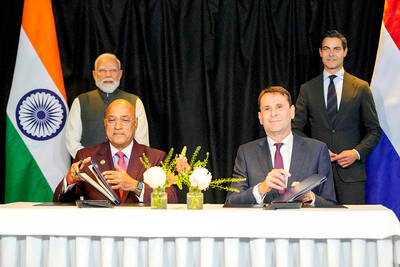
NEW MARKET: The partnership opens up India to the Dutch company, which already has a strong hold in the semiconductor market of South Korea, Taiwan and China ASML Holding NV entered into a partnership agreement with Tata Electronics Pvt Ltd aimed at ramping up India’s goal to develop domestic chip-manufacturing capabilities. The Dutch company’s technology would help power Tata Electronics’ planned 300 millimeter (mm) semiconductor foundry in Gujarat, according to a joint statement from the two companies on Saturday. The signing of a memorandum of understanding coincides with a visit by Indian Prime Minister Narendra Modi to the Netherlands, which is looking to deepen bilateral relations with New Delhi. ASML, whose top customers include Taiwan Semiconductor Manufacturing Co (台積電) and Samsung Electronics Co, makes lithography machines that can print

TECH RELIANCE: Growth is increasingly reflecting an unequal K-shaped distribution, where technology sectors outperform and other industries struggle, an expert said Standard Chartered Bank has significantly raised its forecast for Taiwan’s economic growth to 9.5 percent this year, up from 7.6 percent previously, citing surging artificial intelligence (AI) demand driving exports, semiconductor production and investment. The upgrade reflects a sustained AI supercycle that continues to fuel demand for advanced chips and technology infrastructure, which form the backbone of Taiwan’s exports, the bank said in a report this week. “We raise our 2026 growth forecast to reflect a much stronger-than-expected first-quarter GDP figure,” Standard Chartered senior economist for greater China and Asia Tommy Wu (胡東安) said in the report. Driven largely by a 35.3 percent
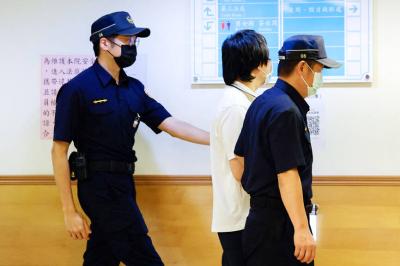
Tokyo Electron's Taiwan unit today said in a written response that it respects the judicial process, takes the court ruling seriously and would not appeal in the Taiwan Semiconductor Manufacturing Co (TSMC, 台積電) trade secrets case. Last month, a court fined the Taiwan unit of Japan's Tokyo Electron NT$150 million (US$4.74 million) in a case involving trade secrets related to TSMC's sensitive chip technology.

Two of Taiwan’s international carriers, Starlux Airlines Co (星宇航空) and EVA Airways Corp (長榮航空), have retained the five-star airline rating awarded by international airline review organization Skytrax. Starlux was awarded the distinction for a second consecutive year, while EVA Air received it for the 11th straight year, Skytrax said in statements released yesterday and on Thursday last week, respectively. The five-star rating is considered one of the airline industry's highest honors and is awarded following professional audits of airline product and frontline service standards, Skytrax said. The ratings are based on in-depth assessments using unified global quality standards rather than customer review scores


 RSS
RSS