


The Financial Supervisory Commission (FSC) on Thursday said it would tighten regulations on property insurance companies and require them to adjust their policy premiums at least every five years.
The measure aims to prevent insurers from engaging in price wars or setting unreasonably high rates, the commission said.
The amendment to the Regulations Governing Pre-sale Procedures for Insurance Products (保險商品銷售前程序作業準則) would take effect in two months, Insurance Bureau Deputy Director-General Wang Li-hui (王麗惠) told a news conference in Taipei.
Currently, property insurance companies are required to review their insurance products at least every six months and adapt their premiums based on their loss ratio or expense loading ratio, but they are not required to adjust them routinely, Wang said.
The loss ratio is the losses an insurer incurs due to claims as a percentage of premiums earned, while the expense ratio is the ratio of the administrative and maintenance expenses compared with the premiums.
A high loss ratio or expense ratio indicates financial distress, while low ratios suggest that insurance products are overpriced.
While insurers are subject to FSC regulation when independently calculating their rates, some tend to be conservative about raising their premiums even though their loss ratio or expense ratio is high, Wang said.
Those insurers are afraid of losing market share, as this hurts their financial strength in the long term, she said.
On the other hand, some insurers are not proactive about trimming their premiums, even as their loss ratio or expense ratio decreases, Wang added.
The tightened regulations would require insurers to regularly assess and adjust their rates for vehicle and fire insurance products, Wang said, adding that the rate adjustments would have to be approved by the insurers’ president and reported to the board of directors.
Insurers that contravene the regulations would be fined NT$600,000 to NT$6 million (US$21,067 to US$210,674), she said, adding that the new rules would make the industry fairer and healthier.
In separate news, Cathay Life Insurance Co (國泰人壽) yesterday announced a capital injection of US$400 million into its branch in Ho Chi Minh City, Vietnam.
This would raise the Vietnamese firm’s capital to US$690 million to fund its expansion, Cathay said in an exchange filing.


The domestic unit of the Chinese-owned, Dutch-headquartered chipmaker Nexperia BV will soon be able to produce semiconductors locally within China, according to two company sources. Nexperia is at the center of a global tug-of-war over critical semiconductor technology, with a Dutch court in February ordering a probe into alleged mismanagement at the company. The geopolitical tussle has disrupted supply chains, with some carmakers reportedly forced to cut production due to chip shortages. Local production would allow Nexperia’s domestic arm, Nexperia Semiconductors (China) Ltd (安世半導體中國), to bypass restrictions in place since October on the supply of silicon wafers — etched with tiny components to

Taiwan’s foreign exchange reserves fell below the US$600 billion mark at the end of last month, with the central bank reporting a total of US$596.89 billion — a decline of US$8.6 billion from February — ending a three-month streak of increases. The central bank attributed the drop to a combination of factors such as outflows by foreign institutional investors, currency fluctuations and its own market interventions. “The large-scale outflows disrupted the balance of supply and demand in the foreign exchange market, prompting the central bank to intervene repeatedly by selling US dollars to stabilize the local currency,” Department of Foreign
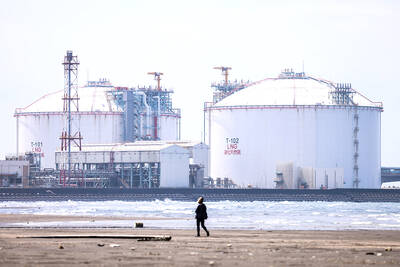
Taiwan is open to joining a global liquefied natural gas (LNG) program if one is created, but on the condition that countries provide delivery even in a scenario where there is a conflict with China, an energy department official said yesterday. While Taiwan’s priority is to have enough LNG at home, the nation is open to exploring potential strategic reserves in other countries such as Japan or South Korea, Energy Administration Deputy Director-General Chen Chung-hsien (陳崇憲) said. While the LNG market does not have a global reserve for emergencies like that of oil, the concept has been raised a few times —
AI-FUELED DEMAND: The company has been benefiting from the skyrocketing prices for DRAM chips amid the AI frenzy, especially its core product — DDR4 DRAM chips DRAM chipmaker Nanya Technology Corp (南亞科技) yesterday reported that its revenue for the first quarter surged 582.91 percent to NT$49.09 billion (US$1.54 billion) from NT$7.19 billion a year earlier, as the supply crunch caused chip price spikes. Last quarter’s figure is the highest on record. On a quarterly basis, revenue jumped 63.14 percent from NT$30.09 billion, the company said. In January, Nanya Technology expected global DRAM supply scarcity to continue through the first half of 2028, thanks to strong demand for artificial intelligence (AI) applications. Market researcher TrendForce Corp (集邦科技) forecast prices of standard DRAM chips would rise between 58 percent and 63


 RSS
RSS