


Taiwan’s housing prices might rise another 10 percent this year in locations with noticeable land supply and amid planned high-tech plants, as record-low interest rates would continue to motivate potential buyers, Cushman & Wakefield Taiwan (戴德梁行) said yesterday.
The housing market is likely to consolidate this year following nationwide price hikes last year, supported by excessive liquidity and ultra-low interest rates, Cushman & Wakefield Taiwan managing director Billy Yen (顏炳立) told a news conference in Taipei.
The central bank’s selective credit controls, which cap loan-to-value ratios at 55 to 65 percent for purchases by corporate and multiple homeowners, as well as on unsold houses and land financing, are intended to deter speculation and would not affect people with real demand, Yen said.
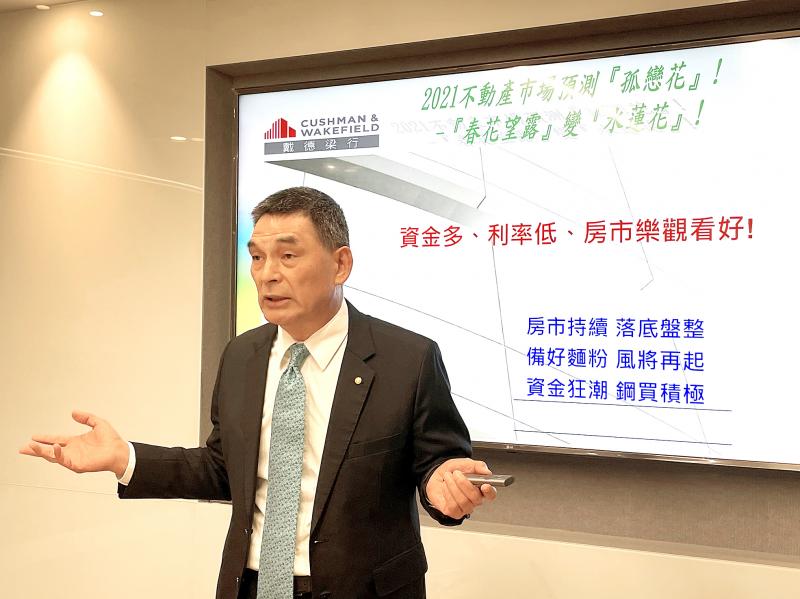
Photo: Hsu Yi-ping, Taipei Times
“I would suggest buyers with real demand quit waiting and take advantage of unprecedented low borrowing costs and own a home if they intend to,” Yen said, adding that global central banks would stand by their loose monetary policies this year and beyond.
Investors, on the other hand, should think twice about seeking to take profit in property investments, as policymakers have pledged further tightening measures if necessary, Yen said, calling the latest credit controls “prudent and effective.”
Against the backdrop, housing projects in rezoning areas in the six special municipalities might climb another 10 percent this year, and two and three-bedroom apartments would continue to dominate the market due to their relative affordability, he said.
New housing projects in locations near forthcoming technology plants across Taiwan would also be popular, as the jobs they create would spur real demand, Yen said.
Foundry company Taiwan Semiconductor Manufacturing Co (台積電), passive components maker Yageo Corp (國巨) and pure-play gallium arsenide foundry supplier Win Semiconductors Corp (穩懋半導體), among others, have announced plans to build new plants in Tainan, Kaohsiung and other places to meet growing market demand.
The presale project market in specific areas would remain warm this year, while the market for existing houses might start to pick up momentum, Yen said.
Cushman & Wakefield Taiwan expects liquidity-driven rallies to drive up office prices this year, aided by companies returning from abroad to cope with US-China trade tensions and a global supply chain realignment.
The pace of increase in land prices might slow down this year after probably hitting their peak last year, allowing the trading volume to further expand, Yen said.
The landscape for luxury houses would remain rugged ahead due to unfavorable financing and tax terms, as well as shrinking room for investment gains, he said.

GROWING OWINGS: While Luxembourg and China swapped the top three spots, the US continued to be the largest exposure for Taiwan for the 41st consecutive quarter The US remained the largest debtor nation to Taiwan’s banking sector for the 41st consecutive quarter at the end of September, after local banks’ exposure to the US market rose more than 2 percent from three months earlier, the central bank said. Exposure to the US increased to US$198.896 billion, up US$4.026 billion, or 2.07 percent, from US$194.87 billion in the previous quarter, data released by the central bank showed on Friday. Of the increase, about US$1.4 billion came from banks’ investments in securitized products and interbank loans in the US, while another US$2.6 billion stemmed from trust assets, including mutual funds,
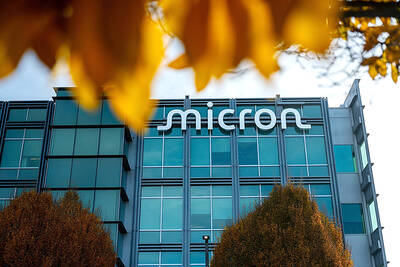
Micron Memory Taiwan Co (台灣美光), a subsidiary of US memorychip maker Micron Technology Inc, has been granted a NT$4.7 billion (US$149.5 million) subsidy under the Ministry of Economic Affairs A+ Corporate Innovation and R&D Enhancement program, the ministry said yesterday. The US memorychip maker’s program aims to back the development of high-performance and high-bandwidth memory chips with a total budget of NT$11.75 billion, the ministry said. Aside from the government funding, Micron is to inject the remaining investment of NT$7.06 billion as the company applied to participate the government’s Global Innovation Partnership Program to deepen technology cooperation, a ministry official told the
Taiwan Semiconductor Manufacturing Co (TSMC, 台積電), the world’s leading advanced chipmaker, officially began volume production of its 2-nanometer chips in the fourth quarter of this year, according to a recent update on the company’s Web site. The low-key announcement confirms that TSMC, the go-to chipmaker for artificial intelligence (AI) hardware providers Nvidia Corp and iPhone maker Apple Inc, met its original roadmap for the next-generation technology. Production is currently centered at Fab 22 in Kaohsiung, utilizing the company’s first-generation nanosheet transistor technology. The new architecture achieves “full-node strides in performance and power consumption,” TSMC said. The company described the 2nm process as

JOINT EFFORTS: MediaTek would partner with Denso to develop custom chips to support the car-part specialist company’s driver-assist systems in an expanding market MediaTek Inc (聯發科), the world’s largest mobile phone chip designer, yesterday said it is working closely with Japan’s Denso Corp to build a custom automotive system-on-chip (SoC) solution tailored for advanced driver-assistance systems and cockpit systems, adding another customer to its new application-specific IC (ASIC) business. This effort merges Denso’s automotive-grade safety expertise and deep vehicle integration with MediaTek’s technologies cultivated through the development of Media- Tek’s Dimensity AX, leveraging efficient, high-performance SoCs and artificial intelligence (AI) capabilities to offer a scalable, production-ready platform for next-generation driver assistance, the company said in a statement yesterday. “Through this collaboration, we are bringing two


 RSS
RSS