


For the Taipei Biennial, with the theme “You and I Don’t Live on the Same Planet,” the Taipei Fine Arts Museum has been transformed into a planetarium, emulating the movement of celestial bodies, with five planets showing the different interpretations and perspectives of participating artists.
On Thursday, CTBC Bank (中國信託銀行) arranged a VIP evening, inviting about 160 VIPs from the bank to explore the environmental, social and corporate governance (ESG) themes of climate change, politics and economics through the prism of the five planets.
Museum director Lin Ping (林平), curator Martin Guinard and public programs curator Eva Lin (林怡華) were on hand to introduce the bank’s VIP art aficionados to “Planet Globalization,” “Planet Terrestrial,” “Planet Security,” “Planet Escape” and “Planet with Alternative Gravity,” explaining the origins and meaning of the concepts informing the five planets.
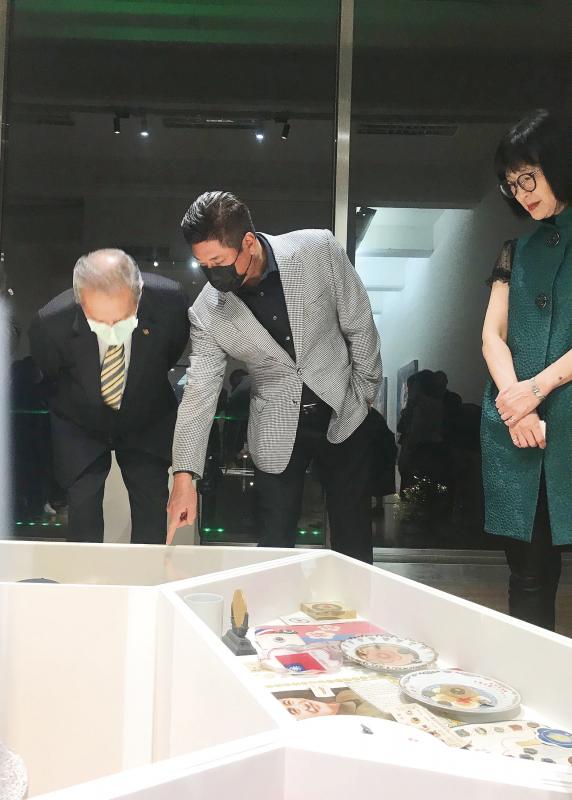
Photo courtesy of CTBC Bank
The VIPs — including CTBC Financial Holding Co (中信金控) president Daniel Wu (吳一揆), chief administration officer Roger Kao (高人傑), institutional and international business CEO Tony Yang (楊銘祥), retail banking executive vice president Amy Yang (楊淑惠), CTBC Charity Foundation chairman Jeffrey Koo Jr (辜仲諒), and CTBC Foundation for Arts and Culture chairman John Feng (馮寄台) — spent the evening contemplating and discussing works by 57 participating artists and groups from 27 countries.
Global warming and climate change are seriously affecting the world and, as one of Taiwan’s most influential financial institutions, CTBC is using its core competitiveness in the financial industry to help solve social issues and promote carbon reduction transformation, fostering the spirit of corporate sustainability and examining changes in the environment, as well as making commitments to its own corporate governance and to social prosperity.
Those attending the VIP evening said they would take their relatives and colleagues to the exhibition, which ends on March 14 next year.
In April, CTBC signed the Task Force on Climate-related Financial Disclosures and, in October, the Partnerships for Carbon Accounting Financials, becoming the first financial institution in Taiwan to join the latter.
Last year, CTBC signed the Equator Principles to implement environmental and social risk management of large-scale project financing, and also voluntarily joined the UN Principles for Responsible Banking, demonstrating CTBC’s commitment to responsible finance in the hopes of having a positive effect on the environment and society.


The domestic unit of the Chinese-owned, Dutch-headquartered chipmaker Nexperia BV will soon be able to produce semiconductors locally within China, according to two company sources. Nexperia is at the center of a global tug-of-war over critical semiconductor technology, with a Dutch court in February ordering a probe into alleged mismanagement at the company. The geopolitical tussle has disrupted supply chains, with some carmakers reportedly forced to cut production due to chip shortages. Local production would allow Nexperia’s domestic arm, Nexperia Semiconductors (China) Ltd (安世半導體中國), to bypass restrictions in place since October on the supply of silicon wafers — etched with tiny components to
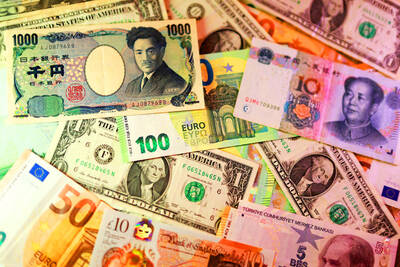
Taiwan’s foreign exchange reserves fell below the US$600 billion mark at the end of last month, with the central bank reporting a total of US$596.89 billion — a decline of US$8.6 billion from February — ending a three-month streak of increases. The central bank attributed the drop to a combination of factors such as outflows by foreign institutional investors, currency fluctuations and its own market interventions. “The large-scale outflows disrupted the balance of supply and demand in the foreign exchange market, prompting the central bank to intervene repeatedly by selling US dollars to stabilize the local currency,” Department of Foreign
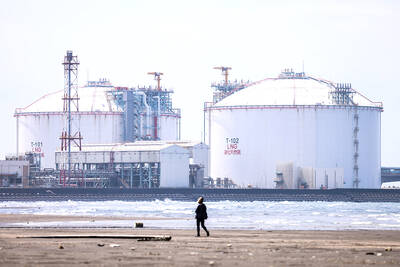
Taiwan is open to joining a global liquefied natural gas (LNG) program if one is created, but on the condition that countries provide delivery even in a scenario where there is a conflict with China, an energy department official said yesterday. While Taiwan’s priority is to have enough LNG at home, the nation is open to exploring potential strategic reserves in other countries such as Japan or South Korea, Energy Administration Deputy Director-General Chen Chung-hsien (陳崇憲) said. While the LNG market does not have a global reserve for emergencies like that of oil, the concept has been raised a few times —
AI-FUELED DEMAND: The company has been benefiting from the skyrocketing prices for DRAM chips amid the AI frenzy, especially its core product — DDR4 DRAM chips DRAM chipmaker Nanya Technology Corp (南亞科技) yesterday reported that its revenue for the first quarter surged 582.91 percent to NT$49.09 billion (US$1.54 billion) from NT$7.19 billion a year earlier, as the supply crunch caused chip price spikes. Last quarter’s figure is the highest on record. On a quarterly basis, revenue jumped 63.14 percent from NT$30.09 billion, the company said. In January, Nanya Technology expected global DRAM supply scarcity to continue through the first half of 2028, thanks to strong demand for artificial intelligence (AI) applications. Market researcher TrendForce Corp (集邦科技) forecast prices of standard DRAM chips would rise between 58 percent and 63


 RSS
RSS