


Down jacket and outdoor garment maker Quang Viet Enterprise Co (廣越企業) yesterday said it expects revenue to return to growth next year due to recovering customer demand following promising developments of a COVID-19 vaccine.
Factory utilization is picking up and could reach 100 percent next month from an average of 80 percent, as customers have restarted orders withheld earlier this year due to the pandemic and started placing orders for next year, the Neihu District (內湖), Taipei-based company said.
Revenue “will start growing again from the second quarter or the third quarter next year,” Quang Viet president Charles Wu (吳朝筆) told investors at a quarterly conference in Taipei.
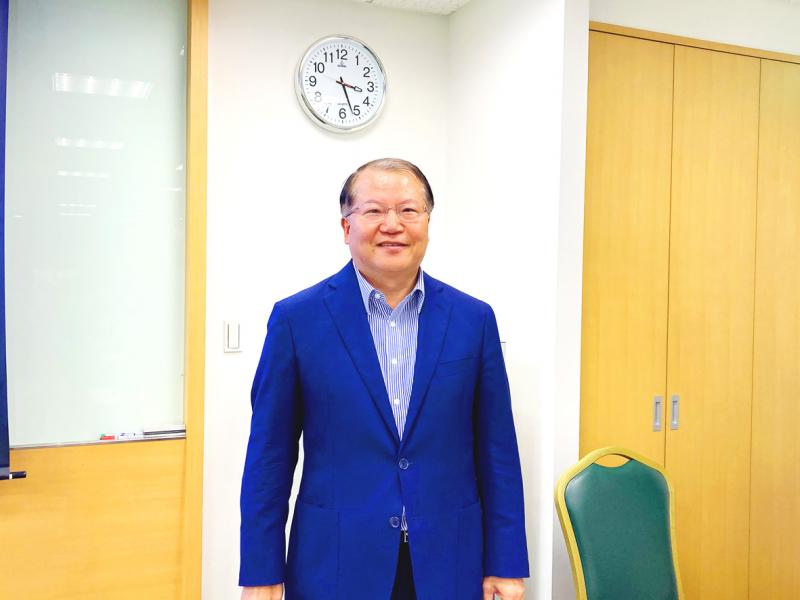
Photo: Lisa Wang, Taipei Times
“Recent news about vaccine developments is encouraging. People will be more willing to go out to shop, which is good for Quang Viet’s business, if vaccines become available next year,” Wu said.
Orders from Patagonia Inc, the company’s second-biggest client, is expected to rise 40 percent next year in volume terms, following a 50 percent slump this year, Wu said.
The North Face is adding orders by 30 percent for next year, he said.
Adidas AG, its biggest customer with a 26 percent share of its revenue last year, is still making its budget for next year, Wu said.
Nike Inc has given a conservative outlook, forecasting a 10 percent annual contraction in orders for next year, he said.
Overall, Quang Viet’s revenue is expected to expand at a double-digit annual rate next year, but it will not return to pre-pandemic levels until 2022, he said.
The pandemic has caused a freeze in customer demand for down jackets, outdoor and sports apparel since February, as large-scale lockdowns worldwide have prevented people from going outdoors and worsening unemployment has stalled consumption of non-essential items, Quang Viet said.
“This year will be the first year of decline [in revenue] in the company’s 25-year history,” Wu said.
Revenue is forecast to plunge 25 percent this year from NT$16.26 billion (US$564.29 million) last year after an estimated 40 percent annual decline this quarter, the company said.
To expand its business and diversify its product portfolio, Quang Viet’s board of directors approved an investment of US$14.77 million for a 50 percent stake in Principle & Will Co (宏昌生物醫療科技), a medical device supplier.
Principle & Will generates half of its revenue from supplying surgical gowns and surgical sheets, Quang Viet said.
It also makes disposable surgical kits and masks, it said.
Quang Viet’s net profit tumbled about 53 percent to NT$468.26 million in the first three quarters of this year, compared with NT$991.4 million in the same period last year. The company attributed it to high operating costs, including wages.
Gross margin declined to 11.8 percent during the nine-month period from 17.07 percent a year earlier, while revenue fell 20.55 percent to NT$10.44 billion from NT$13.14 billion.
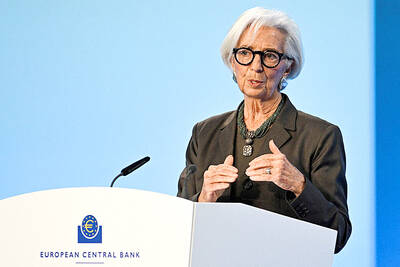
European Central Bank (ECB) President Christine Lagarde is expected to step down from her role before her eight-year term ends in October next year, the Financial Times reported. Lagarde wants to leave before the French presidential election in April next year, which would allow French President Emmanuel Macron and German Chancellor Friedrich Merz to find her replacement together, the report said, citing an unidentified person familiar with her thoughts on the matter. It is not clear yet when she might exit, the report said. “President Lagarde is totally focused on her mission and has not taken any decision regarding the end of
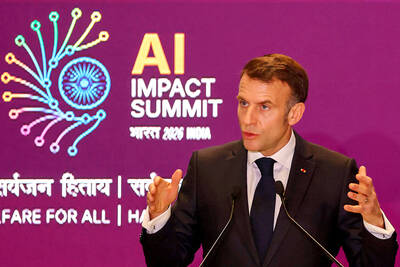
French President Emmanuel Macron told a global artificial intelligence (AI) summit in India yesterday he was determined to ensure safe oversight of the fast-evolving technology. The EU has led the way for global regulation with its Artificial Intelligence Act, which was adopted in 2024 and is coming into force in phases. “We are determined to continue to shape the rules of the game... with our allies such as India,” Macron said in New Delhi. “Europe is not blindly focused on regulation — Europe is a space for innovation and investment, but it is a safe space.” The AI Impact Summit is the fourth
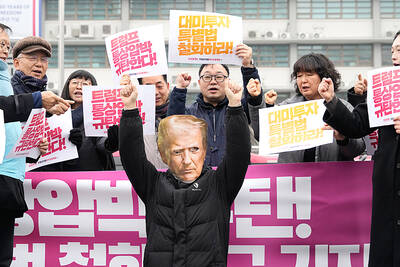
CONFUSION: Taiwan, Japan and other big exporters are cautiously monitoring the situation, while analysts said more Trump responses ate likely after his loss in court US trading partners in Asia started weighing fresh uncertainties yesterday after President Donald Trump vowed to impose a new tariff on imports, hours after the Supreme Court struck down many of the sweeping levies he used to launch a global trade war. The court’s ruling invalidated a number of tariffs that the Trump administration had imposed on Asian export powerhouses from China and South Korea to Japan and Taiwan, the world’s largest chip maker and a key player in tech supply chains. Within hours, Trump said he would impose a new 10 percent duty on US imports from all countries starting on
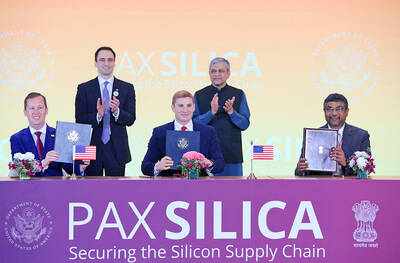
STRATEGIC ALLIANCE: The initiative is aimed at protecting semiconductor supply chain resilience to reduce dependence on China-dominated manufacturing hubs India yesterday joined a US-led initiative to strengthen technology cooperation among strategic allies in a move that underscores the nations’ warming ties after a brief strain over New Delhi’s unabated purchase of discounted Russian oil. The decision aligns India closely with Washington’s efforts to build secure supply chains for semiconductors, advanced manufacturing and critical technologies at a time when geopolitical competition with China is intensifying. It also signals a reset in relations following friction over energy trade and tariffs. Nations that have joined the Pax Silica framework include Japan, South Korea, the UK and Israel. “Pax Silica will be a group of nations


 RSS
RSS