


The Chinese National Association of Industry and Commerce (CNAIC, 工商協進會) yesterday called on the government to postpone the implementation of rules starting next year that would require heavy industrial electricity users to generate or buy green energy.
The Taipei-based trade group’s chairman, Lin Por-fong (林伯豐), made the plea during a breakfast meeting with Vice Premier Shen Jong-chin (沈榮津) and other Cabinet ministers.
Lin pressed the government on behalf of the chamber to postpone implementation of the rules that would require major electricity users to install facilities to generate green energy and purchase portions of green energy depending on the amount of electricity they use on a yearly basis.
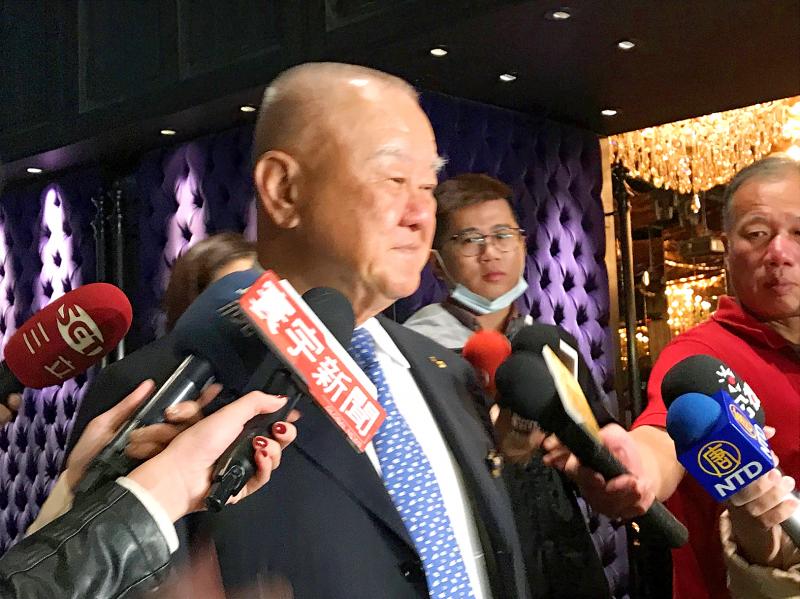
Photo: Lee Ya-wen, Taipei Times
Heavy electricity users are defined as companies that use 5,000 kilowatts of electricity annually. Most are makers of textile, cement, semiconductor or petrochemical products.
Firms in the non-tech sectors have complained about the increase in costs associated with renewable energy sources and questioned the stability of their supply.
The government aims to raise the ratio of green energy in the nation’s energy mix as it seeks to retire nuclear power plants.
Lin’s request came after contract chipmaker Taiwan Semiconductor Manufacturing Co (TSMC, 台積電) in July inked a 20-year agreement with Orsted Taiwan Ltd (沃旭能源) to buy all of the power produced at its two offshore wind farms in Taiwan.
Taiwan Cement Corp (台灣水泥), polyester and textile maker Far Eastern New Century Corp (遠東新世紀) and Shinkong Synthetic Fibers Corp (新纖) have also made investments in green energy production.
The CNAIC also urged the government to quit using anti-China rhetoric while pursuing closer ties with the US, saying that it is in Taiwan’s best interests to befriend all trade partners.
The two economies account for more than 50 percent of Taiwanese exports, government data showed.
Lin warned the government against complacency in dealing with global economic uncertainty, saying that escalating COVID-19 infections worldwide pose a serious challenge.
Taiwan has emerged relatively unscathed from the COVID-19 pandemic, as it contained its virus outbreak quickly and there has been a boom in demand for devices used in remote working and learning.
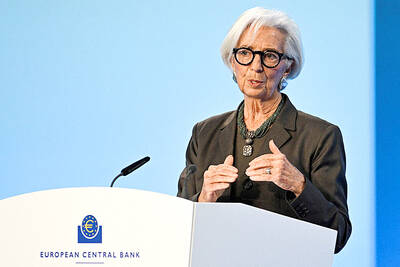
European Central Bank (ECB) President Christine Lagarde is expected to step down from her role before her eight-year term ends in October next year, the Financial Times reported. Lagarde wants to leave before the French presidential election in April next year, which would allow French President Emmanuel Macron and German Chancellor Friedrich Merz to find her replacement together, the report said, citing an unidentified person familiar with her thoughts on the matter. It is not clear yet when she might exit, the report said. “President Lagarde is totally focused on her mission and has not taken any decision regarding the end of
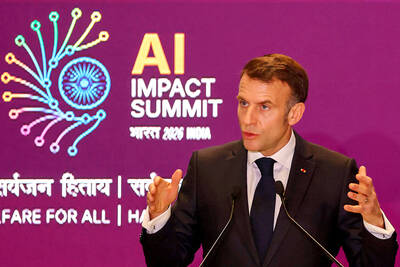
French President Emmanuel Macron told a global artificial intelligence (AI) summit in India yesterday he was determined to ensure safe oversight of the fast-evolving technology. The EU has led the way for global regulation with its Artificial Intelligence Act, which was adopted in 2024 and is coming into force in phases. “We are determined to continue to shape the rules of the game... with our allies such as India,” Macron said in New Delhi. “Europe is not blindly focused on regulation — Europe is a space for innovation and investment, but it is a safe space.” The AI Impact Summit is the fourth
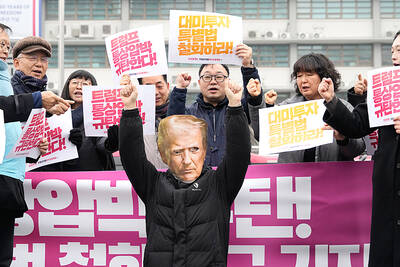
CONFUSION: Taiwan, Japan and other big exporters are cautiously monitoring the situation, while analysts said more Trump responses ate likely after his loss in court US trading partners in Asia started weighing fresh uncertainties yesterday after President Donald Trump vowed to impose a new tariff on imports, hours after the Supreme Court struck down many of the sweeping levies he used to launch a global trade war. The court’s ruling invalidated a number of tariffs that the Trump administration had imposed on Asian export powerhouses from China and South Korea to Japan and Taiwan, the world’s largest chip maker and a key player in tech supply chains. Within hours, Trump said he would impose a new 10 percent duty on US imports from all countries starting on
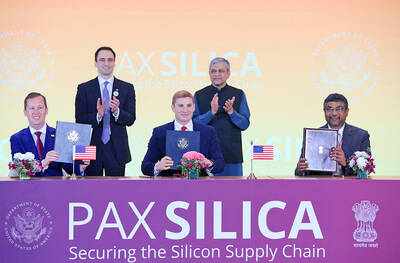
STRATEGIC ALLIANCE: The initiative is aimed at protecting semiconductor supply chain resilience to reduce dependence on China-dominated manufacturing hubs India yesterday joined a US-led initiative to strengthen technology cooperation among strategic allies in a move that underscores the nations’ warming ties after a brief strain over New Delhi’s unabated purchase of discounted Russian oil. The decision aligns India closely with Washington’s efforts to build secure supply chains for semiconductors, advanced manufacturing and critical technologies at a time when geopolitical competition with China is intensifying. It also signals a reset in relations following friction over energy trade and tariffs. Nations that have joined the Pax Silica framework include Japan, South Korea, the UK and Israel. “Pax Silica will be a group of nations


 RSS
RSS