


The National Stabilization Fund (NSF, 國安基金) yesterday decided to exit the local stock market, saying it has achieved its goal of stabilizing the local bourse, which has rallied firm above 12,000 points since the fund’s previous meeting in July.
The National Stabilization Fund Committee said it made the decision at its quarterly meeting because the TAIEX has made a comeback from its March lows.
“There are no major events at home and abroad that might dampen investors’ confidence and throw the financial market into disarray,” it said, adding that it was time to allow the market to return to normalcy.
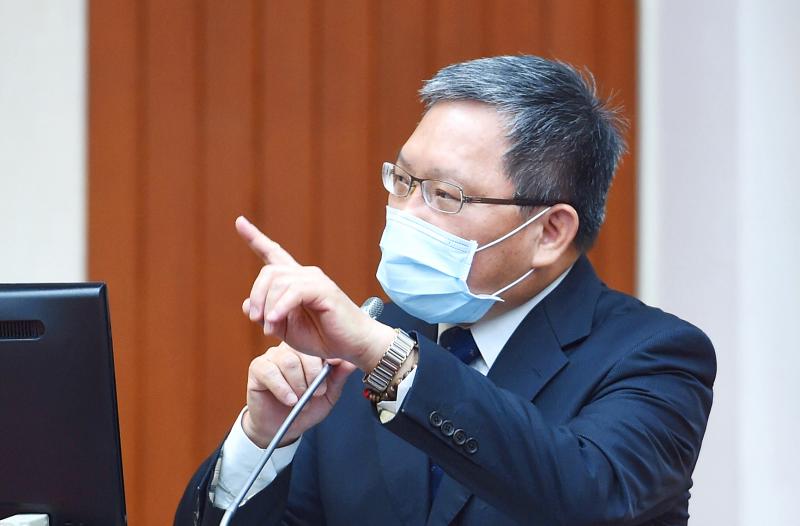
Photo: Liu Hsin-de, Taipei Times
The NT$500 billion (US$17.29 billion) fund made a high-profile entry into the market on March 19 after the TAIEX slumped to 8,681.34 amid a global meltdown caused by draconian lockdowns in major countries after the COVID-19 epidemic was declared a pandemic.
The main board has since swelled 49.27 percent to close at 12,955.91 points yesterday on a large turnover of NT$228.745 billion, Taiwan Stock Exchange data showed.
Minister of Finance Su Jain-rong (蘇建榮) told a legislative meeting that the fund has stayed put since April, after spending NT$757.19 million in March.
Taiwan Semiconductor Manufacturing Co (TSMC, 台積電) shares yesterday rose 1.55 percent to a new high of NT$460, while chip designer MediaTek Inc (聯發科) picked up 6.57 percent to NT$714.
As of Sept. 30, the fund saw NT$217.13 million in unrealized capital gains and an additional NT$34.74 million in dividend income, suggesting a 30 percent return over 207 days, the committee’s statement said.
The figures wrapped up the second-longest intervention by the fund with record-low cash.
Authorities would continue to monitor international political and economic developments, and the fund could step in again whenever necessary, the committee said.
Though uncertainties linger, Taiwan is outperforming most other nations in GDP growth this year due to its quick control of the outbreak, it said, adding that global monetary easing would lend support to economic and financial activity around the world.
While the market might have negative readings of the fund’s departure in the short term, it is expected that the release of corporate earnings reports would provide certain catalysts, analysts said.
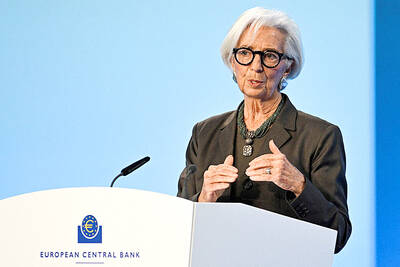
European Central Bank (ECB) President Christine Lagarde is expected to step down from her role before her eight-year term ends in October next year, the Financial Times reported. Lagarde wants to leave before the French presidential election in April next year, which would allow French President Emmanuel Macron and German Chancellor Friedrich Merz to find her replacement together, the report said, citing an unidentified person familiar with her thoughts on the matter. It is not clear yet when she might exit, the report said. “President Lagarde is totally focused on her mission and has not taken any decision regarding the end of
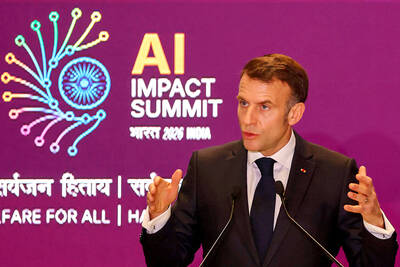
French President Emmanuel Macron told a global artificial intelligence (AI) summit in India yesterday he was determined to ensure safe oversight of the fast-evolving technology. The EU has led the way for global regulation with its Artificial Intelligence Act, which was adopted in 2024 and is coming into force in phases. “We are determined to continue to shape the rules of the game... with our allies such as India,” Macron said in New Delhi. “Europe is not blindly focused on regulation — Europe is a space for innovation and investment, but it is a safe space.” The AI Impact Summit is the fourth
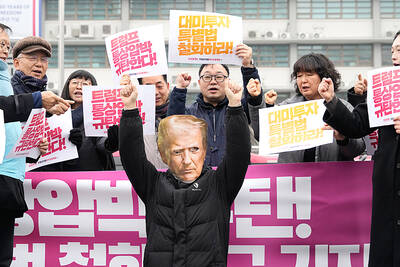
CONFUSION: Taiwan, Japan and other big exporters are cautiously monitoring the situation, while analysts said more Trump responses ate likely after his loss in court US trading partners in Asia started weighing fresh uncertainties yesterday after President Donald Trump vowed to impose a new tariff on imports, hours after the Supreme Court struck down many of the sweeping levies he used to launch a global trade war. The court’s ruling invalidated a number of tariffs that the Trump administration had imposed on Asian export powerhouses from China and South Korea to Japan and Taiwan, the world’s largest chip maker and a key player in tech supply chains. Within hours, Trump said he would impose a new 10 percent duty on US imports from all countries starting on
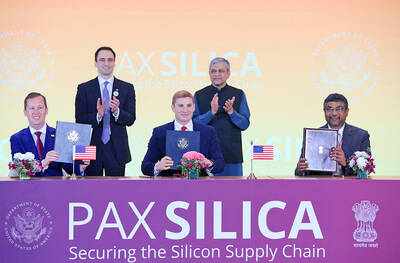
STRATEGIC ALLIANCE: The initiative is aimed at protecting semiconductor supply chain resilience to reduce dependence on China-dominated manufacturing hubs India yesterday joined a US-led initiative to strengthen technology cooperation among strategic allies in a move that underscores the nations’ warming ties after a brief strain over New Delhi’s unabated purchase of discounted Russian oil. The decision aligns India closely with Washington’s efforts to build secure supply chains for semiconductors, advanced manufacturing and critical technologies at a time when geopolitical competition with China is intensifying. It also signals a reset in relations following friction over energy trade and tariffs. Nations that have joined the Pax Silica framework include Japan, South Korea, the UK and Israel. “Pax Silica will be a group of nations


 RSS
RSS