


Jko Fintech Co (街口金融科技) on Tuesday said that it would withdraw from the boardroom of Jko Asset Management Co (街口投信) and would not exercise control over that company’s operations, although it has a 25 percent stake in it.
Jko Fintech, which has two seats on Jko Asset’s board, would have its representatives resign at a board meeting on Thursday next week and would not appoint new board members, it said in a statement.
It would not sell its Jko Asset shares, but it would be a silent shareholder that would not be involved in the asset management house’s operations, such as business decisions or appointing a president, a firm representative told the Taipei Times by telephone.
Jko Fintech chairman Kevin Hu (胡亦嘉) last week said that he would not give in to the Financial Supervisory Commission, after it barred him from taking a seat on Jko Asset’s board over the launch of an unlawful investment service, Tuofu Bao (託付寶).
The commission also fined Jko Asset, as the firm let Hu launch the service without discussing the issue as a board meeting and ignored an internal audit report that said the service had legal issues.
Jko Fintech chose to leave Jko Asset’s boardroom completely as it wants to address its disagreement with the commission, Hu told the Taipei Times.
As the commission is worried that Jko Asset’s corporate governance would be affected by Jko Fintech’s involvement, “we hope to ease its concerns by staying away from Jko Asset’s operations and leaving the boardroom,” Hu said.
He said that he would still appeal the commission’s penalty, in a bid to clarify whether the Executive Yuan agrees with the commission’s punishment and to confirm whether Tuofu Bao was really illegal.
However, he would not return to the Jko Asset boardroom even if he wins, Hu said.
“Our leaving Jko Asset does not mean we have given developing new fintech services, but it is just that we know we need to adjust our strategy,” Hu said. “We will partner with other financial companies to work on new services.”
Jko Asset’s chairman seat remains empty as the commission last month rejected Hu’s application to take over as chair after Kao Wu-chung (高武忠) was removed, corporate data showed.
The asset management firm has no president either, after former president Richard Chuang (莊鈜富) resigned over the Tuofu Bao controversy.
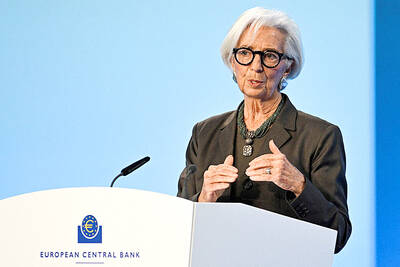
European Central Bank (ECB) President Christine Lagarde is expected to step down from her role before her eight-year term ends in October next year, the Financial Times reported. Lagarde wants to leave before the French presidential election in April next year, which would allow French President Emmanuel Macron and German Chancellor Friedrich Merz to find her replacement together, the report said, citing an unidentified person familiar with her thoughts on the matter. It is not clear yet when she might exit, the report said. “President Lagarde is totally focused on her mission and has not taken any decision regarding the end of
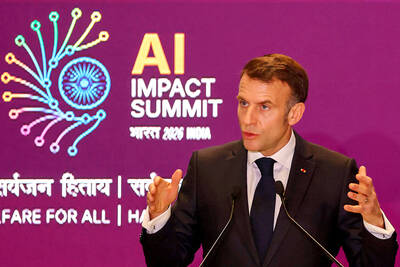
French President Emmanuel Macron told a global artificial intelligence (AI) summit in India yesterday he was determined to ensure safe oversight of the fast-evolving technology. The EU has led the way for global regulation with its Artificial Intelligence Act, which was adopted in 2024 and is coming into force in phases. “We are determined to continue to shape the rules of the game... with our allies such as India,” Macron said in New Delhi. “Europe is not blindly focused on regulation — Europe is a space for innovation and investment, but it is a safe space.” The AI Impact Summit is the fourth
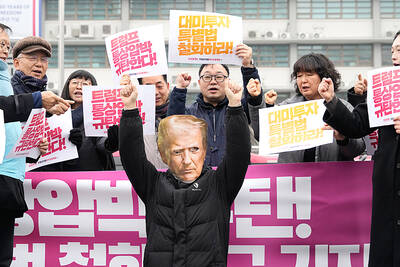
CONFUSION: Taiwan, Japan and other big exporters are cautiously monitoring the situation, while analysts said more Trump responses ate likely after his loss in court US trading partners in Asia started weighing fresh uncertainties yesterday after President Donald Trump vowed to impose a new tariff on imports, hours after the Supreme Court struck down many of the sweeping levies he used to launch a global trade war. The court’s ruling invalidated a number of tariffs that the Trump administration had imposed on Asian export powerhouses from China and South Korea to Japan and Taiwan, the world’s largest chip maker and a key player in tech supply chains. Within hours, Trump said he would impose a new 10 percent duty on US imports from all countries starting on
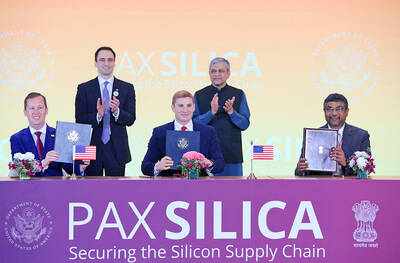
STRATEGIC ALLIANCE: The initiative is aimed at protecting semiconductor supply chain resilience to reduce dependence on China-dominated manufacturing hubs India yesterday joined a US-led initiative to strengthen technology cooperation among strategic allies in a move that underscores the nations’ warming ties after a brief strain over New Delhi’s unabated purchase of discounted Russian oil. The decision aligns India closely with Washington’s efforts to build secure supply chains for semiconductors, advanced manufacturing and critical technologies at a time when geopolitical competition with China is intensifying. It also signals a reset in relations following friction over energy trade and tariffs. Nations that have joined the Pax Silica framework include Japan, South Korea, the UK and Israel. “Pax Silica will be a group of nations


 RSS
RSS