


New vehicle sales last month jumped 13.4 percent year-on-year to 37,241 units as new models from Mercedes-Benz and other brands stimulated sales, online market researcher U-Car said in a report on its Web site yesterday.
The growth bucked a traditional downtrend in Ghost Month and represented a monthly increase of 6.9 percent.
In the first nine months of this year, new vehicle sales expanded at an annual rate of 4.4 percent to 325,805 units, according to U-Car.
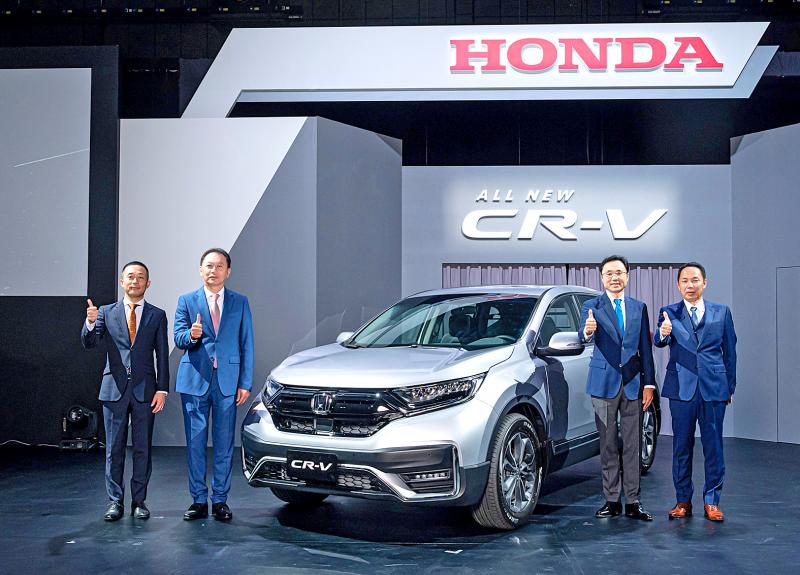
Photo: Amy Yang, Taipei Times
“The effect of Ghost Month was not significant this year. New car sales were much better than before,” U-Car said in a statement. “Many auto brands launched new cars and started taking orders last month following delayed launches in the first half of the year.”
New vehicle launches were delayed in the first six months due to the COVID-19 pandemic, which shut down automakers’ production lines and disrupted their component supply, U-Car said.
The revamped Honda CR-V saw robust demand last month, with sales of 1,753 units, making it the most popular recreational vehicle among local peers, while the new Hyundai Venue crossover was also well-received by local consumers, with sales of 701 units, U-Car’s statistics showed.
Sales of imported vehicles rebounded to 18,669 units, up from 17,178 units in August and accounting for 50.1 percent of overall new vehicle sales.
In comparison, imported vehicles made up a smaller share of 49.3 percent in August.
Among imported vehicle vendors, Mercedes-Benz Taiwan Ltd (台灣賓士) saw sales rise rapidly to 3,573 units from 2,680 a month earlier, retaining its No. 2 position in the domestic market.
The new Mercedes-Benz GLC was the brand’s best-selling model at 1,053 units, while sales of E-Class and C-Class models reached 554 units and 462 units respectively, U-Car reported.
Hotai Motor Co (和泰汽車), which distributes Toyota and Lexus vehicles in Taiwan, again ranked first, with vehicle sales more than doubling to 6,865 units from 3,857 in August.
Ford Lio Ho Motor Co (福特六和) dropped to the third place with sales of 2,978 units, data showed.
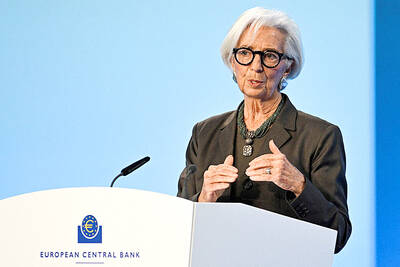
European Central Bank (ECB) President Christine Lagarde is expected to step down from her role before her eight-year term ends in October next year, the Financial Times reported. Lagarde wants to leave before the French presidential election in April next year, which would allow French President Emmanuel Macron and German Chancellor Friedrich Merz to find her replacement together, the report said, citing an unidentified person familiar with her thoughts on the matter. It is not clear yet when she might exit, the report said. “President Lagarde is totally focused on her mission and has not taken any decision regarding the end of
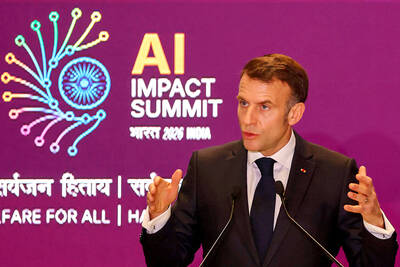
French President Emmanuel Macron told a global artificial intelligence (AI) summit in India yesterday he was determined to ensure safe oversight of the fast-evolving technology. The EU has led the way for global regulation with its Artificial Intelligence Act, which was adopted in 2024 and is coming into force in phases. “We are determined to continue to shape the rules of the game... with our allies such as India,” Macron said in New Delhi. “Europe is not blindly focused on regulation — Europe is a space for innovation and investment, but it is a safe space.” The AI Impact Summit is the fourth
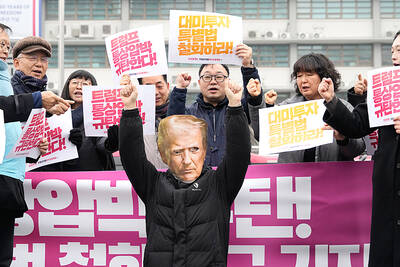
CONFUSION: Taiwan, Japan and other big exporters are cautiously monitoring the situation, while analysts said more Trump responses ate likely after his loss in court US trading partners in Asia started weighing fresh uncertainties yesterday after President Donald Trump vowed to impose a new tariff on imports, hours after the Supreme Court struck down many of the sweeping levies he used to launch a global trade war. The court’s ruling invalidated a number of tariffs that the Trump administration had imposed on Asian export powerhouses from China and South Korea to Japan and Taiwan, the world’s largest chip maker and a key player in tech supply chains. Within hours, Trump said he would impose a new 10 percent duty on US imports from all countries starting on
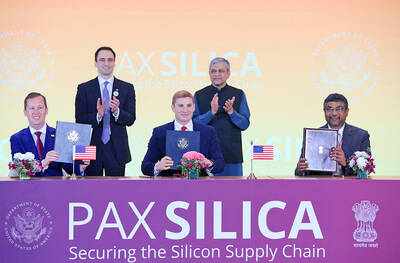
STRATEGIC ALLIANCE: The initiative is aimed at protecting semiconductor supply chain resilience to reduce dependence on China-dominated manufacturing hubs India yesterday joined a US-led initiative to strengthen technology cooperation among strategic allies in a move that underscores the nations’ warming ties after a brief strain over New Delhi’s unabated purchase of discounted Russian oil. The decision aligns India closely with Washington’s efforts to build secure supply chains for semiconductors, advanced manufacturing and critical technologies at a time when geopolitical competition with China is intensifying. It also signals a reset in relations following friction over energy trade and tariffs. Nations that have joined the Pax Silica framework include Japan, South Korea, the UK and Israel. “Pax Silica will be a group of nations


 RSS
RSS