


The TAIEX yesterday closed lower after posting early gains because of mounting diplomatic tensions between the US and China, dealers said.
Selling was seen across the board except in the semiconductor sector, which managed to hold its own, led by the nation’s two top pure foundry plays, preventing the broader market from falling further, they said.
The TAIEX closed down 109 points, or 0.88 percent, at 12,304.04 on turnover of NT$264.547 billion (US$8.95 billion).
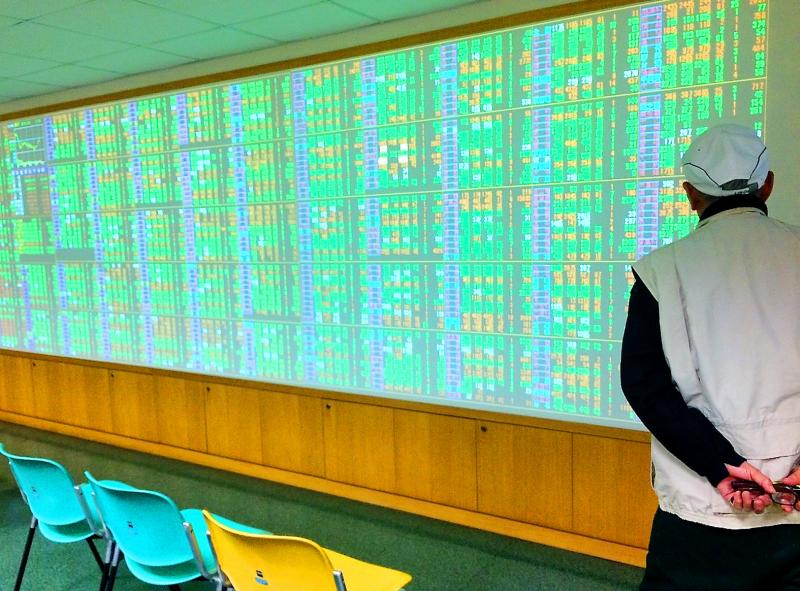
Photo: Wang Meng-lun, Taipei Times
The benchmark index opened up 0.44 percent and rose to the day’s high just before 10:30am on a technical rebound from a session earlier, when it closed down 0.48 percent, dealers said.
However, the upturn was ended by mounting US-China tensions, which pushed the index below the nearest technical support level ahead of the five-day moving average of 12,352.
Investors were reacting to Beijing ordering the US consulate in Chengdu to be closed in retaliation for the US ordering the closure of China’s consulate in Houston, Texas, on Wednesday.
“China’s retaliatory move complicated the political landscape between the two powers,” Concord Securities Co (康和證券) analyst Kerry Huang (黃志祺) said. “Many investors fear the Chinese yuan will weaken and send other regional currencies into a tailspin, leading to a fund outflow from the region.”
“Taiwan was not the only market to feel the pinch. Selling emerged across the region today,” Huang said, referring to the stock markets in Shanghai, Shenzhen, Hong Kong and Seoul.
In Taipei, many investors seized on the political unease as an excuse to lock in gains after the TAIEX closed at a 30-year high earlier this week.
“The silver lining was that the semiconductor sector served as an anchor to prevent further losses, led by contract chipmaker Taiwan Semiconductor Manufacturing Co [TSMC, 台積電] and its smaller rival United Microelectronics Corp [UMC, 聯電],” Huang said.
TSMC shares rose 1.18 percent to close at NT$386, off a high of NT$395, while UMC shares gained 2.6 percent to close at NT$19.75 after hitting a high of NT$20.30.
Chip designer MediaTek Inc (聯發科) lost 0.3 percent to close at NT$675, smartphone camera lens maker Largan Precision Co (大立光) dropped 1.94 percent to close at NT$3,800 and iPhone assembler Hon Hai Precision Industry Co (鴻海精密) shed 2.56 percent to close at NT$80.
Among falling old economy stocks, Far Eastern New Century Corp (遠東新世紀) lost 2.67 percent to close at NT$29.20, Formosa Chemicals & Fibre Corp (台灣化纖) fell 1.13 percent to close at NT$69.80 and Uni-President Enterprises Corp (統一企業) dropped 0.97 percent to close at NT$71.30.
In the financial sector, which ended down 1.16 percent, Fubon Financial Holding Co (富邦金控) lost 1.64 percent to close at NT$42 and Mega Financial Holding Co (兆豐金控) fell 1.68 percent to NT$32.15.
“Politics is dominating global markets, and if things get worse and hurt foreign institutional investor sentiment, further volatility is possible,” Huang said. “The TAIEX may not see strong technical support until 12,097, the 20-day moving average.”
Foreign institutional investors yesterday sold a net NT$10.83 billion of shares, Taiwan Stock Exchange data showed.
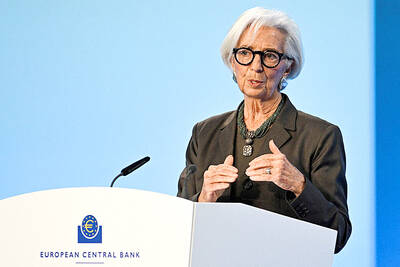
European Central Bank (ECB) President Christine Lagarde is expected to step down from her role before her eight-year term ends in October next year, the Financial Times reported. Lagarde wants to leave before the French presidential election in April next year, which would allow French President Emmanuel Macron and German Chancellor Friedrich Merz to find her replacement together, the report said, citing an unidentified person familiar with her thoughts on the matter. It is not clear yet when she might exit, the report said. “President Lagarde is totally focused on her mission and has not taken any decision regarding the end of

French President Emmanuel Macron told a global artificial intelligence (AI) summit in India yesterday he was determined to ensure safe oversight of the fast-evolving technology. The EU has led the way for global regulation with its Artificial Intelligence Act, which was adopted in 2024 and is coming into force in phases. “We are determined to continue to shape the rules of the game... with our allies such as India,” Macron said in New Delhi. “Europe is not blindly focused on regulation — Europe is a space for innovation and investment, but it is a safe space.” The AI Impact Summit is the fourth
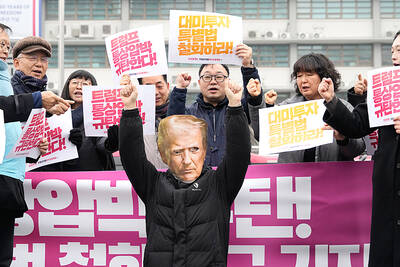
CONFUSION: Taiwan, Japan and other big exporters are cautiously monitoring the situation, while analysts said more Trump responses ate likely after his loss in court US trading partners in Asia started weighing fresh uncertainties yesterday after President Donald Trump vowed to impose a new tariff on imports, hours after the Supreme Court struck down many of the sweeping levies he used to launch a global trade war. The court’s ruling invalidated a number of tariffs that the Trump administration had imposed on Asian export powerhouses from China and South Korea to Japan and Taiwan, the world’s largest chip maker and a key player in tech supply chains. Within hours, Trump said he would impose a new 10 percent duty on US imports from all countries starting on
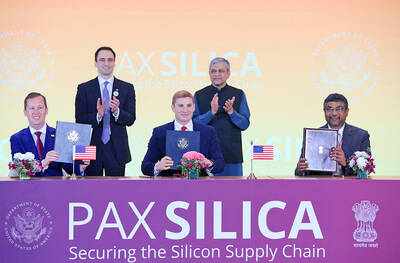
STRATEGIC ALLIANCE: The initiative is aimed at protecting semiconductor supply chain resilience to reduce dependence on China-dominated manufacturing hubs India yesterday joined a US-led initiative to strengthen technology cooperation among strategic allies in a move that underscores the nations’ warming ties after a brief strain over New Delhi’s unabated purchase of discounted Russian oil. The decision aligns India closely with Washington’s efforts to build secure supply chains for semiconductors, advanced manufacturing and critical technologies at a time when geopolitical competition with China is intensifying. It also signals a reset in relations following friction over energy trade and tariffs. Nations that have joined the Pax Silica framework include Japan, South Korea, the UK and Israel. “Pax Silica will be a group of nations


 RSS
RSS