


Apple Inc chief design officer Jony Ive is leaving after decades at the iPhone maker to form an independent company — with Apple as one of its primary clients.
Ive is responsible for the look of the company’s most iconic products.
LoveFrom, his new firm, would continue to work with Apple on projects, he said in an interview with the Financial Times on Thursday.
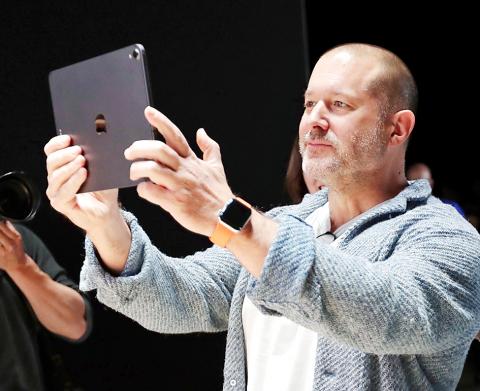
Photo: EPA-EFE
“Apple will continue to benefit from Jony’s talents by working directly with him on exclusive projects, and through the ongoing work of the brilliant and passionate design team he has built,” Apple chief executive officer Tim Cook said in a statement.
Apple shares slipped less than 1 percent in extended trading on Thursday. The stock closed at US$199.74 in New York.
“Ive is leaving a hole in the company and is clearly irreplaceable as he has been one of the most important figures at Apple throughout the past few decades,” Wedbush Securities Inc analyst Dan Ives wrote in a note to analysts.
“While this is a bit if a shocker to Apple and its investors, we are not overly concerned, as Ive will continue to work closely with Cook & Co,” Ives said.
Ive started leading Apple’s design team in 1996, before Apple cofounder Steve Jobs returned to the company, as it was on the brink of bankruptcy.
Over the past two decades, Ive’s designs, from the original iMac desktop computer in 1998 to the first iPod in 2001 and the iPad in 2010, have been a significant factor in Apple’s growth.
In 2012, a year after becoming CEO, Cook put Ive in charge of software design as well.
Ive is to be replaced by existing Apple designers.
Evans Hankey, vice president of industrial design, and Alan Dye, vice president of human interface design, are to report to Apple chief operating officer Jeff Williams, the company said.
Dye and Hankey have played key leadership roles on Apple’s design team for many years. They were among executives who took over day-to-day management of the team when Ive stepped away to focus on the creation of company’s new headquarters in Cupertino, California.
Williams has led the development of Apple Watch since its inception and is to spend more of his time working with the design team in their studio, the company added.
Separately, Apple said that Sabih Khan, a 24-year company veteran, would be senior vice president of operations.
In the past few years, Khan has inherited more responsibility for global supply chain operations that churn out hundreds of millions of devices per year — tasks once handled by Williams.
Khan runs day-to-day manufacturing of the iPhone, as well as other devices, and his team has become involved increasingly early in the design process.


Taiwan’s foreign exchange reserves fell below the US$600 billion mark at the end of last month, with the central bank reporting a total of US$596.89 billion — a decline of US$8.6 billion from February — ending a three-month streak of increases. The central bank attributed the drop to a combination of factors such as outflows by foreign institutional investors, currency fluctuations and its own market interventions. “The large-scale outflows disrupted the balance of supply and demand in the foreign exchange market, prompting the central bank to intervene repeatedly by selling US dollars to stabilize the local currency,” Department of Foreign

Intel Corp is joining Elon Musk’s long-shot effort to develop semiconductors for Tesla Inc, Space Exploration Technologies Corp and xAI, marking a surprising twist in the chipmaker’s comeback bid. Intel would help the Terafab project “refactor” the technology in a chip factory, the company said on Tuesday in a post on X, Musk’s social media platform. That is a stage in the development process that typically helps make chips more powerful or reliable. The chipmaker’s shares jumped 4.2 percent to US$52.91 in New York trading on Tuesday. The Terafab project is a grand plan by Musk to eventually manufacture his own chips for
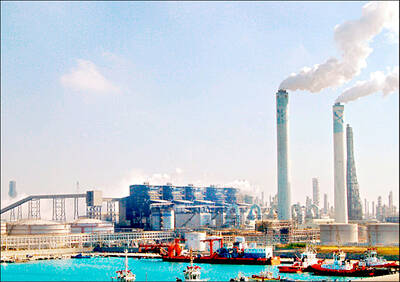
Taiwan Power Co (Taipower, 台電) yesterday said it plans to resume operations at two coal-fired power generators for three months to boost security of electricity supply as liquefied natural gas (LNG) supply risks are running high due to the Middle East conflict. The two coal-fired power generators are at Mailiao Power Plant in Yunlin County’s Mailiao Township (麥寮). The plant, operated by Formosa Plastics Group (台塑集團), supplied electricity to Taipower’s power grid until the end of last year. Taipower’s decision came about one month after Minister of Economic Affairs Kung Ming-hsin (龔明鑫) on March 10 said that the nation had no imminent

Some robotaxi passengers were left stranded in the middle of fast-moving traffic in a major Chinese city after their driverless vehicles stopped running, according to police and media reports on Wednesday. A preliminary investigation indicates more than 100 robotaxis came to a halt because of a “system malfunction,” police in the city of Wuhan said in a statement, without elaborating. No injuries were reported. One passenger told Chinese media that their robotaxi stopped after turning a corner. An instruction on a screen read: “Driving system malfunction. Staff are expected to arrive in 5 minutes.” After no one showed up, the passenger pushed


 RSS
RSS