


CPC Corp, Taiwan (CPC, 台灣中油) and Taiwan Power Co (Taipower, 台電) are on March 21 to sign a cooperation agreement to harness geothermal energy at Renze Hot Spring (仁澤溫泉) in Yilan County, the Chinese-language Liberty Times (sister publication of the Taipei Times) reported yesterday, citing sources at the Ministry of Economic Affairs.
Under the cooperation plans, CPC would drill one or two wells near the hot spring to conduct tests, the newspaper said, adding that if the tests are successful, the state-run refiner would hand over the project to Taipower, which would be tasked with generating geothermal power.
Given the large number of hot springs in the county, the potential for geothermal energy in Yilan is huge.
CPC said it selected Renze for the tests after geological evaluation because it has greater potential to develop geothermal energy than other areas in Taiwan.
Moreover, the plots of land on the site in Renze belong to the Forestry Bureau, making the process less costly and time-consuming than if the company were to lease land from private owners, the newspaper said.
CPC has ample experience drilling geothermal wells and in 1981 helped set up a geothermal power plant in the county’s Cingshuei (清水) area, which was shut down in 1993 as its generators became less efficient.
Taipower is interested in developing geothermal energy and is simultaneously engaged in a geothermal development project on Green Island (綠島) this year.
The state-run utility has carried out well tests and is on track to build a small geothermal power station capable of generating 200kW of electricity on the island by next year, the Liberty Times said, adding that Taipower plans to build a larger geothermal power plant there capable of generating 40 megawatts of electricity by 2020.
The Bureau of Energy has said that the government’s target is to install 200 megawatts of geothermal generation capacity by 2025, as part of the Democratic Progressive Party administration’s pledge to establish a “nuclear-free homeland” by that year.
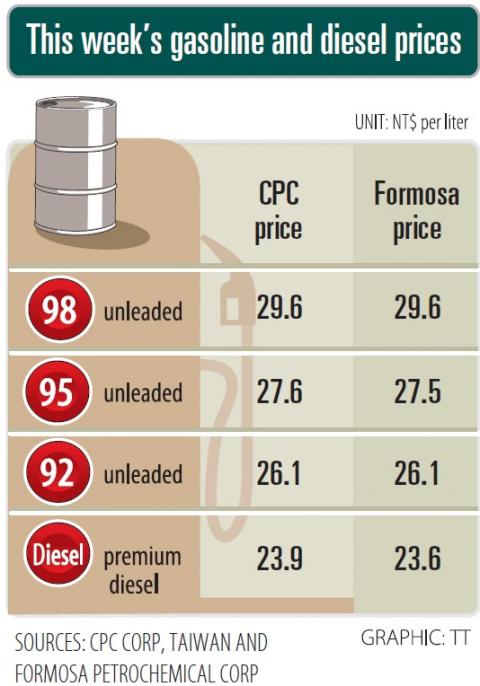
Separately, CPC yesterday announced that it would lower fuel prices this week, as crude oil prices dropped last week after Saudi Arabia lowered its prices for Arab Light sold to Asia and amid a continued increase in US crude oil inventories.
CPC said in a statement that its average crude oil cost fell by US$1.11 per barrel to US$62.41.
That means it is to cut gasoline and diesel prices by NT$0.2 per liter starting today after factoring in the New Taiwan dollar’s depreciation of NT$0.011 against the US dollar, the refiner said.

Singapore-based ride-hailing and delivery giant Grab Holdings Ltd has applied for regulatory approval to acquire the Taiwan operations of Germany-based Delivery Hero SE's Foodpanda in a deal valued at about US$600 million. Grab submitted the filing to the Fair Trade Commission on Friday last week, with the transaction subject to regulatory review and approval, the company said in a statement yesterday. Its independent governance structure would help foster a healthy and competitive market in Taiwan if the deal is approved, Grab said. Grab, which is listed on the NASDAQ, said in the filing that US-based Uber Technologies Inc holds about 13 percent of

The domestic unit of the Chinese-owned, Dutch-headquartered chipmaker Nexperia BV will soon be able to produce semiconductors locally within China, according to two company sources. Nexperia is at the center of a global tug-of-war over critical semiconductor technology, with a Dutch court in February ordering a probe into alleged mismanagement at the company. The geopolitical tussle has disrupted supply chains, with some carmakers reportedly forced to cut production due to chip shortages. Local production would allow Nexperia’s domestic arm, Nexperia Semiconductors (China) Ltd (安世半導體中國), to bypass restrictions in place since October on the supply of silicon wafers — etched with tiny components to

Taiwan Semiconductor Manufacturing Co (TSMC, 台積電) yesterday received government approval to deploy its advanced 3-nanometer (3nm) process at its second fab currently under construction in Japan, the Ministry of Economic Affairs said in a news release. The ministry green-lit the plan for the facility in Kumamoto, which is scheduled to start installing equipment and come online in 2028 with a monthly production capacity of 15,000 12-inch wafers, the ministry said. The Department of Investment Review in June 2024 authorized a US$5.26 billion investment for the facility, slated to manufacture 6- to 12nm chips, significantly less advanced than 3nm process. At a meeting with

Taiwan’s food delivery market could undergo a major shift if Singapore-based Grab Holdings Ltd completes its planned acquisition of Delivery Hero SE’s Foodpanda business in Taiwan, industry experts said. Grab on Monday last week announced it would acquire Foodpanda’s Taiwan operations for US$600 million. The deal is expected to be finalized in the second half of this year, with Grab aiming to complete user migration to its platform by the first half of next year. A duopoly between Uber Eats and Foodpanda dominates Taiwan’s delivery market, a structure that has remained intact since the Fair Trade Commission (FTC) blocked Uber Technologies Inc’s


 RSS
RSS