


Blockchain, the technology behind the cryptocurrency bitcoin, is taking root in a sector far from finance: the world of humanitarian aid.
By offering refugees a virtual identity, reassuring donors that their money is being well spent, or rushing funds where they are needed most, aid charities are experimenting with the technology in the hopes that it can improve their work.
“We are at the very beginning. There is a lot of hype,” said Christopher Fabian, leader of UNICEF’s Ventures Fund, which invests in open-source technology solutions.
At the end of last year, UNICEF — the UN agency dedicated to protecting children — brought together Russian-speaking blockchain experts in a meeting in Kazakhstan.
The goal? To develop a “smart contract” that would facilitate transactions between the organization and its numerous partners for deliveries and payments, if certain conditions were met.
“It totally failed, but we learned a lot from that and will do the same challenge this year in Mexico,” Fabian said, adding that he could envision a host of future projects using blockchain for the “social good” — even if most of them will fail.
However, the agency is thirsty for innovation. Its French office has also launched an operation dubbed Game Chaingers (for blockchain), which challenges tech geeks and gaming enthusiasts to install on their computers software aimed at creating ethereum, a virtual currency, to help Syrian children.
Blockchain allows users to create and spread information across a large network of computers, which its proponents say lends it both transparency and security. And the applications for the technology are multiplying quickly.
For aid and development groups, blockchain can come in all shapes and sizes. Aid donors could, for example, trace their contributions as they spread across an organization. The platform Disberse, supported by a network of 42 humanitarian groups, already road-tested this application by tracking money sent by a British association to four schools in Swaziland.
In theory, the technique can reduce transaction costs, fight corruption by making everything transparent, and allow a better record of where food aid is directed, or make sure that medicines are not counterfeited.
Those in charge of programs that directly send money to people in need also see it as a way of more easily controlling the disbursement of funds or avoiding use of financial intermediaries such as banks, which might also take a cut.
“In the old days, we were delivering aid at the back of the truck,” said Alex Sloan, a consultant at the World Food Program’s (WFP) Innovation Accelerator, which works with start-ups and others to help fight hunger. “Now, we are moving toward distributing cash to our beneficiaries, in the form of actual cash, through vouchers, e-cards, et cetera.”
Sloan’s organization has already field-tested a pilot project in Jordan’s Azraq refugee camp, where Syrian refugees can use iris-identification technology at a cash register to buy food and supplies.
The amount of money is then passed on via a blockchain-based computing platform. The program is currently private and used only by the WFP, making it more of a database project than a real blockchain.
However, Sloan said it could serve as a “tool to bring different partners and organizations together to collaborate and make the industry much more effective.”
The expansion of blockchain is not without risk. Besides the technical constraints, such as the need for an Internet connection, blockchain poses some basic questions about governance and data protection.
How to ensure, for example, that key information about refugees is not hacked by dictatorial regimes? Who authenticates the data? Which countries accept virtual portfolios?
Blockchain has enormous potential but still has a long way to go, said Rosa Akbari, technology adviser at the US charity Mercy Corps.
In fragile states, and dealing with people facing great hardship, “there could be some scary implications if we don’t do it responsibly,” she said.
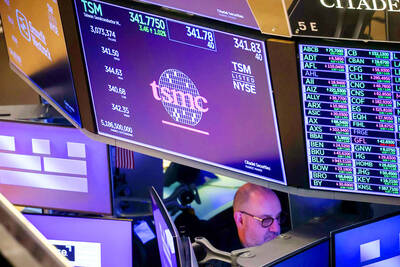
STRONG INTEREST: Analysts have pointed to optimism in TSMC’s growth prospects in the artificial intelligence era as the cause of the rising number of shareholders The number of people holding shares of chipmaker Taiwan Semiconductor Manufacturing Co (TSMC, 台積電) hit a new high last week despite a decline in its stock price, the Taiwan Depository and Clearing Corp (TDCC, 台灣集保) said. The number of TSMC shareholders rose to 2.46 million as of Friday, up 75,536 from a week earlier, TDCC data showed. The stock price fell 1.34 percent during the same week to close at NT$1,840 (US$57.55). The decline in TSMC’s share price resulted from volatility in global tech stocks, driven by rising international crude oil prices as the war against Iran continues. Dealers said
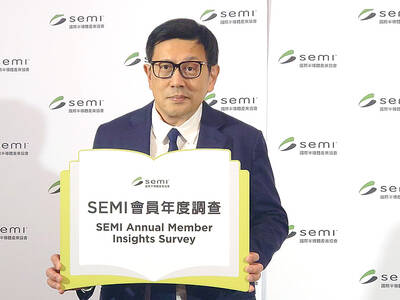
PRICE HIKES: The war in the Middle East would not significantly disrupt supply in the short term, but semiconductor companies are facing price surges for materials Taiwan’s semiconductor companies are not facing imminent supply disruptions of essential chemicals or raw materials due to the war in the Middle East, but surges in material costs loom large, industry association SEMI Taiwan said yesterday. The association’s comments came amid growing concerns that supplies of helium and other key raw materials used in semiconductor production could become a choke point after Qatar shut down its liquefied natural gas (LNG) production and helium output earlier this month due to the conflict. Qatar is the second-largest LNG supplier in the world and accounts for about 33 percent of global helium output. Helium is
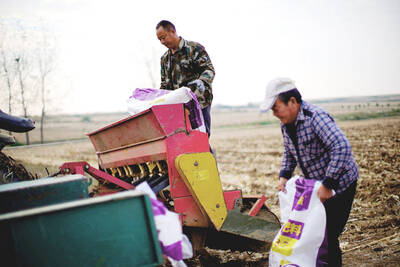
China is clamping down on fertilizer exports to protect its domestic market, industry sources said, putting an additional strain on global markets that were already grappling with shortages caused by the US-Israeli war on Iran. China is among the largest fertilizer exporters — shipping more than US$13 billion of it last year — and it has a history of controlling exports to keep prices low for farmers. Shipments through the war-blocked Strait of Hormuz account for about one-third of the sea-borne supply. This month, Beijing banned exports of nitrogen-potassium fertilizer blends and certain phosphate varieties, sources said. The ban, which has not

AMAZING ABUNDANCE: Elon Musk has announced plans for a new facility in Texas which would manufacture chips for Tesla and SpaceX to use in robotics and AI Elon Musk said his Terafab project — a grand plan to eventually manufacture his own chips for robotics, artificial intelligence (AI) and space data centers — would be built in Austin and jointly run by Tesla Inc and Space Exploration Technologies Corp (SpaceX). Musk, the chief executive officer of the two companies, said he would start off with an “advanced technology fab” in Austin that would have all of the equipment necessary to make chips of any kind. The project would call for one day supporting 1 terawatt (TW) of computing power per year, the amount Musk expects the companies to


 RSS
RSS