


Elon Musk said his Terafab project — a grand plan to eventually manufacture his own chips for robotics, artificial intelligence (AI) and space data centers — would be built in Austin and jointly run by Tesla Inc and Space Exploration Technologies Corp (SpaceX).
Musk, the chief executive officer of the two companies, said he would start off with an “advanced technology fab” in Austin that would have all of the equipment necessary to make chips of any kind.
The project would call for one day supporting 1 terawatt (TW) of computing power per year, the amount Musk expects the companies to eventually use as he ramps up his investments in AI and robotics.
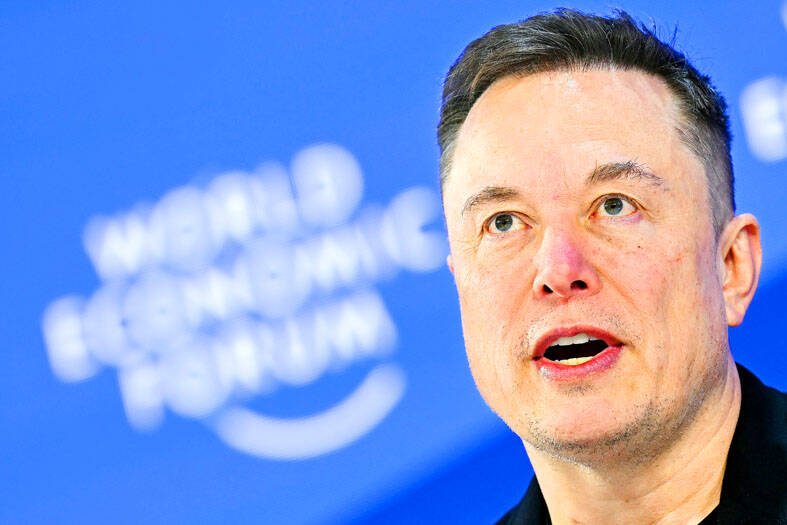
Photo: AFP
The billionaire detailed some specific plans, including producing chips that can support 100 to 200 gigawatts a year of computing power on Earth, and chips that can support 1TW in space, but gave no timelines for the facility or its output.
Musk has said previously that the facility would produce 2 nanometer chips. The project is planned for an area near Tesla’s existing Austin headquarters and gigafactory, based on a photo shown during the presentation.
Many executives have expressed anxiety about a shortage of chips — particularly memory chips — during the race to build computing power for AI, but it is rare to try building them. Bringing semiconductor facilities online typically takes tens of billions dollars and requires the purchase of complex machines from multiple providers. Factories can take years to become fully operational.
Musk made the announcement in a downtown Austin venue to an audience that included Texas Governor Greg Abbott. If it succeeds, the project could help elevate Texas’ status as a chipmaking hub.
Tesla already has an agreement with Samsung Electronics Co facility near Austin on upcoming chips. The electric vehicle company also has existing suppliers, including Taiwan Semiconductor Manufacturing Co (台積電) and Micron Technology Inc that Musk says are also not able to meet all the company’s needs as Tesla pivots its focus to robotics, autonomous driving and AI.
The facility is expected to make two types of chips, one of which would be optimized for edge and inference, primarily for his vehicle, robotaxi and Optimus humanoid robots. The other would be a high-power chip, designed for space that could be used by SpaceX and xAI.
During the presentation, Musk also unveiled a speculative rendering of a future “mini” AI data center satellite, one piece of a much larger satellite system that he wants SpaceX to build to do complex computing in space. He said that the mini satellite he revealed would have the capacity for 100 kilowatts of power.
“We expect future satellites to probably go to the megawatt range,” Musk said.
The presentation also included some of Musk’s loftier ambitions. He showed an animation of how SpaceX could potentially launch satellites from the surface of the moon, and reiterated his vision for a future filled with “amazing abundance” — something he has been touting in recent months.
“The future I want to see: I want us to live long enough to see the mass driver on the moon,” Musk said, referring to the contraption that would launch satellites from the lunar surface, “because that’s going to be incredibly epic.”
After several years flying high as Asia’s best Nvidia Corp proxy, Taiwan Semiconductor Manufacturing Co (TSMC, 台積電) is increasingly vying with other artificial intelligence (AI) stocks for investor attention. Stock traders are chasing a wider array of beneficiaries as mainstream usage of AI creates demand for hardware beyond the most-advanced chips TSMC makes for Nvidia. Subthemes from the deepening memory crunch to advances in robotics are also luring bids. At the same time, investment caps on single stocks are pushing funds to diversify, while retail investors long familiar with TSMC through its US depositary receipts are being offered a broader set of

Netherlands-based semiconductor equipment supplier ASML Holding NV yesterday said that it is planning to hire an additional 1,000 people in Taiwan this year in response to growing demand from clients. ASML had previously planned to recruit 600 people this year, but that the plan has been adjusted upward, ASML vice president and ASML Taiwan general manager Grace Wang (汪佳慧) told reporters. ASML has a workforce of more than 4,500 in Taiwan, accounting for about 10 percent of its global total, Wang said. This year’s recruitment campaign would focus on adding people in the customer support, manufacturing and supply chain domains to assist ASML

UNDER MICROSCOPE: Taiwan detained three people who allegedly conspired to buy servers in Taiwan and export them using fraudulent documentation, prosecutors said Nvidia Corp chief executive officer Jensen Huang (黃仁勳) on Saturday urged Super Micro Computer Inc to tighten up on compliance after Taiwan detained three people this week for allegedly making fraudulent declarations about artificial intelligence (AI) servers made by its US partner. The development marked the nation’s first crackdown on semiconductor smuggling, which grew after the US slapped restrictions on exports of high-end chips such as Nvidia AI accelerators to China. Nvidia is “rigorous” in explaining regulations to all of its partners, Huang told reporters after arriving in Taipei. “Ultimately Super Micro has to run their own company,” he said in response to
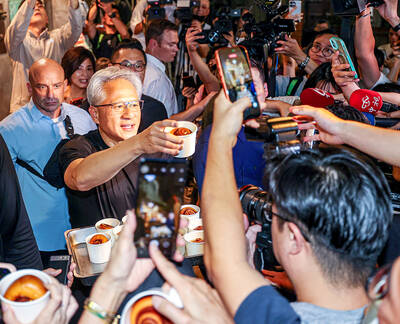
Nvidia Corp yesterday announced that CEO Jensen Huang (黃仁勳) would attend an employee meeting in Taipei tomorrow to celebrate the launch of the company’s Taiwan headquarters project. Huang would attend a gathering at the site of Nvidia’s planned headquarters in Beitou Shilin Technology Park (北投士林科技園區), the company said in a statement. After arriving in Taiwan on Saturday last week, Huang told reporters that he plans to meet with Quanta Computer Inc (廣達) chairman Barry Lam (林百里) and Taiwan Semiconductor Manufacturing Co (TSMC, 台積電) chairman C.C. Wei (魏哲家), and would attend the groundbreaking ceremony for Nvidia’s Taiwan headquarters tomorrow. Nvidia has not yet applied


 RSS
RSS