


Gawker Media Group is filing for Chapter 11 bankruptcy protection and putting itself up for sale, strained by a jury’s verdict that it must pay US$140 million to pro wrestler Hulk Hogan in an invasion-of-privacy lawsuit.
The filing by the 14-year-old Web site follows the revelation last month that Silicon Valley billionaire Peter Thiel bankrolled Hogan’s lawsuit as what he called a “deterrent” to Gawker’s no-holds-barred and sometimes gonzo style of journalism.
Thiel’s secret role sparked anxiety over the possibility that more wealthy individuals might cow publications by covertly funding lawsuits against them.
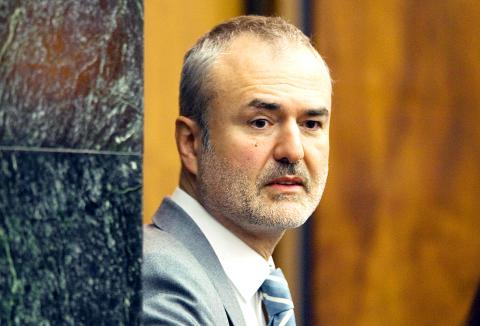
Photo: AP
Gawker said it plans to sell itself to publishing company Ziff Davis, although other bidders could emerge during the bankruptcy court auction. The sale will help it fund its appeal against the Hogan judgement in a Florida state court.
Gawker founder Nick Denton said in a statement that Ziff Davis’ e-commerce, licensing and video assets would be a good fit with Gawker’s Web sites, which include tech site Gizmodo, sports site Deadpsin, video-game site Kotaku, celebrity and women-focused site Jezebel, news and gossip site Gawker, car-site Jalopnik and self-help site Lifehacker.
“We have been forced by this litigation to give up our long-standing independence,” Denton said in the statement. “With stronger backing and disentangled from litigation, [Gawker writers] can perform their vital work on more platforms and in different forms.”
The move also allows Gawker’s Web sites to keep operating normally, the company said.
Gawker filed for Chapter 11 bankruptcy protection about three months after Hogan won a lawsuit against the online gossip and news publisher.
The New York publisher said in the filing that it has as much as US$500 million in debt and up to US$100 million in assets.
Media analyst Dean Starkman, a fellow at the Center for Media, Data and Society at the Central European University in Budapest, said the bankruptcy was an “ominous development” for journalism.
“You don’t want billionaires to be any final arbiter of press fairness — that’s just not democracy,” he said. “While many of us disagreed with Gawker’s news judgement in this case, and many are ambivalent about Gawker itself, the issue here was a billionaire’s use and potential abuse of the legal process to drain a journalism outlet’s resources.”
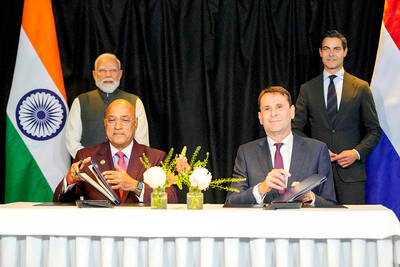
NEW MARKET: The partnership opens up India to the Dutch company, which already has a strong hold in the semiconductor market of South Korea, Taiwan and China ASML Holding NV entered into a partnership agreement with Tata Electronics Pvt Ltd aimed at ramping up India’s goal to develop domestic chip-manufacturing capabilities. The Dutch company’s technology would help power Tata Electronics’ planned 300 millimeter (mm) semiconductor foundry in Gujarat, according to a joint statement from the two companies on Saturday. The signing of a memorandum of understanding coincides with a visit by Indian Prime Minister Narendra Modi to the Netherlands, which is looking to deepen bilateral relations with New Delhi. ASML, whose top customers include Taiwan Semiconductor Manufacturing Co (台積電) and Samsung Electronics Co, makes lithography machines that can print

TECH RELIANCE: Growth is increasingly reflecting an unequal K-shaped distribution, where technology sectors outperform and other industries struggle, an expert said Standard Chartered Bank has significantly raised its forecast for Taiwan’s economic growth to 9.5 percent this year, up from 7.6 percent previously, citing surging artificial intelligence (AI) demand driving exports, semiconductor production and investment. The upgrade reflects a sustained AI supercycle that continues to fuel demand for advanced chips and technology infrastructure, which form the backbone of Taiwan’s exports, the bank said in a report this week. “We raise our 2026 growth forecast to reflect a much stronger-than-expected first-quarter GDP figure,” Standard Chartered senior economist for greater China and Asia Tommy Wu (胡東安) said in the report. Driven largely by a 35.3 percent

Tokyo Electron's Taiwan unit today said in a written response that it respects the judicial process, takes the court ruling seriously and would not appeal in the Taiwan Semiconductor Manufacturing Co (TSMC, 台積電) trade secrets case. Last month, a court fined the Taiwan unit of Japan's Tokyo Electron NT$150 million (US$4.74 million) in a case involving trade secrets related to TSMC's sensitive chip technology.
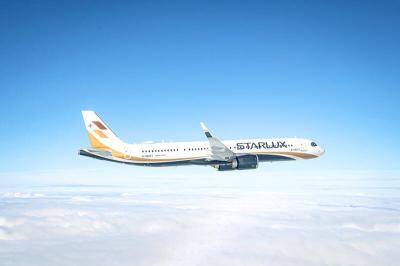
Two of Taiwan’s international carriers, Starlux Airlines Co (星宇航空) and EVA Airways Corp (長榮航空), have retained the five-star airline rating awarded by international airline review organization Skytrax. Starlux was awarded the distinction for a second consecutive year, while EVA Air received it for the 11th straight year, Skytrax said in statements released yesterday and on Thursday last week, respectively. The five-star rating is considered one of the airline industry's highest honors and is awarded following professional audits of airline product and frontline service standards, Skytrax said. The ratings are based on in-depth assessments using unified global quality standards rather than customer review scores


 RSS
RSS