


Cheng Shin Rubber Industry Co (正新橡膠), the world’s ninth-largest tire maker, said it expects that spending more on research and development (R&D) at its operation in Kunshan, Jiangsu Province, China, this year will help it secure more orders from international brands.
The Changhua County-based company — known for its brands CST, Maxxis, Sakura and Presa — also aims to dethrone Japan’s Yokohama Rubber Co to become the eighth-largest tire maker in the world by tapping the fast growth the Chinese car market has exhibited over recent years, it said.
Although the US currently has the largest amount of cars in the world, China is likely to supersede the US as the world’s largest car market in the future, Cheng Shin chairman Robert Lo (羅才仁) said on Tuesday in Kunshan.
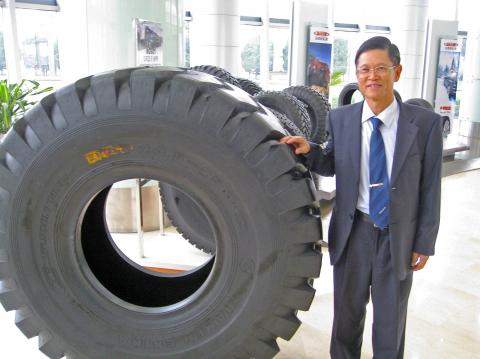
Photo: CNA
Last year, Cheng Shin supplied 13 million tires for about 3 million new cars in China, accounting for 13 percent of the country’s total new car sales of 23 million. That is higher than the 10 percent registered in 2012, Lo said.
From January through last month, Cheng Shin reported revenue of NT$87.18 billion (US$2.9 billion), registering a 4.83 percent decline from NT$89.35 billion a year ago due to fierce competition from global tier-one tire makers in China.
Analysts say the sales drop also emphatically reflects the slowing growth in China’s commercial vehicle market.
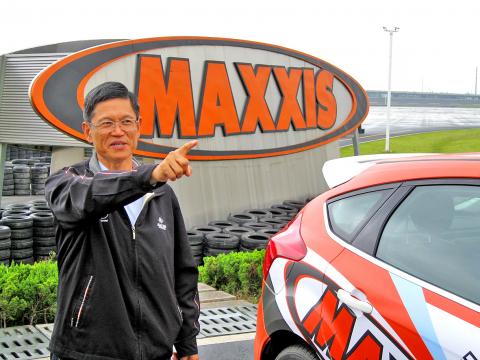
Photo: CNA
“It is as if all major tire makers around the world are playing the [soccer] World Cup in China,” said Lo, who in June took the helm of the company from his father, Luo Jye (羅結), who founded Cheng Shin.
The younger Lo said his role is to try to support the different teams within the company and help them cooperate with each other.
“It is impossible for a chairman to control every part of the company; we have to also rely on our professional management personnel,” Robert Lo said.
He said he is confident that Cheng Shin can obtain more orders from global car vendors, given that the company has Asia’s largest proven tire testing ground in Kunshan.
The NT$5 billion testing facility — the building of which began in 2003 and was completed in November 2012 — spans 86 hectares, nearly 60 percent of the total area of Cheng Shin’s Kunshan operation.
To build the field, the company spent one year investigating road conditions around the world and another two years designing the ground, Robert Lo said.
The tire-testing facility employs 300 R&D personnel, while the Kunshan operation has a total of 6,000 employees, he said.
“The testing facility allows us to submit every car to the most extreme conditions and see if the design of our tires goes well with the vehicle,” he said.
According to Lo, although the world’s top 10 tire makers all have testing facilities like the Kunshan ground, Cheng Shin is the only one with such a facility in Asia.
“Car makers tend to have more confidence in a tire company with a field like that,” Robert Lo said.
He said the test facility can cut the development time for a tire by about 30 percent because the company does not need to ship the tires to Europe or other places for testing.
The Kunshan test facility’s largest client is BMW AG, Robert Lo said, adding that Ford Motor Co is also a major client.
Cheng Shin supplies the tires used for the best-selling Ford Focus sedans in China, with 400,000 of the cars distributed in the country each year by Ford’s local subsidiary.
This year, the Kunshan operation will spend about 3 percent of its revenue on R&D, Robert Lo said.
In total, Cheng Shin spent NT$1.57 billion on R&D in the first half of the year, accounting for 2.45 percent of its NT$64.29 billion revenue, according to the company’s filing with the Taiwan Stock Exchange.
The Kunshan operation accounted for 18 percent of Cheng Shin’s total revenue of NT$133.09 billion last year, assistant vice president Richard Lo (羅永勵) told reporters yesterday.
In the first half of the year, about 64.3 percent of the division’s revenue came from sales in the original equipment market, the highest rate among all the company’s factories, according to Cheng Shin.
About 26.9 percent of the company’s revenue from January through June came from the original equipment market, it said.

Taiwan’s foreign exchange reserves fell below the US$600 billion mark at the end of last month, with the central bank reporting a total of US$596.89 billion — a decline of US$8.6 billion from February — ending a three-month streak of increases. The central bank attributed the drop to a combination of factors such as outflows by foreign institutional investors, currency fluctuations and its own market interventions. “The large-scale outflows disrupted the balance of supply and demand in the foreign exchange market, prompting the central bank to intervene repeatedly by selling US dollars to stabilize the local currency,” Department of Foreign
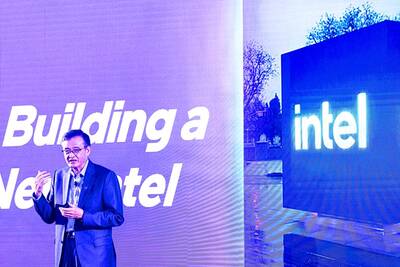
Intel Corp is joining Elon Musk’s long-shot effort to develop semiconductors for Tesla Inc, Space Exploration Technologies Corp and xAI, marking a surprising twist in the chipmaker’s comeback bid. Intel would help the Terafab project “refactor” the technology in a chip factory, the company said on Tuesday in a post on X, Musk’s social media platform. That is a stage in the development process that typically helps make chips more powerful or reliable. The chipmaker’s shares jumped 4.2 percent to US$52.91 in New York trading on Tuesday. The Terafab project is a grand plan by Musk to eventually manufacture his own chips for
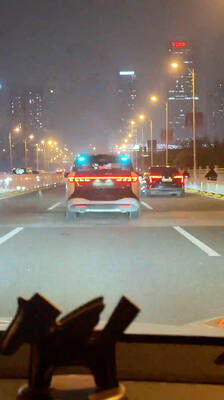
Some robotaxi passengers were left stranded in the middle of fast-moving traffic in a major Chinese city after their driverless vehicles stopped running, according to police and media reports on Wednesday. A preliminary investigation indicates more than 100 robotaxis came to a halt because of a “system malfunction,” police in the city of Wuhan said in a statement, without elaborating. No injuries were reported. One passenger told Chinese media that their robotaxi stopped after turning a corner. An instruction on a screen read: “Driving system malfunction. Staff are expected to arrive in 5 minutes.” After no one showed up, the passenger pushed
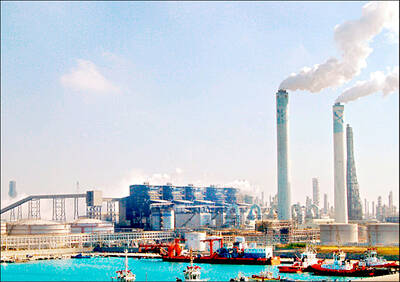
Taiwan Power Co (Taipower, 台電) yesterday said it plans to resume operations at two coal-fired power generators for three months to boost security of electricity supply as liquefied natural gas (LNG) supply risks are running high due to the Middle East conflict. The two coal-fired power generators are at Mailiao Power Plant in Yunlin County’s Mailiao Township (麥寮). The plant, operated by Formosa Plastics Group (台塑集團), supplied electricity to Taipower’s power grid until the end of last year. Taipower’s decision came about one month after Minister of Economic Affairs Kung Ming-hsin (龔明鑫) on March 10 said that the nation had no imminent


 RSS
RSS