


With his pilgrim’s staff and Panama hat, Father Godfrey Nzamujo nips up and down the paths of the Songhai Center, the organic farm he created in Benin nearly 30 years ago to fight poverty and rural migration in Africa.
The small farm barely covered a hectare when it was set up in the Beninese capital of Porto-Novo in 1985, but has since become a pilot project for the rest of a continent badly in need of new ideas to maximize crop yields.
The farm’s center now stretches over 24 hectares and employs an army of workers and apprentices, who toil from sunrise to sunset growing fruit, vegetables and rice, as well as rearing fish, pigs, poultry.
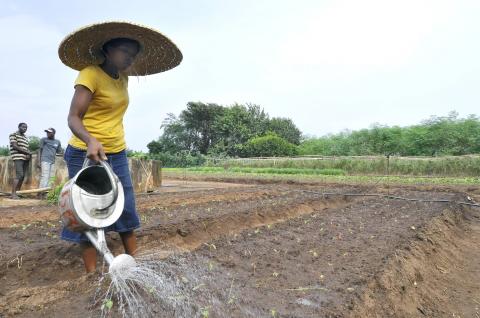
Photo: AFP
In accordance with Nzamujo’s principle, “nothing is wasted, everything is transformed,” on the farm, with even chicken droppings turned into bio-gas that powers the center’s kitchens.
Though it is housed in the tiny West African nation, Songhai has big plans for the rest of the continent. It already has similar operations in Nigeria, Liberia and Sierra Leone and wants to set up shop in 13 more western and central countries.
Nzamujo’s raison d’etre is how to help Africans increase yields through simple techniques, without using pesticides or fertilizers, while cutting production costs and protecting the environment.

Photo: AFP
The Nigeria-born priest, who was raised in California, said he was shocked by the appalling images of famine in Africa broadcast on TV in the early 1980s.
He left to discover the continent and see how he could put his university training in agronomics, economics and information technology to good use and fight against poverty on his own terms.
After visiting several countries, he ended up in Benin, where the then-Marxist government gave him a small plot of land.
“It was abandoned land, killed by chemical fertilizer and conventional agricultural practices. It didn’t work,” he said.
“There were seven of us. We dug wells and watered with our own hands, and during the main dry season, this gray surface became green,” he said.
Nzamujo’s secret is imitating nature, encouraging the “good bacteria” present in the soil to maximize production without having to rely on chemicals.
Songhai’s yields speak for themselves: The farm produces 7 tonnes of rice per hectare three times a year, up from 1 tonne per hectare once a year at the beginning of the project.
“Songhai is facing up to the triple challenge of Africa today: poverty, environment and youth employment,” Nzamujo said proudly.
The cleric’s system centers on local production and distribution, creating economic activity to tackle poverty head on.
At Songhai, jam simmers in large pots, as chickens are roasted and soya oil, rice and fruit juice are packaged for sale in the center’s shop or served at its restaurant.
Discarded parts of agricultural machinery are reused to create ingenious contraptions and used water is filtered using water hyacinths.
The farm center also has an Internet point and a bank so locals can avoid going into the center of Porto-Novo.
Youth employment is encouraged and about 400 farming apprentices are selected by a competition and trained at Songhai every year. The 18-month course is entirely free.
Paul Okou is one of them, a 25-year-old from Parakou, northern Benin, who said he wants to follow his parents into farming, but is hoping to work more profitably.
“My parents use traditional, archaic methods, while at Songhai we learn the modern way, albeit makeshift,” he said. “What we used to do in two days, now we do in two hours.”
The apprentices are sent to villages where they apply what they have learned. Once in charge of a farm, they join the Songhai network and are checked on regularly.
Songhai also welcomes interns who pay for their own training.
They include Abua Eucharia Nchinor, a Nigerian in his 30s, and Kemajou Nathanael, a 39-year-old former salesman from Cameroon, who both want to open an organic farm in their respective countries.
Nzamujo said Songhai is not a cure-all for Africa’s problems but does tackle their root causes.
“Imagine if all the young people who hang around big cities did their training here and we equip them... Imagine the productivity of Africa today,” he said.

UNPRECEDENTED PACE: Micron Technology has announced plans to expand manufacturing capabilities with the acquisition of a new chip plant in Miaoli Micron Technology Inc unveiled a newly acquired chip plant in Miaoli County yesterday, as the company expands capacity to meet growing demand for advanced DRAM chips, including high-bandwidth memory chips amid the artificial intelligence boom. The plant in Miaoli County’s Tongluo Township (銅鑼), which Micron acquired from Powerchip Semiconductor Manufacturing Corp (力積電) for US$1.8 billion, is expected to make a sizeable capacity contribution to the company from fiscal 2028, the company said in a statement. It would be an extended production site of Micron’s large-scale manufacturing hub in Taichung, the company said. As the global semiconductor industry is racing to reach US$1 trillion

Singapore-based ride-hailing and delivery giant Grab Holdings Ltd has applied for regulatory approval to acquire the Taiwan operations of Germany-based Delivery Hero SE's Foodpanda in a deal valued at about US$600 million. Grab submitted the filing to the Fair Trade Commission on Friday last week, with the transaction subject to regulatory review and approval, the company said in a statement yesterday. Its independent governance structure would help foster a healthy and competitive market in Taiwan if the deal is approved, Grab said. Grab, which is listed on the NASDAQ, said in the filing that US-based Uber Technologies Inc holds about 13 percent of

Taiwan’s food delivery market could undergo a major shift if Singapore-based Grab Holdings Ltd completes its planned acquisition of Delivery Hero SE’s Foodpanda business in Taiwan, industry experts said. Grab on Monday last week announced it would acquire Foodpanda’s Taiwan operations for US$600 million. The deal is expected to be finalized in the second half of this year, with Grab aiming to complete user migration to its platform by the first half of next year. A duopoly between Uber Eats and Foodpanda dominates Taiwan’s delivery market, a structure that has remained intact since the Fair Trade Commission (FTC) blocked Uber Technologies Inc’s

Memory chip stocks extended their losses yesterday after Alphabet Inc’s Google publicized research that could allow more efficient use of the storage needed for artificial intelligence (AI) development. SK Hynix Inc and Samsung Electronics Co, South Korean leaders in the market, fell more than 6 percent and about 5 percent respectively in Seoul. In the US, Micron Technology Inc, Western Digital Corp and Sandisk Corp slid more than 2 percent in pre-market trading, after they all closed lower on Wednesday. Memory companies have been on a tear in recent months as the rapid development of AI infrastructure triggered a spike in chip


 RSS
RSS