


With its masters required to hone their skills over decades, sushi in Japan is steeped in tradition, but it is also often a high-tech operation where robotic precision steals the limelight from the chef’s knife.
The country is dotted with thousands of kaiten (revolving) sushi restaurants where raw fish slices atop rice balls travel on conveyer belts along counters waiting to be picked up by diners.
However, behind the scenes it is far from a simple merry-go-round, with robots in some locations rolling out perfectly-sized rice balls onto plates embedded with microchips.
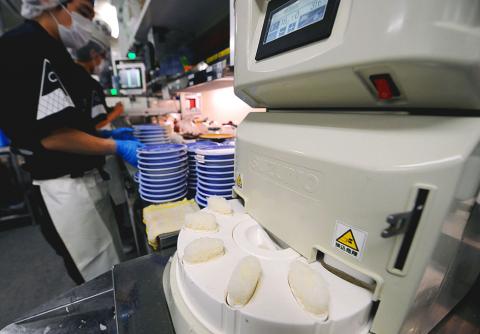
Photo: AFP
Measured dollops of spicy wasabi paste are squirted onto the rice assembly-line style before they are topped with raw fish. The most cutting-edge eateries are even connected to monitoring centers that can quickly tell whether the right balance of dishes is being produced — a far cry from traditional places where the sushi chef and his knife still reign supreme.
“Sushi isn’t going round at random, but rather it is coming out based on a number of calculations,” said Akihiro Tsuji, public relations manager at Kura Corp, a major operator in a market expected to post US$5 billion in revenue this year, according to industry figures.
“Though traditional, sushi is stuffed with high technology. You can’t operate low-price revolving sushi restaurants without databases and scientific management,” he said at a Tokyo outlet.
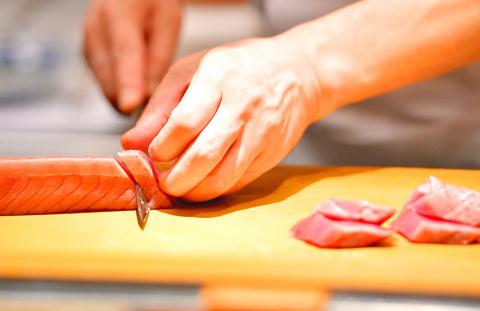
Photo: AFP
Kura has invented a serving device called sendo-kun, which translates roughly as “Mr Fresh,” a plate with a transparent dome that opens automatically when diners select the dish.
While the hood keeps the sushi moist and clean, it also contains a microchip telling managers what kinds of fish are going around on the conveyer belts and how long they have been there.
Since their birth half-a-century ago, kaiten sushi restaurants have evolved from selling traditional sushi into miniature museums of the food that Japanese people eat today, including battered tempura, noodles and even ice cream. The dishes are cheap, usually starting at about ¥100 (US$1) for two pieces of sushi.
Now, more and more outlets are equipped with dedicated “high-speed” lanes where customers can make their order via a touchscreen menu.
Ryozo Aida, a 68-year-old university lecturer, said he visits Kura outlets with his wife because of its “affordable prices.”
“It may sound strange in a sushi restaurant, but I like tempura,” he said as he jabbed his fingers at a touchscreen panel.
Inside the kitchen, screens show how many adults and children are dining and approximately how long they have been in the restaurant.
“Even if all the 199 seats here are occupied, how much sushi we need will differ depending on how long they have been at the table,” Tsuji said.
The system combines real-time data with information about how many items were consumed in similar circumstances in the past, displaying results for kitchen staff.
Complementing on-the-spot efforts, the Kura chain also has a remote assistance system serving its network of more than 300 outlets.
In-store cameras feed images to dozens of supervisors who move from restaurant to restaurant with laptops, while others watch from monitoring centers to advise restaurants instantly if there is enough food and the right mix of offerings on the conveyer belt.
The cameras can zoom in on sushi to make sure it is laid out in regulation elegance, although they do not monitor customers’ faces for privacy reasons.
At another outlet run by Genki Sushi’s “Uobei” brand in Tokyo’s fashionable Shibuya District, the concept of one conveyor belt has been updated. All 90 seats face counters with three decks of “high-speed” lanes delivering sushi directly to customers who ordered it using a multilingual touch screen.
Accuracy and speed is the name of the game, with the store targeting delivery in less than one minute.
“As we looked at how fast we can deliver what’s ordered, we came up with this system,” said Akira Koyanagi, district manager for Genki, adding that it also cuts down on wasted food.
All this high-end technology costs money, but sales at kaiten sushi restaurants have grown 20 percent over the past five years, with the industry expected to rake in nearly US$5 billion this year, according to research firm Fuji-Keizai Group.
However, a key challenge is that Japanese are eating less fish and more meat these days as world prices rise due to strong demand in the US and Europe.
“Procurement is getting tough,” a Genki Sushi spokesman said.


The domestic unit of the Chinese-owned, Dutch-headquartered chipmaker Nexperia BV will soon be able to produce semiconductors locally within China, according to two company sources. Nexperia is at the center of a global tug-of-war over critical semiconductor technology, with a Dutch court in February ordering a probe into alleged mismanagement at the company. The geopolitical tussle has disrupted supply chains, with some carmakers reportedly forced to cut production due to chip shortages. Local production would allow Nexperia’s domestic arm, Nexperia Semiconductors (China) Ltd (安世半導體中國), to bypass restrictions in place since October on the supply of silicon wafers — etched with tiny components to
Taiwan’s foreign exchange reserves fell below the US$600 billion mark at the end of last month, with the central bank reporting a total of US$596.89 billion — a decline of US$8.6 billion from February — ending a three-month streak of increases. The central bank attributed the drop to a combination of factors such as outflows by foreign institutional investors, currency fluctuations and its own market interventions. “The large-scale outflows disrupted the balance of supply and demand in the foreign exchange market, prompting the central bank to intervene repeatedly by selling US dollars to stabilize the local currency,” Department of Foreign
Taiwan is open to joining a global liquefied natural gas (LNG) program if one is created, but on the condition that countries provide delivery even in a scenario where there is a conflict with China, an energy department official said yesterday. While Taiwan’s priority is to have enough LNG at home, the nation is open to exploring potential strategic reserves in other countries such as Japan or South Korea, Energy Administration Deputy Director-General Chen Chung-hsien (陳崇憲) said. While the LNG market does not have a global reserve for emergencies like that of oil, the concept has been raised a few times —
AI-FUELED DEMAND: The company has been benefiting from the skyrocketing prices for DRAM chips amid the AI frenzy, especially its core product — DDR4 DRAM chips DRAM chipmaker Nanya Technology Corp (南亞科技) yesterday reported that its revenue for the first quarter surged 582.91 percent to NT$49.09 billion (US$1.54 billion) from NT$7.19 billion a year earlier, as the supply crunch caused chip price spikes. Last quarter’s figure is the highest on record. On a quarterly basis, revenue jumped 63.14 percent from NT$30.09 billion, the company said. In January, Nanya Technology expected global DRAM supply scarcity to continue through the first half of 2028, thanks to strong demand for artificial intelligence (AI) applications. Market researcher TrendForce Corp (集邦科技) forecast prices of standard DRAM chips would rise between 58 percent and 63


 RSS
RSS