


Bosch Taiwan, the local unit of the German engineering giant Bosch Group, is aiming for modest sales growth this year following the acquisition of Unipoint Group (揚弘實業) last year, a move that boosted its staff nearly fourfold, newly installed managing director Bernd Barkey said yesterday.
“It is unlikely we’ll achieve double-digit sales growth this year as the economic picture looks tough ahead,” Barkey told a media briefing.
Bosch’s core products include automotive components, industrial products, consumer goods and building products.
Bosch Taiwan generated sales of NT$3.7 billion (US$123.75 million) last year, up 32 percent on 2010, growth that was attributable to improvements in all its business segments, said Barkey, who assumed his position in September last year.
The group hopes to expand its presence in Taiwan and strengthen its position in the automotive technology, industrial technology, consumer goods and building technology sectors, he said.
Toward that end, the company in December last year acquired Unipoint Group, which focuses on making starters, alternators, temperature controls and wiper blades for the automotive after-sales market.
The acquisition has enabled Unipoint to explore more business opportunities worldwide through Bosch’s existing networks and it has allowed Bosch to strengthen its leadership in the automotive after-sales market and to expand in the rest of Asia, Barkey said.
Taoyuan-based Unipoint has more than 500 employees in Taiwan and 1,900 employees in China.
Bosch Taiwan plans to hire more workers, but it is placing more emphasis on integration with Unipoint to enhance the synergy benefits, he said, adding that the company plans to set up a new repair center in September to better serve its local customers.
Last month, the German group founded BSH Home Appliances Private Ltd to sell its products — dishwashers, ovens, washing machines, dryers and coffee machines — that used to be represented by local distributor Achelis Taiwan Co (德商雅基利).
Bosch plans to open an experience center in Taipei’s Neihu District (內湖) in September to showcase its products, Barkey said.
Apart from the pursuit of steady sales growth, the company is also stepping up research and development on Internet protocol cameras, commonly used for surveillance, he said.
“Taiwan, while accounting for only 0.2 percent of the group’s overall sales, is an important market,” Barkey said.
Bosch’s global revenues totaled NT$2.06 trillion last year, up 9 percent from a year earlier, driven mainly by the automotive technology sector, which had a 59 percent contribution, company data showed.
Europe accounted for 59 percent of the sales, followed by the Asia-Pacific region with 23 percent and North America with 14 percent, company statistics showed.


Taiwan’s foreign exchange reserves fell below the US$600 billion mark at the end of last month, with the central bank reporting a total of US$596.89 billion — a decline of US$8.6 billion from February — ending a three-month streak of increases. The central bank attributed the drop to a combination of factors such as outflows by foreign institutional investors, currency fluctuations and its own market interventions. “The large-scale outflows disrupted the balance of supply and demand in the foreign exchange market, prompting the central bank to intervene repeatedly by selling US dollars to stabilize the local currency,” Department of Foreign

Intel Corp is joining Elon Musk’s long-shot effort to develop semiconductors for Tesla Inc, Space Exploration Technologies Corp and xAI, marking a surprising twist in the chipmaker’s comeback bid. Intel would help the Terafab project “refactor” the technology in a chip factory, the company said on Tuesday in a post on X, Musk’s social media platform. That is a stage in the development process that typically helps make chips more powerful or reliable. The chipmaker’s shares jumped 4.2 percent to US$52.91 in New York trading on Tuesday. The Terafab project is a grand plan by Musk to eventually manufacture his own chips for
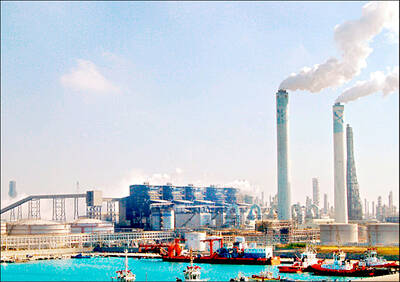
Taiwan Power Co (Taipower, 台電) yesterday said it plans to resume operations at two coal-fired power generators for three months to boost security of electricity supply as liquefied natural gas (LNG) supply risks are running high due to the Middle East conflict. The two coal-fired power generators are at Mailiao Power Plant in Yunlin County’s Mailiao Township (麥寮). The plant, operated by Formosa Plastics Group (台塑集團), supplied electricity to Taipower’s power grid until the end of last year. Taipower’s decision came about one month after Minister of Economic Affairs Kung Ming-hsin (龔明鑫) on March 10 said that the nation had no imminent

Some robotaxi passengers were left stranded in the middle of fast-moving traffic in a major Chinese city after their driverless vehicles stopped running, according to police and media reports on Wednesday. A preliminary investigation indicates more than 100 robotaxis came to a halt because of a “system malfunction,” police in the city of Wuhan said in a statement, without elaborating. No injuries were reported. One passenger told Chinese media that their robotaxi stopped after turning a corner. An instruction on a screen read: “Driving system malfunction. Staff are expected to arrive in 5 minutes.” After no one showed up, the passenger pushed


 RSS
RSS