


Pandora raised the price range of its initial public offering (IPO) on Friday by at least one-third and boosted the number of shares to be sold by as many as 1 million, demonstrating again a seemingly insatiable demand from investors for a stake a new slate of Internet companies.
The popular online radio service may raise as much as US$176.3 million with the new offer.
Proceeds for Pandora Media Inc could reach about US$72 million if the shares price at US$12. Selling stockholders would get up to US$104.2 million.

Photo: AFP
Pandora raised the price range for the shares to between US$10 and US$12, up from the initial US$7 and US$9 it had been seeking. Pandora and the selling stockholders are also now offering up to 14.7 million shares, up from 13.7 million earlier.
The IPO from Pandora, based in Oakland, California, comes amid a sizzling market for the latest generation of Internet companies. These include daily deals site Groupon Inc, which has filed to go public, and professional networking service LinkedIn Corp, which has already completed its IPO.
Shares of LinkedIn, issued at US$45 in the middle of last month, soared above US$100 before noon on the day they hit the market and closed at US$94.25 on a trading volume of 30 million shares. Shares are now trading above US$72.
Pandora got its start in 2000 as a music recommendation service, then known as Savage Beast Technologies. It changed its name in 2005 when it launched an Internet radio service that lets people stream music over the Web. Users can create custom stations based on songs, genres or artists.
Pandora chief executive Joseph Kennedy owns 4.2 million Pandora shares. Other stockholders include venture capitalists Crosslink Capital, Walden Venture Capital and Greylock Partners and newspaper and magazine publisher Hearst Corp.
Pandora offers a basic, ad--supported service for free. Users can pay for a service with no ads that allows them to skip more songs they don’t like and listen to songs in higher sound quality. Most listeners still use the free service.


Taiwan’s foreign exchange reserves fell below the US$600 billion mark at the end of last month, with the central bank reporting a total of US$596.89 billion — a decline of US$8.6 billion from February — ending a three-month streak of increases. The central bank attributed the drop to a combination of factors such as outflows by foreign institutional investors, currency fluctuations and its own market interventions. “The large-scale outflows disrupted the balance of supply and demand in the foreign exchange market, prompting the central bank to intervene repeatedly by selling US dollars to stabilize the local currency,” Department of Foreign

Intel Corp is joining Elon Musk’s long-shot effort to develop semiconductors for Tesla Inc, Space Exploration Technologies Corp and xAI, marking a surprising twist in the chipmaker’s comeback bid. Intel would help the Terafab project “refactor” the technology in a chip factory, the company said on Tuesday in a post on X, Musk’s social media platform. That is a stage in the development process that typically helps make chips more powerful or reliable. The chipmaker’s shares jumped 4.2 percent to US$52.91 in New York trading on Tuesday. The Terafab project is a grand plan by Musk to eventually manufacture his own chips for
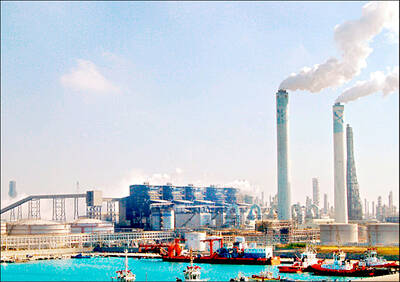
Taiwan Power Co (Taipower, 台電) yesterday said it plans to resume operations at two coal-fired power generators for three months to boost security of electricity supply as liquefied natural gas (LNG) supply risks are running high due to the Middle East conflict. The two coal-fired power generators are at Mailiao Power Plant in Yunlin County’s Mailiao Township (麥寮). The plant, operated by Formosa Plastics Group (台塑集團), supplied electricity to Taipower’s power grid until the end of last year. Taipower’s decision came about one month after Minister of Economic Affairs Kung Ming-hsin (龔明鑫) on March 10 said that the nation had no imminent

Some robotaxi passengers were left stranded in the middle of fast-moving traffic in a major Chinese city after their driverless vehicles stopped running, according to police and media reports on Wednesday. A preliminary investigation indicates more than 100 robotaxis came to a halt because of a “system malfunction,” police in the city of Wuhan said in a statement, without elaborating. No injuries were reported. One passenger told Chinese media that their robotaxi stopped after turning a corner. An instruction on a screen read: “Driving system malfunction. Staff are expected to arrive in 5 minutes.” After no one showed up, the passenger pushed


 RSS
RSS