


Can Halo hero Master Chief blast his way past Spider-Man 3 too?
We'll soon find out as the third installment in the Halo video game franchise debuts Tuesday for the Xbox 360 console.
Microsoft Corp won't divulge exact sales predictions for Halo 3 (and won't specify just how many tens of millions they poured into developing it) but seems confident of outdoing the Spider-Man 3 movie, the summer blockbuster that grossed US$151 million in its opening weekend -- a comparison the company has embraced itself.
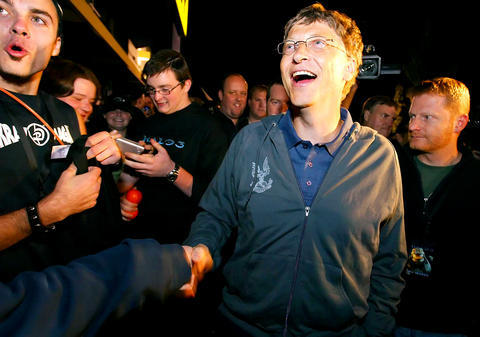
PHOTO: AP
Released in 2004, Halo 2 grossed US$125 million during the first 24 hours of its release, according to company sales statistics.
"We know we're going to clear that," Microsoft spokesman Ryan James said.
For months, the Halo 3 hype machine has been in overdrive with star-studded events where celebrities effuse about how chic it is to be a Halo geek. And then there's a merchandising juggernaut that would make George Lucas proud: From Halo 3 edition Mountain Dew soda bottles to novels, comic books and action figures.
Even for some self-professed Halo fans, it's all getting to be a bit much.
"It's crazy, you see it everywhere," said Rich Douek, a 32-year-old graphic designer who lives in New York. He plans on buying Halo 3 soon but won't be lining up for one of the Monday midnight madness events.
"At end of the day it's just a really good first-person shooter. I don't see it as breaking any molds or being any new revolutionary concept in gaming," he said. "It may turn out to be best first-person shooter ever, but it's not going to, like, change the world in a meaningful way."
In Atlanta, 25-year-old insurance worker Graham Jones plans to be among the first in line at a local GameStop store to pick up his pre-ordered US$69.99, "limited edition" version of the game that includes an art book and other extras.
(More than a million copies of the game have already been pre-ordered, according to Microsoft. There's also a US$59.99 "regular edition" that comes with just the game; a US$129.99 "legendary edition" complete with a replica helmet worn by Master Chief; and a US$399.99 special edition Xbox 360 with a Halo-themed custom paint job -- but no Halo 3 game).
A Best Buy Co store near Times Square in New York will also be open at midnight, when rabid fans can get their hands on the game as soon as possible.
Halo 3 promises to tie up the loose ends in Halo 2 that left some fans confused, even angry, said Brian Jarrard, an executive for Bungie Studios (which Microsoft acquired in 2000).
With the tagline "Finish the Fight," it resumes the saga of hero Master Chief, a masked human soldier of the future, returning to Earth in the midst of a battle for humanity's survival.
The alien armies of the Covenant are seeking to take over the planet, while an even more nefarious alien threat called the Flood threatens the galaxy's very existence.
As a player, gamers will guide Master Chief in the single-story mode to the conclusion.
"We've definitely heard a lot of complaints about the cliffhanger ending in Halo 2," Jarrard said. "For us this is the third chapter. We are definitely wrapping up the story arc. We talk about it as our Return of the King."
The significance of Halo can't be underestimated for Microsoft, which was a newcomer to the video game console business when it debuted the original Xbox in 2001.
Halo: Combat Evolved, the first game in the series, "really defined an entire gaming platform," said Dan Hsu, editor-in-chief of Electronic Gaming Monthly.
Halo and Halo 2 have gone on to sell 14.8 million copies on the Xbox and PC, according to Microsoft.
"When you look back at when Xbox launched, there was this cold software company trying to get into the gaming market," he said. "If it weren't for Halo 1, who knows if there would still be an Xbox."
And despite Halo 3 being the final chapter in the story arc, it doesn't appear the series will be fading anytime soon, Jarrard said.

Taichung reported the steepest fall in completed home prices among the six special municipalities in the first quarter of this year, data compiled by Taiwan Realty Co (台灣房屋) showed yesterday. From January through last month, the average transaction price for completed homes in Taichung fell 8 percent from a year earlier to NT$299,000 (US$9,483) per ping (3.3m²), said Taiwan Realty, which compiled the data based on the government’s price registration platform. The decline could be attributed to many home buyers choosing relatively affordable used homes to live in themselves, instead of newly built homes in the city’s prime property market, Taiwan Realty
The government yesterday approved applications by Alphabet Inc’s Google to invest NT$27.08 billion (US$859.98 million) in Taiwan, the Ministry of Economic Affairs said in a statement. The Department of Investment Review approved two investments proposed by Google, with much of the funds to be used for data processing and electronic information supply services, as well as inventory procurement businesses in the semiconductor field, the ministry said. It marks the second consecutive year that Google has applied to increase its investment in Taiwan. Google plans to infuse NT$25.34 billion into Charter Investments Ltd (特許投資顧問) through its Singapore-based subsidiary Fructan Holdings Singapore Pte Ltd, and
Micron Technology Inc is a driving force pushing the US Congress to pass legislation that would put new export restrictions on equipment its Chinese competitors use to make their chips, according to people familiar with the matter. A US House of Representatives panel yesterday was to vote on the “MATCH Act,” a bill designed to close gaps in restrictions on chipmaking equipment. It would also pressure foreign companies that sell equipment to Chinese chipmaking facilities to align with export curbs on US companies like Lam Research Corp and Applied Materials Inc. The bill targets facilities operated by China’s ChangXin Memory Technologies Inc

Singapore-based ride-hailing and delivery giant Grab Holdings’ planned acquisition of Foodpanda’s Taiwan operations has yet to enter the formal review stage, as regulators await supplementary documents, the Fair Trade Commission (FTC) said yesterday. Acting FTC Chairman Chen Chih-min (陳志民) told the legislature’s Economics Committee that although Grab submitted its application on March 27, the case has not been officially accepted because required materials remain incomplete. Once the filing is finalized, the FTC would launch a formal probe into the deal, focusing on issues such as cross-shareholding and potential restrictions on market competition, Chen told lawmakers. Grab last month announced that it would acquire


 RSS
RSS