


C.C. Leung (梁次震), who helped turn a tiny computer company into the world's largest portable computer contract maker, has a new vision for this company's future. This time, the plan is to say goodbye to its conservative image.
"We will be a `flying turtle,'" said Leung, the new president of Quanta Computer Inc (
In the past, the computer maker had expanded its business via the "Turtle Philosophy," a term coined by company cofounder Barry Lam (
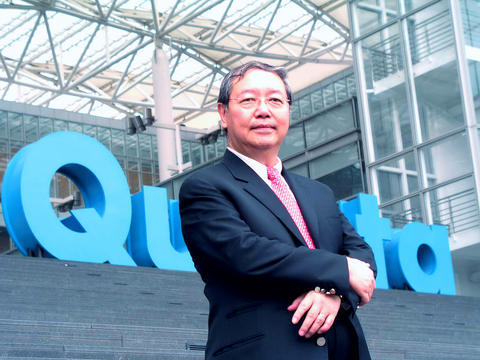
PHOTO: CHO YI-CHUN, TAIPEI TIMES
"The philosophy is still our motto, but now this turtle will be flying sky high," Leung said.
The event, where the company's quarterly financial results were unveiled, marked Leung's first official meeting with the press after he was elected by the board to replace Michael Wang (王震華) on Aug. 24.
Leung, who cofounded Quanta in 1998 with Wang and Lam, said he expected to cope well with his new responsibilities. He also doubles as vice chairman.
The new appointment marks Leung's second time as president. He held the position for 13 years before handing over the responsibilities to Wang in June last year.
The company's organizational structure will remain unchanged, but the main priority will now be to "enable greater space so that every staff member can give full play to his or her talent," he said.
Leung will face an urgent task of retaining talent, especially following Wang's departure, which made the headlines in newspapers and sparked speculation on possible discord among the three pillars of the company.
"Wang, with his well-rounded sales background, told staff that the manner in which we sell products to clients is far more important than just developing top-notch products," a veteran magazine journalist covering the local IT industry scene said.
"He told the research team not just to design products inside the office cubicles, but to try to offer what clients really wanted," he said.
Wang's outgoing and strong personality and emphasis on sales led to Quanta's losing a number of research and development employees.
In March, Jason Lin (林群傑), ex-director of the strategic investment division and deputy spokesman of the company, confirmed to the Taipei Times that 20 handset researchers had left the company.
He said, however, that it is not unusual in the high-tech industry for employees to resign after receiving their year-end bonuses.
Lin himself has just left Quanta to go back to the securities industry.
"We will not hesitate to provide training and offer our employees more `humanized company management,'" Leung said, without stating concrete strategies.
Leung said Wang had decided to leave the company for personal reasons and wanted to spend more time with his family.
Leung told reporters he could manage the sales aspect.
"What the media said about my not having a strong sales background is false," he said.
Leung, a graduate of National Taiwan University's physics department, helped establish the company's research and development team in its early days.
He switched over to manufacturing in 1993 and has been involved in sales since 1996.
"I have had an enjoyable time dealing with clients in the US and Japan," he said.
With the soft spoken, meticulous Leung taking the helm, the industry will be paying close attention as the company attempts to cement its lead in the notebook production industry, where competition is firing up and profit margins are deteriorating.
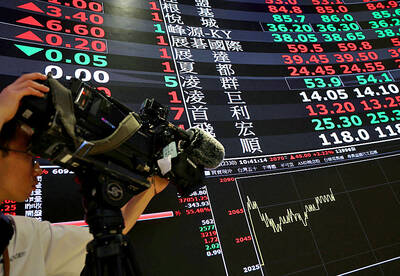
After several years flying high as Asia’s best Nvidia Corp proxy, Taiwan Semiconductor Manufacturing Co (TSMC, 台積電) is increasingly vying with other artificial intelligence (AI) stocks for investor attention. Stock traders are chasing a wider array of beneficiaries as mainstream usage of AI creates demand for hardware beyond the most-advanced chips TSMC makes for Nvidia. Subthemes from the deepening memory crunch to advances in robotics are also luring bids. At the same time, investment caps on single stocks are pushing funds to diversify, while retail investors long familiar with TSMC through its US depositary receipts are being offered a broader set of
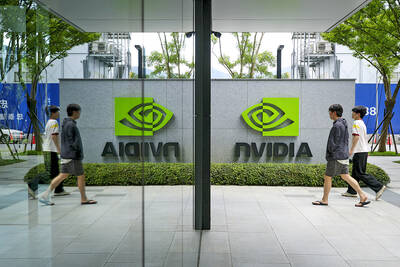
UNDER MICROSCOPE: Taiwan detained three people who allegedly conspired to buy servers in Taiwan and export them using fraudulent documentation, prosecutors said Nvidia Corp chief executive officer Jensen Huang (黃仁勳) on Saturday urged Super Micro Computer Inc to tighten up on compliance after Taiwan detained three people this week for allegedly making fraudulent declarations about artificial intelligence (AI) servers made by its US partner. The development marked the nation’s first crackdown on semiconductor smuggling, which grew after the US slapped restrictions on exports of high-end chips such as Nvidia AI accelerators to China. Nvidia is “rigorous” in explaining regulations to all of its partners, Huang told reporters after arriving in Taipei. “Ultimately Super Micro has to run their own company,” he said in response to
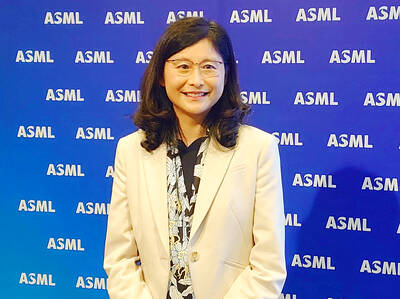
Netherlands-based semiconductor equipment supplier ASML Holding NV yesterday said that it is planning to hire an additional 1,000 people in Taiwan this year in response to growing demand from clients. ASML had previously planned to recruit 600 people this year, but that the plan has been adjusted upward, ASML vice president and ASML Taiwan general manager Grace Wang (汪佳慧) told reporters. ASML has a workforce of more than 4,500 in Taiwan, accounting for about 10 percent of its global total, Wang said. This year’s recruitment campaign would focus on adding people in the customer support, manufacturing and supply chain domains to assist ASML
TECH RELIANCE: Growth is increasingly reflecting an unequal K-shaped distribution, where technology sectors outperform and other industries struggle, an expert said Standard Chartered Bank has significantly raised its forecast for Taiwan’s economic growth to 9.5 percent this year, up from 7.6 percent previously, citing surging artificial intelligence (AI) demand driving exports, semiconductor production and investment. The upgrade reflects a sustained AI supercycle that continues to fuel demand for advanced chips and technology infrastructure, which form the backbone of Taiwan’s exports, the bank said in a report this week. “We raise our 2026 growth forecast to reflect a much stronger-than-expected first-quarter GDP figure,” Standard Chartered senior economist for greater China and Asia Tommy Wu (胡東安) said in the report. Driven largely by a 35.3 percent


 RSS
RSS