


Peter Shyu, an engineer, spends most of his day out of the office and when he needs an Internet connection he often pops into one of the many coffee shops in Taipei that offer free wireless access.
He could use WiFly, the extensive wireless network commissioned by the city government that is the cornerstone of Taipei's ambitious plan to turn itself into an international technology hub. But that would cost him US$12.50 a month.
"I'm here because it's free and if it's free elsewhere, I'll go there, too," said Shyu, hunched over his IBM laptop in an outlet of the Doutor coffee chain. "It's very easy to find free wireless connections."
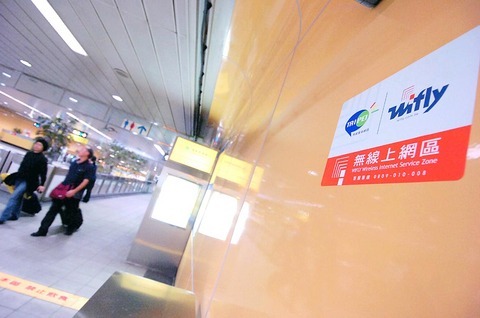
PHOTO: CHAO-YANG CHAN, NY TIMES NEWS SERVICE
Despite WiFly's ubiquity -- with 4,100 hot spot access points reaching 90 percent of the population -- just 40,000 of Taipei's 2.6 million residents have agreed to pay for the service since January. Qware Systems Inc (
That such a vast and reasonably priced wireless network has attracted so few users in an otherwise tech-hungry metropolis should give pause to civic leaders in Chicago, Philadelphia and dozens of other US cities that are building wireless networks of their own.
Like Taipei, these cities hope to use their new networks to help less affluent people get online and to make their cities more business-friendly. Yet as Taipei has found out, just building a citywide network does not guarantee that people will use it. Most people already have plenty of access to the Internet in their offices and at home, while wireless data services let them get online anywhere using phones, laptops and PDAs.
Like Qware, operators in the US, Europe and other parts of Asia are eager to build municipal networks. But they are grappling with the high expectations politicians are placing on them. On June 9, MobilePro backed out of plans to develop a wireless network in Sacramento, California, because it said the city wanted it to offer free access and recoup its investment with advertising, not subscriptions, a model that other cities are hoping to adopt. Elsewhere, incumbent carriers have challenged cities' rights to requisition new networks. And many services have had difficulty attracting customers.
"There is a lot of hype about public access," said Craig Settles, a technology consultant in Oakland, California, and author of Fighting the Good Fight for Municipal Wireless. "What's missing from a lot of these discussions is what people are willing to pay for."
Qware's relationship with Taipei has been less contentious, partly because the WiFly network is just one piece of a far broader and highly regarded plan to incorporate the Internet into everything the government does.
The brainchild of Taipei Mayor Ma Ying-jeou (馬英九), the CyberCity project was first conceived in 1998 as a way to catapult past Hong Kong, Seoul, South Korea and other Asian cities that were recasting themselves as metropolises of the future. Many government agencies now communicate almost exclusively online, saving millions of dollars and citizens have been given hundreds of thousands of free e-mail accounts and computer lessons.
WiFly plays a role, too, by allowing policemen to submit traffic tickets wirelessly, for instance. But making it appeal to the average citizen is another story. Qware, which is part of a conglomerate that, among other things, operates 7-Eleven franchises in Taiwan, has found that consumers will pay subscription fees only if there are original offerings to pull them in.

South Korea’s equity benchmark yesterday crossed a new milestone just a month after surpassing the once-unthinkable 5,000 mark as surging global memory demand powers the country’s biggest chipmakers. The KOSPI advanced as much as 2.6 percent to a record 6,123, with Samsung Electronics Co and SK Hynix Inc each gaining more than 2 percent. With the benchmark now up 45 percent this year, South Korea’s stock market capitalization has also moved past France’s, following last month’s overtaking of Germany’s. Long overlooked by foreign funds, despite being undervalued, South Korean stocks have now emerged as clear winners in the global market. The so-called “artificial intelligence
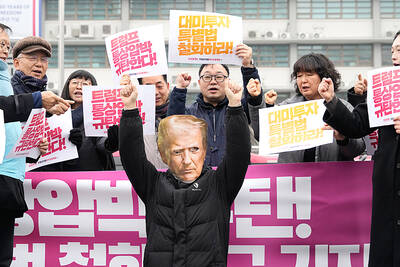
CONFUSION: Taiwan, Japan and other big exporters are cautiously monitoring the situation, while analysts said more Trump responses ate likely after his loss in court US trading partners in Asia started weighing fresh uncertainties yesterday after President Donald Trump vowed to impose a new tariff on imports, hours after the Supreme Court struck down many of the sweeping levies he used to launch a global trade war. The court’s ruling invalidated a number of tariffs that the Trump administration had imposed on Asian export powerhouses from China and South Korea to Japan and Taiwan, the world’s largest chip maker and a key player in tech supply chains. Within hours, Trump said he would impose a new 10 percent duty on US imports from all countries starting on
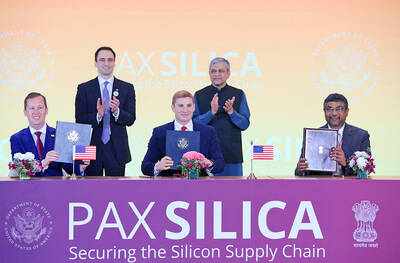
STRATEGIC ALLIANCE: The initiative is aimed at protecting semiconductor supply chain resilience to reduce dependence on China-dominated manufacturing hubs India yesterday joined a US-led initiative to strengthen technology cooperation among strategic allies in a move that underscores the nations’ warming ties after a brief strain over New Delhi’s unabated purchase of discounted Russian oil. The decision aligns India closely with Washington’s efforts to build secure supply chains for semiconductors, advanced manufacturing and critical technologies at a time when geopolitical competition with China is intensifying. It also signals a reset in relations following friction over energy trade and tariffs. Nations that have joined the Pax Silica framework include Japan, South Korea, the UK and Israel. “Pax Silica will be a group of nations
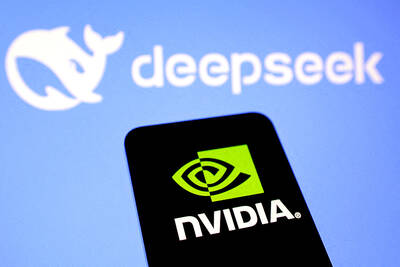
Chinese artificial intelligence (AI) start-up DeepSeek’s (深度求索) latest AI model, set to be released as soon as next week, was trained on Nvidia Corp’s most advanced AI chip, the Blackwell, a senior official of US President Donald Trump’s administration said on Monday, in what could represent a violation of US export controls. The US believes DeepSeek will remove the technical indicators that might reveal its use of American AI chips, the official said, adding that the Blackwells are likely clustered at its data center in Inner Mongolia, an autonomous region of China. The person declined to say how the US government received


 RSS
RSS