


On the first day of the annual Taipei Digital 3C Exhibition, which kicked off on Friday, crowds were busy checking out the latest technology products and making price comparisons for the best buy.
The show was a reflection of the latest trends in the 3C (computers, communications and consumer electronics) world that consumers can expect in the near future.
"Five megapixels is the mainstream resolution for digital cameras this year. Three and four megapixels are no longer classed as entry-level models," said Tony Sun (孫亞藍), sales manager of Heng Leong Hang Co (恆隆行), a distributor which displayed an eight-megapixel camera from the Japanese manufacturer Ricoh.

PHOTO: CHO YI-CHUN, TAIPEI TIMES
It is expected that six megapixels will take the center stage next year, while three megapixels are being phased out and four is turning into the low-end model, he said.
Before consumers decide to splash out on the highest-resolution models, they should understand their exact needs, as a four mega-pixel camera, which can produce a printout of 11 by 17-inch with good clarity, will do just fine for most needs, he said.
Sun's statements are echoed by Christopher Chute, a senior research analyst with International Data Corp (IDC).
"Those models below five megapixels will be withdrawn from the market by 2008 as technologies evolve, five-megapixel models will become low-end cameras available at a cheap price by then," he told a media gathering in Taipei on Sept. 8.
Notebooks, one of the hottest products at most consumer computer and electronics shows, remained so at the Taipei Digital 3C Exhibition.
"As most specifications are similar nowadays, brands and after-sales service have become the most decisive factors when consumers purchase a portable computer," said Henry Wu (吳旻哲), a sales engineer from Three Well Computer Chain Supermarket (三井電腦連鎖超市).
Smart buyers will opt for models with functionality such as a DVD burner, Bluetooth and Centrino wireless technology, as these have become standard for the newest laptops, he said.
A survey released early this month by the Chinese-language PC Shopper (電腦買物王) magazine supported this, as its results revealed that after-sales service are the top concern when consumers make a laptop purchase, while the second concern is the brand.
Asustek Computer Inc (華碩), Acer Inc and Hewlett-Packard (HP) Taiwan Ltd, took a combined 71.5 percent of the domestic market for laptop computers in the second quarter of this year, according to statistics provided by IDC.
Another eye-catching product at the venue was a 56-inch rear projection TV from Vivitek Corp (麗訊科技), the largest TV screen displayed at the show.
The TV uses digital light processing (DLP) technology developed by Texas Instruments, and is said to have significantly resolved the problems that plagued previous generations of rear projection screens, including lack of brightness and contrast.
DLP is superior to liquid crystal displays (LCD) as it offers high-quality pictures during its entire life span while LCD screens deteriorate over time, said Gill Chen (陳俐伶), the firm's Pan-Asia regional sales manager.
Though rear projection screens are chunkier than both plasma and LCD panels, their comparatively low price make them ideal for people wanting to recreate the cinema experience in their living room, she said.
Citing current figures, she said that 60-inch plasma TVs on the market currently cost around NT$300,000 to NT$400,000 (US$9,050 to US$12,066) apiece, with the same-size LCD models soaring up to NT$900,000.
However, DLP TVs from Vivitek were slashed to NT$130,000 from NT$138,800 to attract more buyers during the show.
The four-day Taipei Digital 3C Exhibition, which will end today, is a venue for showcasing the latest digital solutions suitable for the general public, computer geeks and students aiming for value-for-money bargains.
The show is held at the Taipei World Trade Center Hall 3, and admission is NT$150 per person with NT$50 discount vouchers available at 7-Eleven convenience stores.
Other offerings include personal digital assistants, MP3 players, handsets, as well as home electronics.
However, for those who can wait, Info Month -- a consumer computer and electronics exposition -- coming in December will be even more alluring for consumers looking to indulge in some of the latest products.


The domestic unit of the Chinese-owned, Dutch-headquartered chipmaker Nexperia BV will soon be able to produce semiconductors locally within China, according to two company sources. Nexperia is at the center of a global tug-of-war over critical semiconductor technology, with a Dutch court in February ordering a probe into alleged mismanagement at the company. The geopolitical tussle has disrupted supply chains, with some carmakers reportedly forced to cut production due to chip shortages. Local production would allow Nexperia’s domestic arm, Nexperia Semiconductors (China) Ltd (安世半導體中國), to bypass restrictions in place since October on the supply of silicon wafers — etched with tiny components to

Taiwan’s foreign exchange reserves fell below the US$600 billion mark at the end of last month, with the central bank reporting a total of US$596.89 billion — a decline of US$8.6 billion from February — ending a three-month streak of increases. The central bank attributed the drop to a combination of factors such as outflows by foreign institutional investors, currency fluctuations and its own market interventions. “The large-scale outflows disrupted the balance of supply and demand in the foreign exchange market, prompting the central bank to intervene repeatedly by selling US dollars to stabilize the local currency,” Department of Foreign
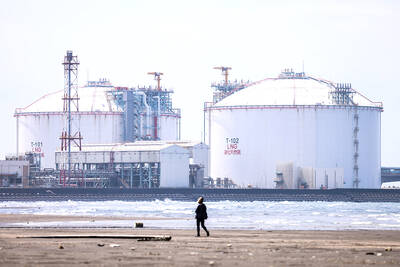
Taiwan is open to joining a global liquefied natural gas (LNG) program if one is created, but on the condition that countries provide delivery even in a scenario where there is a conflict with China, an energy department official said yesterday. While Taiwan’s priority is to have enough LNG at home, the nation is open to exploring potential strategic reserves in other countries such as Japan or South Korea, Energy Administration Deputy Director-General Chen Chung-hsien (陳崇憲) said. While the LNG market does not have a global reserve for emergencies like that of oil, the concept has been raised a few times —
AI-FUELED DEMAND: The company has been benefiting from the skyrocketing prices for DRAM chips amid the AI frenzy, especially its core product — DDR4 DRAM chips DRAM chipmaker Nanya Technology Corp (南亞科技) yesterday reported that its revenue for the first quarter surged 582.91 percent to NT$49.09 billion (US$1.54 billion) from NT$7.19 billion a year earlier, as the supply crunch caused chip price spikes. Last quarter’s figure is the highest on record. On a quarterly basis, revenue jumped 63.14 percent from NT$30.09 billion, the company said. In January, Nanya Technology expected global DRAM supply scarcity to continue through the first half of 2028, thanks to strong demand for artificial intelligence (AI) applications. Market researcher TrendForce Corp (集邦科技) forecast prices of standard DRAM chips would rise between 58 percent and 63


 RSS
RSS