


■ Finacial services
Koo Jr plans share sale
Jeffrey Koo Jr (辜仲諒), vice chairman of Chinatrust Financial Holding Co (中信金控), plans to sell 10 million shares in the company, Taiwan's sixth-biggest financial services provider. Koo filed for the sale with the Taiwan Stock Exchange on Friday, according to the Web site of the exchange in Taipei. The planned sale is valued at NT$341 million (US$10.6 million), based on the stock's closing price of NT$34.10 on Friday. Koo's father, Jeffrey Koo Sr (辜濂松), chairman of the company, is Taiwan's fourth-richest man as ranked by Forbes.
■ Liquor
Tequila exports at new high
Production and exports of Mexico's most famous liquor reached record levels in the first half of the year, according to the tequila industry's regulatory council. Overall production hit 110.2 million liters, up from 87.4 million for the same period last year and from the previous record, 95.8 million, in 2000. Of that, 60.8 million liters were exported, up from the previous record of 54.9 million liters for the same period last year. The previous six-month production record appeared to be 97.6 million liters in the first half of 1999 as the industry headed for a record yearly output of 190.6 million liters. The first half of this year also saw record production of premium, 100 percent agave tequilas: 37.2 million liters, a jump of 84.15 percent over the first half of last year's figure of 20.2 million liters. Exports of premium tequila hit 10.5 million liters, up from 7.4 million in the same period last year.
■ Macroeconomics
Russia still lagging Portugal
Russian President Vladimir Putin's bold goal of doubling the size of the national economy in a decade and catching up with the EU's economic lightweight Portugal is looking shaky. With a GDP for last year of US$580.6 billion, according to Business Monitor International, Russia is still a comparative minnow despite its mineral resource wealth and status as the world's second-biggest oil exporter after Saudi Arabia. Russia's GDP per capita was US$4,065 last year, Business Monitor said, by far the lowest in the G8. Even as oil prices break new records beyond US$60 per barrel, Russia's oil and gas-dependent economy is seeing its growth flag as investment and expansion in the key petroleum sector falls. A variety of reasons are cited -- from a tough tax regime that scoops up 90 percent of everything companies earn above US$20 per barrel to fears of renationalization, spurred by the politically charged carve-up of the Yukos oil giant.
■ Oil
Partners expand China plant
Exxon Mobil Corp has started work with China's third-biggest state oil company and a Saudi partner on a US$3.5 billion project to expand a refinery in southern China. The project comes amid efforts by energy companies to tap China's market for fuel to drive its booming economy, already one of the world's biggest oil consumers, along with the US and Japan. A groundbreaking ceremony was held on Friday by Exxon Mobil and its partners -- Sinopec of China and Aramco of Saudi Arabia -- in the southern city of Quanzhou in Fujian Province attended by the Saudi oil minister. The project will triple the refinery's output to 85 million barrels of petroleum a year and equip it to process imported Saudi crude, the companies said. The Chinese partner will own 50 percent of the venture and Exxon and the Saudi company will each hold 25 percent.
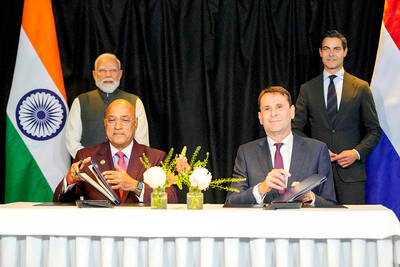
NEW MARKET: The partnership opens up India to the Dutch company, which already has a strong hold in the semiconductor market of South Korea, Taiwan and China ASML Holding NV entered into a partnership agreement with Tata Electronics Pvt Ltd aimed at ramping up India’s goal to develop domestic chip-manufacturing capabilities. The Dutch company’s technology would help power Tata Electronics’ planned 300 millimeter (mm) semiconductor foundry in Gujarat, according to a joint statement from the two companies on Saturday. The signing of a memorandum of understanding coincides with a visit by Indian Prime Minister Narendra Modi to the Netherlands, which is looking to deepen bilateral relations with New Delhi. ASML, whose top customers include Taiwan Semiconductor Manufacturing Co (台積電) and Samsung Electronics Co, makes lithography machines that can print
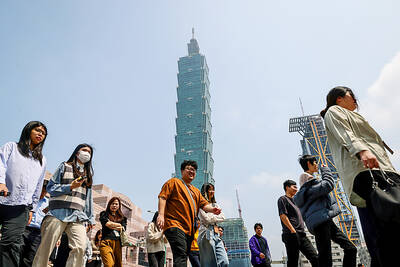
TECH RELIANCE: Growth is increasingly reflecting an unequal K-shaped distribution, where technology sectors outperform and other industries struggle, an expert said Standard Chartered Bank has significantly raised its forecast for Taiwan’s economic growth to 9.5 percent this year, up from 7.6 percent previously, citing surging artificial intelligence (AI) demand driving exports, semiconductor production and investment. The upgrade reflects a sustained AI supercycle that continues to fuel demand for advanced chips and technology infrastructure, which form the backbone of Taiwan’s exports, the bank said in a report this week. “We raise our 2026 growth forecast to reflect a much stronger-than-expected first-quarter GDP figure,” Standard Chartered senior economist for greater China and Asia Tommy Wu (胡東安) said in the report. Driven largely by a 35.3 percent

Tokyo Electron's Taiwan unit today said in a written response that it respects the judicial process, takes the court ruling seriously and would not appeal in the Taiwan Semiconductor Manufacturing Co (TSMC, 台積電) trade secrets case. Last month, a court fined the Taiwan unit of Japan's Tokyo Electron NT$150 million (US$4.74 million) in a case involving trade secrets related to TSMC's sensitive chip technology.
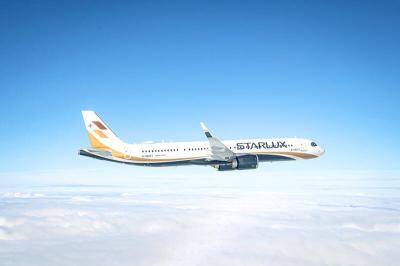
Two of Taiwan’s international carriers, Starlux Airlines Co (星宇航空) and EVA Airways Corp (長榮航空), have retained the five-star airline rating awarded by international airline review organization Skytrax. Starlux was awarded the distinction for a second consecutive year, while EVA Air received it for the 11th straight year, Skytrax said in statements released yesterday and on Thursday last week, respectively. The five-star rating is considered one of the airline industry's highest honors and is awarded following professional audits of airline product and frontline service standards, Skytrax said. The ratings are based on in-depth assessments using unified global quality standards rather than customer review scores


 RSS
RSS