


Software maker Skype said Friday that it was launching two more premium services as the number of downloads of its popular program surpassed 100 million.
The company also said it was launching SkypeIn and Skype Voicemail, two premium services available in the latest download versions of Skype software for Linux, MAC OS X, Pocket PC and Windows platforms.
Skype's signature program lets computer users call each other online for free anywhere in the world.
The new SkypeIn offers users personal numbers and lets them receive inbound calls from the Skype program from land lines or mobile phones without having to pay roaming charges.
Skype Voicemail lets users manage incoming messages.
"Skype is setting new standards for modern communications by expanding premium services that extend Skype portability, mobility and ubiquity across a variety of platforms, including the traditional phone network," said Niklas Zennstrom, the company's chief executive and co-founder.
"SkypeIn and Skype Voicemail enhance the basic free Skype and give friends, family and colleagues not connected to the Internet an inexpensive and convenient way to contact members of our global user base," he said.
The new offerings came as Skype, which is based in Luxembourg and founded in Sweden, said that downloads of its signature program surpassed 100 million.
SkypeIn works by letting users choose a country and area code and then receive a regular phone number.
Users can purchase up to three numbers from their home country in Denmark, Finland, France, Hong Kong, Norway, Sweden, the United Kingdom and the United States during the beta period.
Skype Voicemail customers can receive a voicemail message up to 10 minutes long from any user or traditional phone and tailor their messages.
Both services will be sold in pre-paid chunks, the company said.
Three-month SkypeIn subscriptions are available for euro10 (US$13) and 12-month subscriptions for euro30 (US$39). Skype Voicemail subscriptions are available for euro5 (US$7) for 3 months or euro15 (US$19) for 12 months.

MANAGING RISKS: Taiwan has secured LNG sufficient to cover 95 percent of electricity demand for next month, UBS said, describing the government’s approach as proactive UBS Group AG has raised its forecast for Taiwan’s economic growth this year to 8 percent, up from 6.9 percent previously, and said expansion could reach as high as 8.6 percent if external energy shocks are avoided. The upgrade reflects a stronger-than-expected first-quarter performance and sustained momentum in artificial intelligence (AI)-driven exports, which UBS said are providing a firm foundation for growth despite geopolitical and energy risks. Taiwan’s GDP expanded 13.69 percent year-on-year in the first quarter, the fastest growth since the second quarter of 1987, the Directorate-General of Budget, Accounting and Statistics (DGBAS) reported on Thursday. On a seasonally
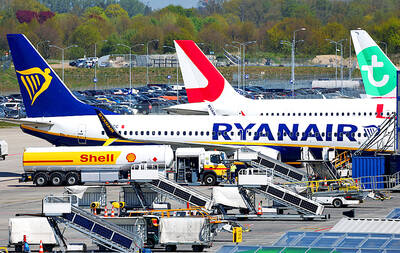
Ryanair, Transavia, Volotea and other low-cost airlines are feeling the financial pain from high jet fuel prices as a result of the Middle East war and are cutting flights. The closure of the Strait of Hormuz has taken a huge chunk of oil supplies off the market, sending the price of jet fuel soaring and triggering fears of shortages that could force airlines to cancel flights. Airlines are not waiting for a lack of supplies to react. “Travel alert: Airlines are cutting thousands of flights right now,” Travel Therapy host Karen Schaler said in an Instagram reel this past weekend.

Shares of Taiwan Semiconductor Manufacturing Co (TSMC, 台積電) have repeatedly hit new highs, but an equity analyst said the stock’s valuation remains within a reasonable range and any pullback would likely be technical. The contract chipmaker’s historical price-to-earnings (P/E) ratio has ranged between 20 and 30, Cathay Futures Consultant Co (國泰證期) analyst Tsai Ming-han (蔡明翰) told Central News Agency. With market consensus projecting that TSMC would post earnings per share of about NT$100 (US$3.17) this year, supported by strong global demand for artificial intelligence (AI) applications, and the stock currently trading at a P/E ratio of below 25, Tsai said the valuation

The list of Asian stocks that benefit from business partnership with Nvidia Corp is getting longer, as the region further integrates into the artificial intelligence (AI) chip giant’s business ecosystem. Just in the past week, South Korea’s LG Electronics Inc, Taiwan’s Nanya Technology Corp (南亞科技), as well as China’s Huizhou Desay SV Automotive Co (德賽西威) and Pateo Connect Technology Shanghai Corp (博泰車聯) have become the latest to rally on news of tie-ups, supply-chain participation or product collaboration with the US chip designer. Asian suppliers account for about 90 percent of Nvidia’s production costs, up from about 65 percent last year, data compiled


 RSS
RSS