


Canadian Tire Corp is opening a Shanghai office this fall as it increases the number of made-in-China products it sells in Canada, the country's biggest hardware retailer said.
"There has been some growth in the China supply to Canadian Tire and this would certainly reflect that," Canadian Tire spokesman Scott Bonikowsky told reporters in an interview Friday.
Bonikowsky would not say what percentage of goods sold at Canadian Tire comes from China, nor how much that percentage has increased over the past few years or might increase once the store has staff in China.
"What I will say is that the overwhelming majority is domestically sourced, but we do have an important part of program that would be from China as well and all of the Pacific Rim for that matter," he said.
Canadian Tire has had an office in Hong Kong for 25 years, and will keep that operation even after opening the office in Shanghai, Bonikowsky said.
The company also has an office in Seoul and one in Taipei.
Michael McLarney, editor and publisher of the hardware industry newsletter Hardlines, said that by opening an office in Shanghai, Canadian Tire is following the lead of many other hardware retailers.
McLarney said while Canadian Tire's Chinese-made products will be less expensive to manufacture than products made at home, their quality won't likely suffer.
"What they're doing is they're going over and having products made to spec," McLarney said. "They'll get right into the Chinese factories."
Canadian Tire's Bonikowsky wouldn't say what products the 452-store retailer currently imports from China or which new ones might be available in the future. But McLarney guessed much of the store's Chinese products involve its private-label goods, such as its Mastercraft tools.
Canadian Tire also owns clothing retailer Mark's Work Warehouse, which could benefit from the inexpensive textile market in China.
For shoppers, Canadian Tire's foray into China should mean the company will stay competitive with other retailers with operations in that country, including US-based Wal-Mart, the world's biggest retailer, which reportedly bought US$12 billion worth of Chinese goods in 2002, and Home Depot.
The decision to open an office in China comes as Home Depot, the US big-box home-improvement retailer, examines opportunities to open stores in China.
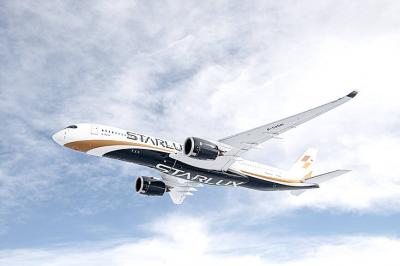
Starlux Airlines Co (星宇航空) today unveiled a long-haul network expansion plan at a shareholders’ meeting in Taipei, including direct flights to Barcelona, Spain, and Zurich, Switzerland, as well as a service connecting Taipei, Sydney and New Zealand. Starlux is to become the first Taiwanese carrier to offer non-stop services to the two European cities, while the inaugural oceanic route is expected to expand transit opportunities within the Australia-New Zealand market, Starlux said. Flight services to Chicago, Dallas, Washington and New York are under evaluation, the airline added. Prior to the shareholders’ meeting, the airline earlier this year announced that it would be

Cairo’s new monorail slices across the city skyline, running above the familiar chaos of blaring horns and aging buses’ exhaust fumes that mark rush hour below. The US$4.5 billion monorail, opened this month, is among Egypt’s most prominent new transport projects, part of a debt-funded infrastructure drive criticized for sapping state finances while bringing limited benefits to most of the country’s 109 million people. “It feels like you’re in a different country,” said Ramy Sayed, a restaurant manager, aboard a driverless Innovia 300 train. “No noise, no traffic, we’re not used to this.” The eastern line runs 56km from the bustling middle-class

Netherlands-based semiconductor equipment supplier ASML Holding NV yesterday said that it is planning to hire an additional 1,000 people in Taiwan this year in response to growing demand from clients. ASML had previously planned to recruit 600 people this year, but that the plan has been adjusted upward, ASML vice president and ASML Taiwan general manager Grace Wang (汪佳慧) told reporters. ASML has a workforce of more than 4,500 in Taiwan, accounting for about 10 percent of its global total, Wang said. This year’s recruitment campaign would focus on adding people in the customer support, manufacturing and supply chain domains to assist ASML
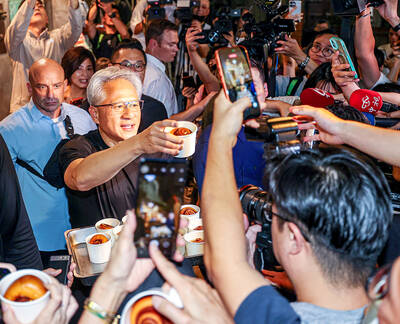
Nvidia Corp yesterday announced that CEO Jensen Huang (黃仁勳) would attend an employee meeting in Taipei tomorrow to celebrate the launch of the company’s Taiwan headquarters project. Huang would attend a gathering at the site of Nvidia’s planned headquarters in Beitou Shilin Technology Park (北投士林科技園區), the company said in a statement. After arriving in Taiwan on Saturday last week, Huang told reporters that he plans to meet with Quanta Computer Inc (廣達) chairman Barry Lam (林百里) and Taiwan Semiconductor Manufacturing Co (TSMC, 台積電) chairman C.C. Wei (魏哲家), and would attend the groundbreaking ceremony for Nvidia’s Taiwan headquarters tomorrow. Nvidia has not yet applied


 RSS
RSS