


Soft-World International Corp (智冠科技), an online game developer, yesterday cemented a capital injection of US$10 million (NT$349 million) from the Hong Kong and Shanghai Banking Corp, in a bid to expand world markets, the company said.
Under the agreement, HSBC will be Soft-World's largest shareholder with a 6.7 percent stake and will be allowed to appoint one board member to the company's nine member board.
"With the HSBC's financial assistance, Soft-World will be able to pursue its goal of internationalization," said company president Wang Chin-po (
The capital will be used to improve Soft-World's R&D and develop plans to grab big shares of market in northeastern Asia including Japan and Korea, Wang said.
Soft-World, currently the biggest online game developer in the greater Chinese market, also plans to increase its capital from NT$479 million to NT$629 million in the near term, according to company spokesperson Gavin Lin (
Soft-World's subsidiary company -- the Chinese Gamer International Corp (中華網龍) -- introduced quite a few popular self-designed computer games including the Jin Yung Online (金庸群俠傳), and Three Kingdom Online (三國演義), which once attracted over 900,000 online players respectively in Taiwan and China at the same time.
Vincent Chen (
He said that the bank, after
undertaking thorough studies, concluded that global markets of cyber games are expected to grow from US$100 million in 2001 to US$600 million in 2005.
The bank also estimated that China's markets would grow by 100 percent within the next three years while Taiwan will maintain its 25 percent growth rate in three years.
As the biggest investor, Chen yesterday further praised Soft-World's business strategies, saying the company has successfully reduced its commercial risks by simultaneously developing its own computer games and acting as an agent of other cyber game products.
According to Lin, Soft-World -- with NT$1.75 billion in revenues for the past nine months -- has the biggest computer game design team in the greater-China region, a publication circulation of 650,000 copies per month with a 40 percent market share and 4.2 million members throughout the world.
Its subsidiary -- the Chinese Gamer International Corp -- also secured NT$255 million in pre-tax profits for the first six months this year. Shares of Soft-World rose NT$7.5 to close at NT$120.5 per share on the TAIEX.
Though Taiwan still lags behind South Korea in the development of online games, Claire Hsu (許瓊予), a senior software and e-commerce analyst at the Market Intelligence Center, yesterday said that Soft-World has great potential of making headway in the greater Chinese markets.
She also said that, among other Taiwanese computer game software companies, Soft-World makes stable profits from online games, which is probably the reason it attracted investment from HSBC.

SECOND-RATE: Models distilled from US products do not perform the same as the original and undo measures that ensure the systems are neutral, the US’ cable said The US Department of State has ordered a global push to bring attention to what it said are widespread efforts by Chinese companies, including artificial intelligence (AI) start-up DeepSeek (深度求索), to steal intellectual property from US AI labs, according to a diplomatic cable. The cable, dated Friday and sent to diplomatic and consular posts around the world, instructs diplomatic staff to speak to their foreign counterparts about “concerns over adversaries’ extraction and distillation of US AI models.” Distillation is the process of training smaller AI models using output from larger, more expensive ones to lower the costs of training a powerful new
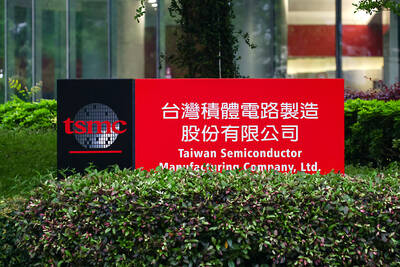
Shares of Taiwan Semiconductor Manufacturing Co (TSMC, 台積電) have repeatedly hit new highs, but an equity analyst said the stock’s valuation remains within a reasonable range and any pullback would likely be technical. The contract chipmaker’s historical price-to-earnings (P/E) ratio has ranged between 20 and 30, Cathay Futures Consultant Co (國泰證期) analyst Tsai Ming-han (蔡明翰) told Central News Agency. With market consensus projecting that TSMC would post earnings per share of about NT$100 (US$3.17) this year, supported by strong global demand for artificial intelligence (AI) applications, and the stock currently trading at a P/E ratio of below 25, Tsai said the valuation
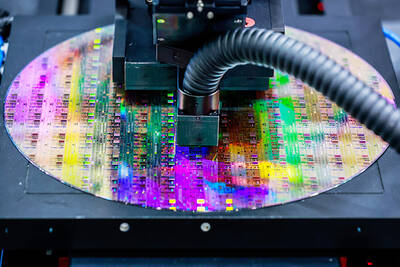
The artificial intelligence (AI) boom has triggered a seismic reshuffling of global equity markets, with Taiwan and South Korea muscling past European nations one by one. With its stock market now valued at nearly US$4.3 trillion, Taiwan surpassed the UK, Europe’s biggest market, earlier this month, data compiled by Bloomberg showed. South Korea is about US$140 billion away from doing the same. The tech-heavy Asian markets have shot past Germany and France in the past seven months. The shift is largely down to massive gains in shares of three companies that provide essential hardware for AI: Taiwan Semiconductor Manufacturing Co (TSMC, 台積電),
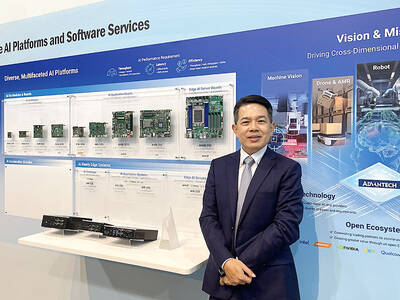
NEXT-GENERATION: The company announced plans to roll out platforms with 100 TOPS performance and expects AI-capable systems to become the standard Industrial computer maker Advantech Co (研華) is eyeing strong growth potential in edge artificial intelligence (AI), as the technology shifts from cloud-centric computing to edge deployment and real-world applications, Advantech embedded Internet of Things president Miller Chang (張家豪) said on Thursday last week. Amid rising demand for inference as the industry shifts from training, edge AI is emerging as a key field, given the need for low latency, real-time response and data privacy, Chang said in an exclusive interview with the Taipei Times. While consumer devices such as smartphones already feature some AI capabilities, large-scale inference demand would mainly come from applications


 RSS
RSS