


To measure how far the human race has come, let's examine one of our greatest achievements.
The mapping of the human genome? Not exactly. Microwave kettle corn popcorn? Not quite.
The real measuring stick is at your local toy store. Head to the water-toys area. That's it, the plaything from your childhood: the water gun.
Once palm-size toys that leaked faster than a crumbling roof during an afternoon rainstorm, water guns are now Shaq-sized and have a Constant Pressure System that can launch virtual rivers from four nozzles as far as 15m. They come with reserve tanks you can strap to your back for those extended afternoon battles. Some even come equipped with lights to target your prey.
We've come a long way, baby.
School's out for summer, and when the heat rises a funny thing happens: It fries our brains, turning us into rascally kids ready to splish-splash. The season's inaugural wet ambush can't be too far behind.
"Let's face it, how much fun is it to squirt someone?" asks Tim Englert, the Tampa Bay, Floriday, inventor of Water Wheels, a bicycle-mounted water-gun system. "It's a blast."
Ah, the anticipation as you sneak up on your friend, then quickly but firmly squeeze the trigger in high-noon, Wild West fashion, releasing a narrow spritz of water that smacks him right on target. You squeeze again. And again. And once more for total soaking humiliation. Then you run, not only to escape from your antagonized victim but also to reload at the nearest water hose. What a rush.
Englert, who has a patent on Water Wheels but is looking for an investor, hopes his invention becomes the next generation of water guns, a field dominated by Laramie's Super Soaker line.
He got his idea when he saw children riding bikes and squirting one another with water pistols. Englert, a structural/architectural designer, figured he could make something that was just as much fun but safer, allowing kids to keep both hands on the handlebars. Water Wheels comes with two front guns, optional rear guns and tanks. A thumb-controlled button maneuvers the guns.
The 41-year-old fondly recalls his first water gun.
"I remember the days of the old plastic, 6-inch squirt gun," he says. "It looked like a German Luger. You had to run up to the garden hose or spigot, pull off the plastic cap, fill it with water and turn the gun upside down to let the air bubbles out."
The Toy Industry Association estimates that water guns are a US$100 million-a-year business. In 2000, the latest figures available, Americans bought 15 million of them. Water guns enjoy the reputation as the No. 1 spring/summer toy.
Chris "The Toy Guy" Byrne, a New York-based toy researcher and analyst for more than two decades, says toy pistols caught on in the 1950s and 1960s when kids emulated cowboys. But the water guns of old weren't very dependable. They held little water, and they leaked. Sometimes the trigger jammed or the nozzle clogged.
Motorized water guns running on batteries arrived in the 1970s and 1980s. All you had to do was press and hold the trigger, freeing your trigger-happy index finger from cramps and potential carpal tunnel syndrome. Better, but not quite perfect.
The big innovation came in 1990 with the advent of the Super Soaker (briefly known as the Drencher), created by nuclear scientist Lonnie Johnson, who designed an air-pressure system that can shoot streams of water up to 15m. Finally some serious power.
Byrne says Trend Masters, a toy company, recently entered the water-blaster market with a line of weapons called Storm that feature red or blue lights to help you aim.
Just listen to the arsenal that's available: There's Super Soaker Wipeout, Super Soaker XP 240, Storm 3000 Tsunami Force 5, Storm 1000 Typhoon Force 2, Storm 2000 Monsoon Force 4 and Super Soaker Monster X, which holds a whopping 120 ounces of water, the largest Super Soaker.
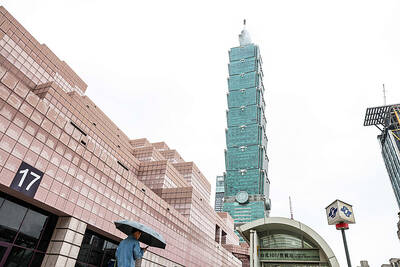
MANAGING RISKS: Taiwan has secured LNG sufficient to cover 95 percent of electricity demand for next month, UBS said, describing the government’s approach as proactive UBS Group AG has raised its forecast for Taiwan’s economic growth this year to 8 percent, up from 6.9 percent previously, and said expansion could reach as high as 8.6 percent if external energy shocks are avoided. The upgrade reflects a stronger-than-expected first-quarter performance and sustained momentum in artificial intelligence (AI)-driven exports, which UBS said are providing a firm foundation for growth despite geopolitical and energy risks. Taiwan’s GDP expanded 13.69 percent year-on-year in the first quarter, the fastest growth since the second quarter of 1987, the Directorate-General of Budget, Accounting and Statistics (DGBAS) reported on Thursday. On a seasonally
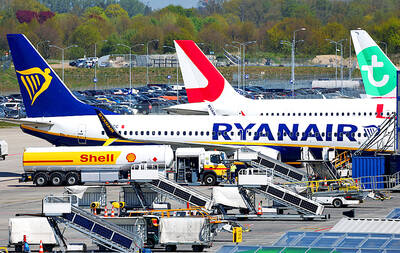
Ryanair, Transavia, Volotea and other low-cost airlines are feeling the financial pain from high jet fuel prices as a result of the Middle East war and are cutting flights. The closure of the Strait of Hormuz has taken a huge chunk of oil supplies off the market, sending the price of jet fuel soaring and triggering fears of shortages that could force airlines to cancel flights. Airlines are not waiting for a lack of supplies to react. “Travel alert: Airlines are cutting thousands of flights right now,” Travel Therapy host Karen Schaler said in an Instagram reel this past weekend.
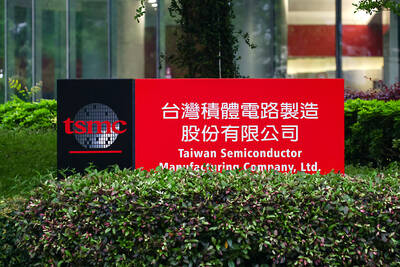
Shares of Taiwan Semiconductor Manufacturing Co (TSMC, 台積電) have repeatedly hit new highs, but an equity analyst said the stock’s valuation remains within a reasonable range and any pullback would likely be technical. The contract chipmaker’s historical price-to-earnings (P/E) ratio has ranged between 20 and 30, Cathay Futures Consultant Co (國泰證期) analyst Tsai Ming-han (蔡明翰) told Central News Agency. With market consensus projecting that TSMC would post earnings per share of about NT$100 (US$3.17) this year, supported by strong global demand for artificial intelligence (AI) applications, and the stock currently trading at a P/E ratio of below 25, Tsai said the valuation
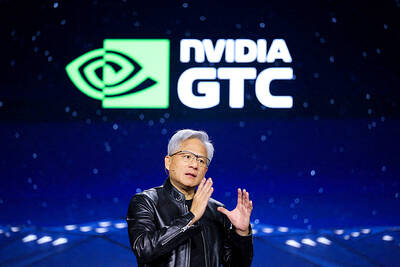
The list of Asian stocks that benefit from business partnership with Nvidia Corp is getting longer, as the region further integrates into the artificial intelligence (AI) chip giant’s business ecosystem. Just in the past week, South Korea’s LG Electronics Inc, Taiwan’s Nanya Technology Corp (南亞科技), as well as China’s Huizhou Desay SV Automotive Co (德賽西威) and Pateo Connect Technology Shanghai Corp (博泰車聯) have become the latest to rally on news of tie-ups, supply-chain participation or product collaboration with the US chip designer. Asian suppliers account for about 90 percent of Nvidia’s production costs, up from about 65 percent last year, data compiled


 RSS
RSS